

For many students, studying at a good university can feel financially out of reach. Tuition fees, accommodation, travel, books, health insurance, and everyday living expenses can quickly add up. The good news is that scholarships in 2026 continue to create opportunities for students who want to study at home or abroad without carrying the full financial burden themselves.
Whether you are looking for a fully funded scholarship in 2026, an undergraduate scholarship, a master’s scholarship, or financial support for doctoral studies, the key is knowing where to look, what universities and scholarship providers expect, and how to prepare a strong application.
This guide explains the most important things students should know about scholarships in 2026, including eligibility requirements, application documents, funding types, deadlines, and practical tips for improving your chances of success.
What Is a Scholarship?
A scholarship is financial support provided to a student to help cover the cost of education. Unlike a student loan, scholarship funding usually does not need to be repaid.
Scholarships may be offered by:
- Universities and colleges
- Governments
- International organizations
- Charitable foundations
- Private companies
- Research institutions
- Non-governmental organizations
Some scholarships cover only part of the tuition fee, while others can cover almost every major study-related expense.
For this reason, students should always check exactly what is included before applying.
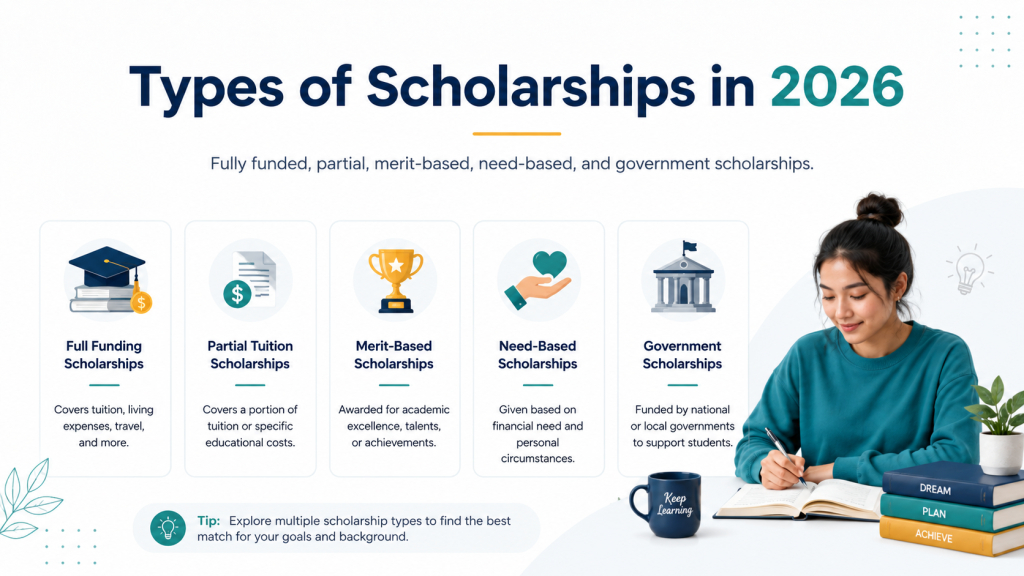
Types of Scholarships Available in 2026
Students searching for scholarships in 2026 will come across several different funding options.
1. Fully Funded Scholarships
A fully funded scholarship generally provides the most comprehensive financial support.
Depending on the scholarship program, funding may include:
- Full tuition fees
- Monthly living allowance
- Accommodation support
- Travel or airfare
- Health insurance
- Study materials
- Visa-related expenses
- Research funding
Fully funded scholarships are highly competitive because they significantly reduce the financial pressure of studying abroad.
2. Partial Scholarships
Partial scholarships cover only a portion of a student’s education costs.
For example, a university may offer:
- 25% tuition reduction
- 50% tuition reduction
- Fixed financial awards
- Accommodation discounts
Students receiving partial scholarships may still need to show that they can cover the remaining tuition and living expenses.
3. Merit-Based Scholarships
Merit scholarships are awarded primarily on academic achievement or outstanding performance.
Selection criteria may include:
- High GPA
- Strong examination results
- Academic awards
- Research achievements
- Leadership experience
- Extracurricular activities
Universities often use merit scholarships to attract high-performing students.
4. Need-Based Scholarships
Need-based scholarships are designed for students who may not have sufficient financial resources to fund their education independently.
Applicants may need to submit documentation showing their household income or financial circumstances.
5. Government Scholarships
Many countries offer scholarship programs to attract international students and strengthen educational cooperation.
Government scholarships can be particularly valuable because many provide full or substantial financial support.
Examples of countries that regularly offer international scholarship opportunities include:
- United Kingdom
- United States
- Canada
- Australia
- Germany
- Japan
- South Korea
- Türkiye
- China
- Hungary
Students should always confirm the latest eligibility rules and deadlines on the official scholarship website.
Who Can Apply for a 2026 Scholarship?
Eligibility requirements vary from one scholarship to another.
However, scholarship providers commonly evaluate applicants based on several factors.
Academic Performance
Strong academic results are important for many competitive scholarships.
Universities may assess:
- GPA
- Secondary school results
- Bachelor’s degree performance
- Master’s degree performance
- Relevant academic subjects
There is no universal GPA requirement, so students should check the specific requirements of each scholarship.
English Language Ability
International students may be asked to demonstrate English proficiency through tests such as:
- IELTS
- TOEFL
- PTE Academic
Some universities may waive English language tests if the applicant previously studied in English, although waiver policies vary significantly between institutions.
Leadership and Extracurricular Activities
Scholarship committees often look beyond grades.
Leadership experience may come from:
- Student organizations
- Volunteer work
- Community projects
- Professional organizations
- Entrepreneurship
- Sports or cultural activities
Applicants should focus on what they achieved rather than simply listing activities.
Professional Experience
Certain postgraduate scholarships require professional experience.
This is especially common for scholarships focused on leadership, public policy, development, business, or professional training.
Research Experience
Students applying for master’s-by-research or PhD scholarships may need to demonstrate previous research experience.
This could include:
- Academic publications
- Thesis work
- Research assistantships
- Conference presentations
- Research projects
A strong research proposal may also be required.
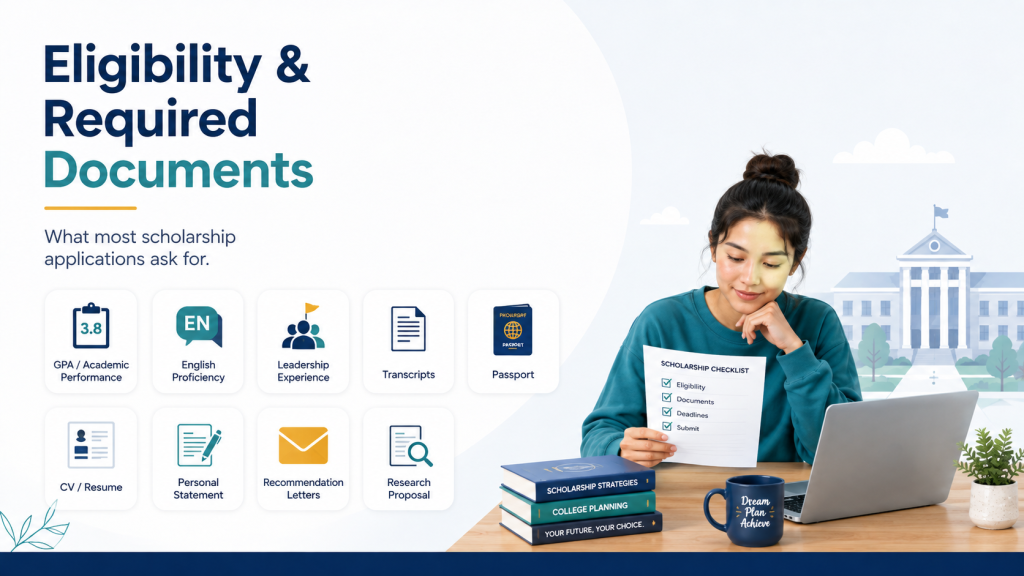
Documents Commonly Required for Scholarship Applications
Preparing documents early can make the scholarship application process much easier.
A typical 2026 scholarship application may require the following documents.
Academic Transcripts
Applicants usually need official records showing their previous academic performance.
Make sure your transcripts are clear, complete, and translated into the required language if necessary.
Passport
International scholarship applications commonly require a valid passport or another accepted identification document.
Students planning to study abroad should check their passport validity well before applying.
Curriculum Vitae or Resume
A scholarship CV should clearly summarize your:
- Education
- Work experience
- Leadership activities
- Skills
- Awards
- Volunteering
- Research experience
Keep the information relevant and easy to scan.
Personal Statement
A personal statement gives the scholarship committee a better understanding of who you are beyond your grades.
A strong personal statement should explain:
- Your academic background
- Your motivation
- Your achievements
- Your career plans
- Why you selected the course or university
- How the scholarship would support your goals
Avoid making the statement sound like a generic template.
Specific stories and genuine experiences are usually more memorable.
Statement of Purpose
A Statement of Purpose, commonly called an SOP, focuses heavily on your academic and professional direction.
Your SOP should create a logical connection between your past experiences, chosen program, and future goals.
Recommendation Letters
Scholarship providers may request one or more letters of recommendation.
Suitable referees can include:
- University professors
- Academic supervisors
- Employers
- Research supervisors
- Professional mentors
Choose people who actually know your work and can provide specific examples of your abilities.
English Language Test Results
If IELTS, TOEFL, PTE, or another test is required, make sure the score remains valid during the application period.
Research Proposal
Research-based programs may require applicants to submit a detailed proposal outlining:
- Research topic
- Research problem
- Objectives
- Methodology
- Expected contribution
- Relevant literature
The proposal should demonstrate that the applicant understands the field and can undertake independent research.
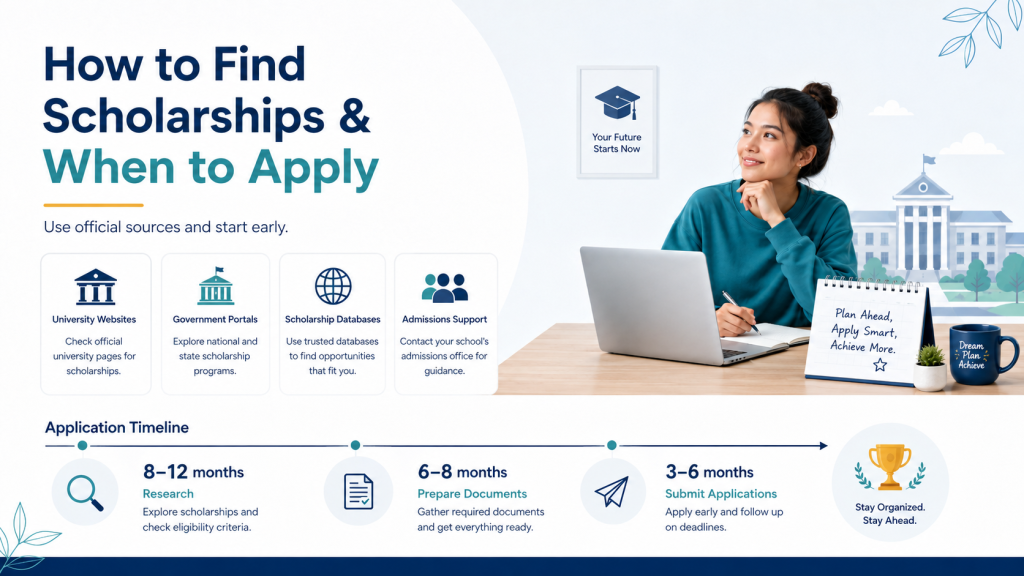
How to Find Scholarships for 2026
Finding the right scholarship can sometimes be more difficult than completing the application itself.
The most reliable approach is to search through official sources.
Check University Websites
Start with universities that offer your preferred course.
Visit sections such as:
Admissions → International Students → Scholarships → Funding
Universities often publish scholarships that may not appear prominently on third-party websites.
Search Government Scholarship Portals
Government education ministries, foreign affairs departments, and official study-abroad portals often publish scholarship opportunities.
Always verify scholarship information through an official government website before submitting personal documents.
Explore Scholarship Databases
Scholarship databases can help students discover opportunities across multiple universities and countries.
However, use these websites primarily for discovery.
After finding a scholarship, confirm the requirements directly with the organization offering it.
Speak With University Admissions Teams
If scholarship information is unclear, contacting the university directly can be helpful.
Ask specific questions such as:
- Is the scholarship available to international students?
- Is there a separate scholarship application?
- Do I need an admission offer first?
- Is the scholarship renewable?
- What costs are covered?
Clear questions usually produce more useful answers.
When Should You Apply for a 2026 Scholarship?
One of the biggest mistakes students make is starting too late.
Many scholarships for programs beginning in 2026 may open several months before the academic intake.
A practical preparation timeline might look like this:
8–12 Months Before Intake
Start researching universities, countries, programs, and scholarship options.
Review eligibility requirements and identify any academic or language tests you need.
6–8 Months Before Intake
Prepare your:
- CV
- Personal statement
- SOP
- Academic transcripts
- Recommendation letters
- English language test
You should also shortlist scholarships based on eligibility and funding.
3–6 Months Before Intake
Submit applications according to official deadlines.
Do not wait until the final day, especially if the application portal requires multiple documents.
After Submission
Continue checking your email and scholarship portal.
Some programs may require:
- Interviews
- Additional documents
- Verification
- University admission confirmation
Respond promptly when additional information is requested.
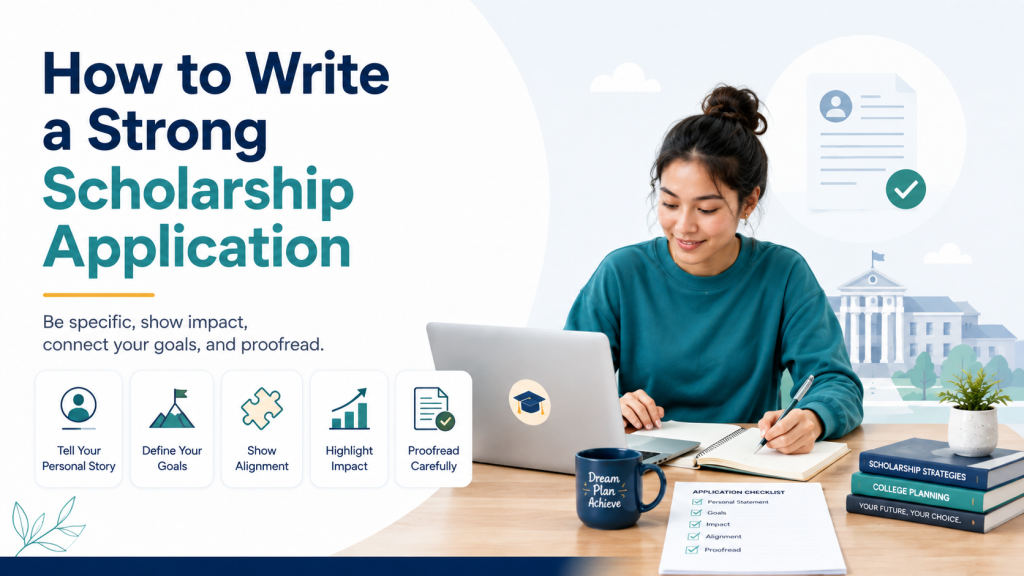
How to Write a Strong Scholarship Application
A successful scholarship application usually communicates three things clearly:
Who you are, what you have already achieved, and what you intend to accomplish next.
Be Specific
Instead of writing:
I am passionate about helping my community.
Explain what you actually did.
For example, describe a project you participated in, the problem you addressed, and the outcome.
Specific evidence makes your application more credible.
Connect Your Past With Your Future
Your application should tell a coherent story.
For example:
Previous education → relevant experience → chosen degree → future career goal
If these elements feel disconnected, scholarship committees may struggle to understand your motivation.
Research the Scholarship Provider
Different scholarships prioritize different qualities.
One program may focus heavily on leadership, while another may prioritize academic achievement or community development.
Read the scholarship’s mission carefully and demonstrate how your goals align naturally with it.
Do not simply copy phrases from the scholarship website.
Show Impact
Whenever possible, demonstrate measurable outcomes.
For example:
Instead of saying:
I helped organize a student event.
You could explain:
I coordinated a five-member team that organized a career workshop attended by more than 150 students.
Concrete details make achievements easier to understand.
Proofread Everything
Grammar mistakes will not necessarily destroy an application, but careless errors can make a strong candidate appear less prepared.
Check:
- Names
- Dates
- University names
- Course names
- Grammar
- Document formatting
Ask another person to review important statements before submission.
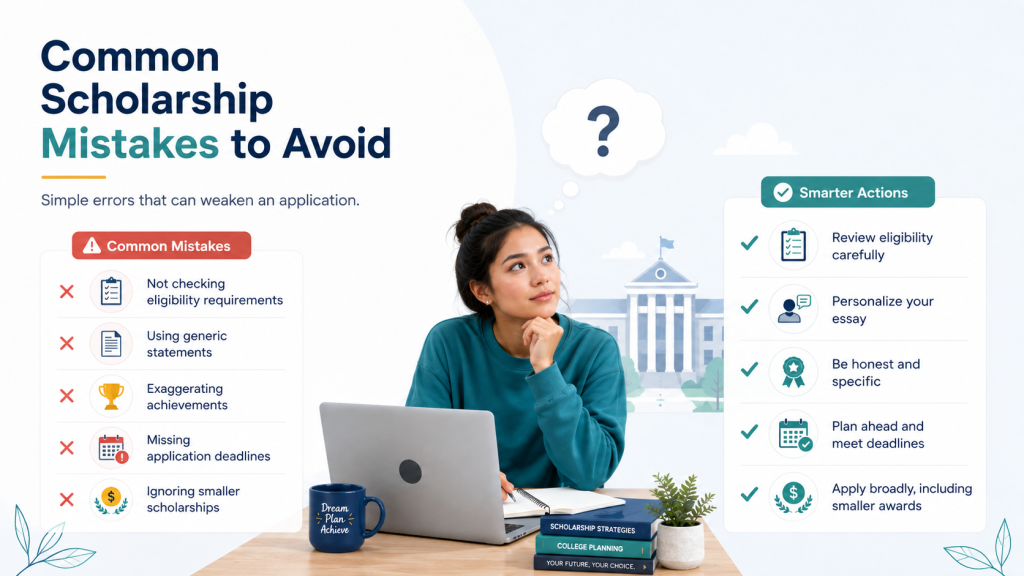
Common Scholarship Application Mistakes
Avoiding simple mistakes can significantly improve the quality of an application.
Applying Without Checking Eligibility
Read every eligibility requirement before spending hours preparing an application.
Using the Same Personal Statement Everywhere
Using one generic statement for multiple scholarships usually produces weaker applications.
Adapt your application to the scholarship’s priorities.
Exaggerating Achievements
Scholarship applications should be persuasive but truthful.
Some universities verify academic, employment, or leadership claims.
Missing Deadlines
A strong application submitted after the deadline may not be considered at all.
Keep a spreadsheet or calendar containing:
- Scholarship name
- University
- Country
- Deadline
- Required documents
- Application status
Ignoring Smaller Scholarships
Students often focus exclusively on famous fully funded scholarships.
That can be a mistake.
Smaller university scholarships may have fewer applicants and can still significantly reduce tuition expenses.
Are Fully Funded Scholarships Difficult to Get?
Yes, many fully funded scholarships are competitive.
However, competitive does not mean impossible.
Scholarship committees are not necessarily looking for a candidate who is perfect in every category. They usually want applicants who strongly match the objectives of the program.
A candidate with excellent grades but no clear motivation may lose to someone with slightly lower grades who demonstrates strong leadership, relevant experience, and a well-defined career plan.
This is why the overall quality of your application matters.
Can You Apply for Multiple Scholarships in 2026?
In many cases, yes.
Applying for several suitable scholarships can improve your overall chances of receiving funding.
However, always read the conditions carefully.
Some scholarship programs may restrict recipients from holding multiple awards simultaneously.
The best strategy is to apply broadly while focusing only on opportunities for which you genuinely meet the requirements.
Can International Students Get Scholarships in 2026?
Yes. Universities and governments around the world continue to provide scholarships specifically for international students.
Funding opportunities exist at:
- Undergraduate level
- Master’s level
- MBA level
- PhD level
- Research level
- Professional training level
Eligibility often depends on nationality, academic background, chosen subject, and destination country.
International applicants should also consider additional costs such as visa fees, flights, health insurance, and accommodation when comparing scholarship packages.
How to Avoid Scholarship Scams
Unfortunately, scholarship scams exist.
Be cautious if an organization:
- Guarantees you a scholarship
- Requests unusually large application fees
- Asks for banking information without explanation
- Uses unofficial email addresses
- Pressures you to pay immediately
- Provides no verifiable institution or official website
Legitimate scholarship opportunities should have clear eligibility criteria, application procedures, and official contact information.
When uncertain, verify the scholarship directly through the relevant university or government organization.

Frequently Asked Questions About Scholarships in 2026
What is the best scholarship for 2026?
There is no single scholarship that is best for every student. The right scholarship depends on your academic level, nationality, subject, destination country, financial needs, and career goals.
Can I get a scholarship without IELTS?
Some universities and scholarship programs may accept alternative English-language evidence or provide IELTS exemptions. However, policies vary by institution, so applicants should confirm the official requirements before applying.
Can students with an average GPA get scholarships?
Yes. Not every scholarship is based exclusively on grades. Some programs also consider leadership, financial need, professional experience, community involvement, sports, creativity, or research potential.
Do scholarships cover living expenses?
Some do. Fully funded scholarships often provide living allowances, while partial scholarships may cover only tuition fees.
Always check the scholarship’s official funding details.
When should I start searching for 2026 scholarships?
Ideally, begin researching 6 to 12 months before your intended study intake. Starting early gives you more time to prepare test scores, recommendation letters, academic documents, and personal statements.
Final Thoughts
Winning a scholarship in 2026 is rarely about submitting as many applications as possible. A better strategy is to identify scholarships that genuinely match your background and prepare each application carefully.
Start early, research official sources, understand the scholarship’s objectives, and build an application that clearly demonstrates your academic ability, experience, motivation, and future potential.
Most importantly, do not reject yourself before the scholarship committee has a chance to evaluate you.
A scholarship opportunity may be competitive, but every successful applicant started in exactly the same place: researching an opportunity and deciding to apply.
Add a Comment