
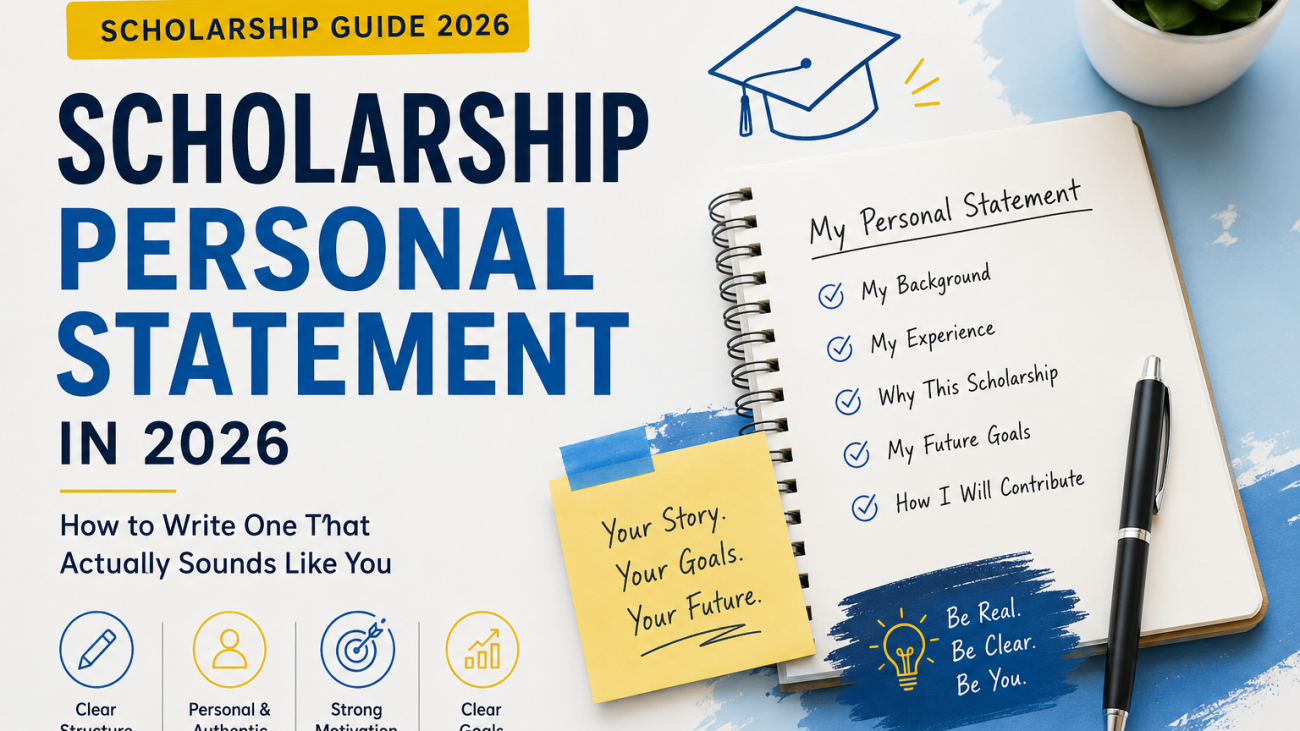
A scholarship personal statement is often the part of the application students worry about most.
Grades are straightforward. Your CV lists what you have done. Recommendation letters come from someone else.
But the personal statement is different.
It asks you to explain who you are, what shaped you, why you are applying, and what you plan to do with the opportunity.
That can feel difficult, especially when you know hundreds or even thousands of other students may be applying for the same scholarship.
The good news is that you do not need to sound extraordinary in every sentence.
A strong scholarship personal statement in 2026 should sound clear, specific, honest, and personal. It should help the reader understand the person behind the application.
This guide explains how to write one naturally, what scholarship committees usually look for, what to avoid, and how to make your statement feel genuinely yours rather than like something copied from the internet.
What Is a Scholarship Personal Statement?
A scholarship personal statement is a short essay that explains your background, motivation, achievements, goals, and reasons for applying for a scholarship.
Depending on the program, it may be called:
- Personal statement
- Motivation letter
- Scholarship essay
- Statement of motivation
- Personal essay
Although these documents can have slightly different purposes, they usually try to answer similar questions.
The scholarship committee wants to understand:
Who are you?
What have you done so far?
Why does this opportunity matter to you?
What do you hope to achieve next?
Your personal statement connects all of those pieces.
Why Scholarship Personal Statements Matter
Imagine two students applying for the same scholarship.
Both have good grades.
Both have extracurricular activities.
Both meet the eligibility requirements.
One writes:
I have always dreamed of studying abroad because I believe education is important for my future.
The other explains how a particular academic experience changed their interests, what they did afterward, and how the scholarship connects directly with their future plans.
The second application is easier to remember.
That is what a good personal statement does.
It gives context to everything else in your application.
Your grades show performance.
Your CV shows experience.
Your personal statement explains why those experiences matter.
What Scholarship Committees Usually Look For
Different scholarships have different priorities, but many selection committees look for similar qualities.
Clear Motivation
They want to understand why you are applying.
Avoid vague reasons such as:
I want to study at a prestigious university.
Instead, explain what specifically interests you about the opportunity.
Maybe the degree offers a particular specialization.
Maybe the scholarship supports students interested in community development.
Maybe the program aligns strongly with the work you are already doing.
Specific reasons are more convincing.
Academic Potential
You do not need to repeat your entire transcript.
Instead, highlight experiences that demonstrate your ability to learn, solve problems, conduct research, or work independently.
For example, you might discuss:
- A major university project
- Research experience
- A difficult subject you improved in
- An academic competition
- A thesis
- A practical project related to your intended field
The goal is not to prove that you have never struggled.
The goal is to show that you can grow.
Leadership and Initiative
Leadership does not necessarily mean being president of a large organization.
You may have demonstrated leadership by:
- Organizing a student event
- Starting a small community project
- Managing a university team
- Helping classmates
- Taking responsibility at work
- Solving a problem without being asked
Scholarship committees often care more about what you actually did than the title you held.
Impact
Whenever possible, explain the result of your actions.
Instead of:
I volunteered at a local organization.
You could write:
I volunteered with a weekend tutoring program where I helped secondary-school students prepare for mathematics exams.
And if possible, go one step further.
Over six months, I worked with approximately 20 students and helped develop weekly practice materials for the program.
Now the reader understands your contribution.
Future Direction
Scholarship providers usually want to know what you intend to do with the opportunity.
Your future plan does not need to predict every detail of your career.
But it should show direction.
For example:
Current experience → chosen degree → future career → wider contribution
That sequence helps the scholarship committee understand how the opportunity fits into your journey.
How to Structure a Scholarship Personal Statement
There is no single perfect structure.
However, a simple structure can make writing much easier.
1. Start With a Meaningful Opening
Your opening should make the reader want to continue.
That does not mean you need a dramatic story.
You can begin with:
- A specific experience
- A moment that influenced your career choice
- A problem you became interested in solving
- A project that changed your thinking
- A personal observation connected to your academic goals
Avoid overly dramatic openings that do not connect naturally with the rest of your essay.
Example of a Weak Opening
From a very young age, I have always believed that education is the key to success.
There is nothing technically wrong with this sentence.
The problem is that thousands of applicants could write exactly the same thing.
Example of a More Personal Opening
During my final undergraduate project, I spent several weeks analyzing why a community health initiative was struggling to reach rural families. That experience showed me how much good policy depends on understanding people, data, and local realities.
This opening tells us something about the applicant immediately.
It also creates a natural path toward discussing academic interests and future goals.
2. Explain Your Academic Journey
Your academic section should not simply repeat your transcript.
Instead, choose experiences that support your current direction.
You might discuss:
- Why you chose your field
- A project that influenced you
- A professor or course that changed your perspective
- Research you completed
- A challenge you overcame
- Skills you developed
Try to connect these experiences with the program or scholarship you are applying for.
3. Discuss Relevant Experience
This could include:
- Employment
- Internships
- Research
- Volunteering
- Leadership
- Entrepreneurship
- Community involvement
- Student organizations
Do not try to mention every activity.
Choose the experiences that strengthen your story.
Three meaningful examples are usually better than ten disconnected achievements.
4. Explain Why You Are Applying
This section should answer an important question:
Why this scholarship?
A weak answer focuses only on money.
For example:
I need this scholarship because studying abroad is expensive.
Financial support can absolutely be important.
But competitive scholarship providers usually want to understand what the opportunity enables beyond simply paying tuition.
A stronger explanation might discuss:
- Access to a specialized program
- Research opportunities
- International exposure
- Leadership development
- Professional networks
- Training unavailable in your current environment
The scholarship should feel connected to your goals.
5. Explain Your Future Goals
Your future goals should be realistic and connected to your past experience.
Avoid extremely broad claims such as:
I want to change the world.
Instead, explain what area you want to work in.
For example:
After completing the program, I hope to work in public-health data analysis and eventually support evidence-based health programs in underserved communities.
That goal is specific enough to feel real.
6. Finish With Purpose
A strong conclusion should bring the statement together.
Do not simply repeat everything you already wrote.
Instead, briefly reinforce:
- Your motivation
- Your readiness
- What the opportunity would enable
- What you hope to contribute
The ending should feel confident without sounding arrogant.
How to Make Your Personal Statement Sound Human
One of the biggest problems with scholarship essays today is that many sound almost identical.
They are technically correct.
The grammar is polished.
The vocabulary sounds impressive.
But you cannot tell who wrote them.
This has become even more important as more students use AI writing tools.
Your goal should not be to avoid good writing.
Your goal should be to preserve your voice.
Use Real Details
Instead of saying:
I developed strong leadership skills.
Explain when.
Where?
What happened?
Who was involved?
What did you do?
What changed?
Real details make writing sound naturally human.
Write the Way an Educated Version of You Would Speak
You do not need to use complicated vocabulary.
For example:
This transformative academic endeavor significantly augmented my interdisciplinary competencies.
Sounds impressive but unnatural.
You could simply write:
The project taught me how to work across different disciplines and communicate with people from different backgrounds.
The second version is much easier to trust.
Include Reflection
Strong personal statements do not only explain what happened.
They explain what the applicant learned.
For example:
Managing the event taught me that leadership is less about giving instructions and more about creating clarity when a team is under pressure.
That sentence gives the reader insight into how the applicant thinks.
Should You Use AI to Write a Scholarship Personal Statement?
AI can be useful.
It can help you:
- Brainstorm ideas
- Organize your structure
- Improve grammar
- Identify repetitive sentences
- Shorten long paragraphs
- Check clarity
However, there is a risk.
If you give an AI tool a prompt such as:
Write me a scholarship personal statement.
You may get a polished essay that could belong to almost anyone.
That is not what you want.
A scholarship personal statement should contain experiences, motivations, and details that actually belong to you.
A better approach is to write down your real experiences first and then use AI to help refine the presentation.
The ideas should remain yours.
How Long Should a Scholarship Personal Statement Be?
Always follow the official scholarship instructions.
A personal statement might have:
- A word limit
- A character limit
- A page limit
- Several separate essay questions
Common limits may fall somewhere around several hundred words, but there is no universal standard.
If a scholarship says 500 words, treat 500 words as the limit.
Do not submit 750 because you believe your story deserves more space.
Following instructions is part of the application.
What Should You Include in Your Scholarship Personal Statement?
A strong statement normally includes several of these elements:
- Academic background
- Relevant achievements
- Leadership experience
- Professional experience
- Community involvement
- Motivation
- Career goals
- Challenges you have learned from
- Why the scholarship fits your goals
- What you hope to contribute
You do not need to include all of them equally.
Choose what supports your application best.
Scholarship Personal Statement Example Framework
You can use this simple framework when planning your essay.
Paragraph 1 — Opening
Introduce a meaningful experience, motivation, or academic interest.
Paragraph 2 — Academic Background
Explain the educational experiences that prepared you for the opportunity.
Paragraph 3 — Experience and Achievements
Discuss relevant leadership, research, professional, or community experience.
Paragraph 4 — Why This Scholarship
Explain why the specific scholarship and program are appropriate for you.
Paragraph 5 — Future Goals
Explain what you intend to do afterward.
Paragraph 6 — Conclusion
Connect your experiences, goals, and the opportunity.
This is only a framework.
Your essay should still feel natural.
Common Scholarship Personal Statement Mistakes
Starting With Generic Statements
Avoid openings that could belong to any applicant.
Examples include:
Education has always been my passion.
I have dreamed of success since childhood.
I believe knowledge is power.
There is nothing inherently wrong with these ideas.
They are simply too broad to reveal much about you.
Repeating Your CV
Your personal statement should not become a paragraph version of your resume.
The committee already has your CV.
Use the essay to explain the meaning behind selected experiences.
Trying Too Hard to Impress
Complicated language does not automatically make an essay better.
Clarity is usually more effective.
If a simple word communicates your idea accurately, use it.
Exaggerating Your Story
Do not invent hardship, leadership, achievements, or impact because you think the committee expects a dramatic story.
Your experiences do not have to sound extraordinary.
They need to be genuine and relevant.
Writing About the Scholarship Instead of Yourself
Some applicants spend too much space praising the university or scholarship.
For example:
Your prestigious institution has world-class faculty, outstanding infrastructure, exceptional research opportunities…
The scholarship committee already knows about its own program.
Focus on why those resources matter specifically to your goals.
Ignoring the Scholarship’s Values
If the scholarship emphasizes leadership, your statement should contain evidence of leadership.
If it focuses on research, demonstrate your research potential.
If it focuses on community development, show how your experience connects to that mission.
One generic personal statement should not be submitted everywhere without modification.
How to Edit Your Scholarship Personal Statement
Do not submit your first draft.
A good editing process can significantly improve the essay.
First Edit: Content
Ask:
- Does every paragraph have a purpose?
- Have I provided real examples?
- Are my goals clear?
- Is the scholarship connection obvious?
Second Edit: Structure
Check whether one idea naturally leads to another.
Your essay should feel like one story rather than several unrelated paragraphs.
Third Edit: Language
Remove:
- Repetition
- Unnecessary adjectives
- Complicated phrases
- Generic statements
- Sentences that sound unnatural
Final Edit: Accuracy
Double-check:
- Scholarship name
- University name
- Course name
- Dates
- Grammar
- Word count
One small copy-and-paste error involving the wrong university name can make an otherwise good application look careless.
Questions to Ask Yourself Before Submitting
Before you submit your scholarship personal statement, ask yourself:
Could someone else submit this exact essay without changing much?
If yes, it probably needs more personal detail.
Then ask:
Can the reader understand what I have done?
Can they understand why I am applying?
Can they understand what I want to do next?
Have I shown evidence rather than making unsupported claims?
If those answers are clear, your statement is moving in the right direction.
Scholarship Personal Statement Checklist
Before submitting, make sure you have:
- Followed the word limit
- Answered the actual scholarship question
- Included specific examples
- Explained your motivation
- Connected your past with your future
- Explained why the scholarship matters
- Avoided copying your CV
- Removed generic phrases
- Proofread names and dates
- Asked someone else to review it
- Kept the writing truthful
Frequently Asked Questions
How do I start a scholarship personal statement?
Start with something specific and relevant to your academic journey, experience, interests, or goals. You do not need an overly dramatic opening.
Should I talk about financial difficulties?
You can if financial need is relevant to the scholarship or genuinely part of your story. However, do not make financial difficulty the entire statement unless the scholarship specifically asks for it.
Can I use the same personal statement for multiple scholarships?
You can reuse parts of your background and experience, but important applications should be customized to the scholarship’s goals and selection criteria.
Should I mention my weaknesses?
You do not need to create a list of weaknesses. However, discussing a genuine challenge can be useful if you explain how you responded and what you learned.
Can AI write my scholarship personal statement?
AI can help with brainstorming, editing, grammar, and structure. Your final statement should still reflect your real experiences, voice, and goals.
What makes a scholarship essay memorable?
Usually, specificity.
Real situations, thoughtful reflection, clear motivation, and concrete goals make an essay easier to remember than complicated vocabulary.
Final Thoughts
A strong scholarship personal statement in 2026 does not need to make you sound like a completely different person.
It should make the reader understand the strongest version of the person you already are.
You do not need to claim that every experience changed your life.
You do not need to sound perfect.
And you certainly do not need to fill every paragraph with impressive words.
Tell the reader what you have done, what those experiences taught you, where you want to go next, and why this scholarship would help you get there.
Specificity builds credibility.
Reflection shows maturity.
And a clear connection between your past, present, and future gives your application a story worth remembering.
Add a Comment