
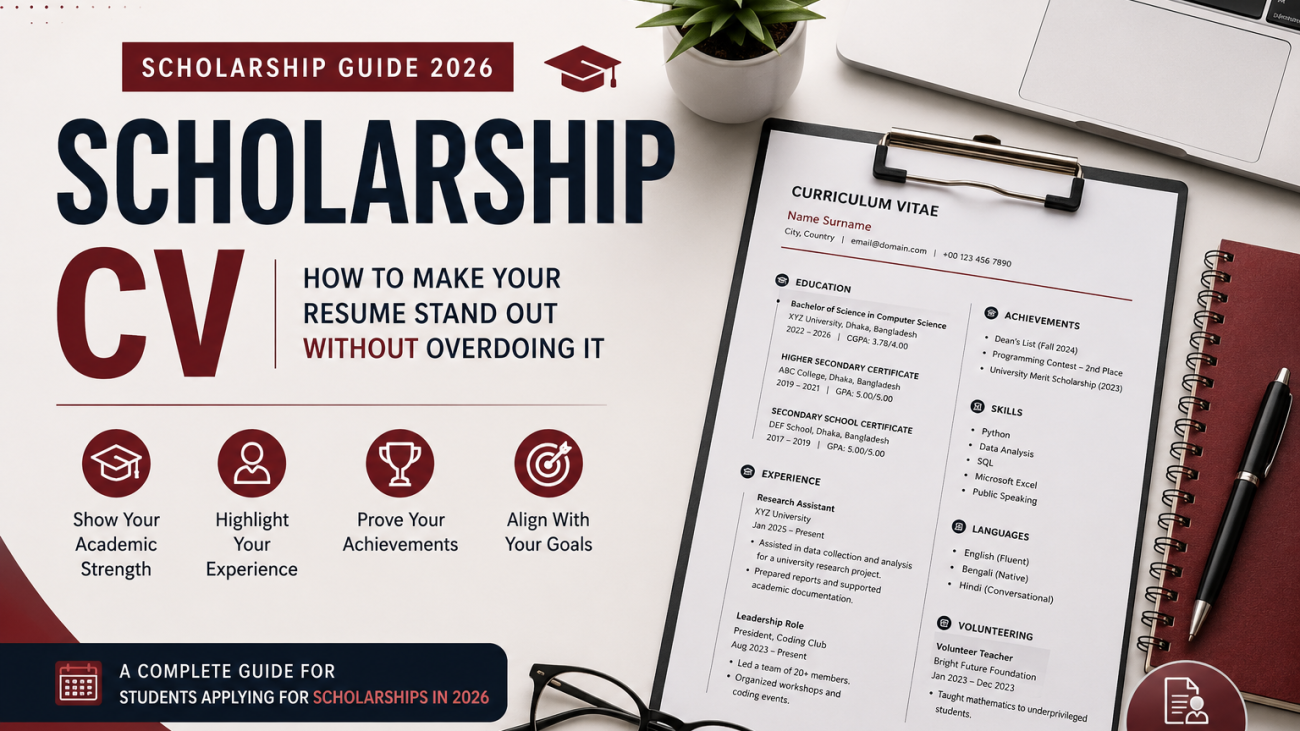
A scholarship CV can feel confusing because it is not exactly the same as a job resume.
You are not simply trying to show that you can perform a role. You are trying to show the scholarship committee that you have a strong academic background, useful experience, clear potential, and a reason to be considered for funding.
That means your CV should be focused, easy to read, and relevant to the scholarship you are applying for.
You do not need a fancy design. You do not need to fill it with every activity you have ever done. And you definitely do not need to make yourself sound more impressive than you really are.
A strong scholarship CV in 2026 is usually the one that makes it easy for the reader to understand your journey quickly.
This guide will show you what to include, what to leave out, how to organize your information, and how to make your scholarship CV feel professional without sounding robotic.
What Is a Scholarship CV?
A scholarship CV is a document that summarizes your academic background, achievements, experience, leadership, research, volunteering, skills, and other relevant activities.
It gives the scholarship committee a quick overview of who you are.
Think of it as a snapshot of your application.
Your personal statement tells your story.
Your recommendation letter gives someone else’s perspective.
Your scholarship CV shows the facts.
All three should support the same overall picture.
Why a Scholarship CV Matters
Scholarship committees may receive hundreds of applications.
They often need to understand an applicant quickly.
A clear CV can help them see:
- What you have studied
- What you have achieved
- What experience you have
- Whether you have leadership potential
- Whether your background fits the scholarship
- Whether your academic interests match the program
A poorly organized CV can hide good achievements.
A well-organized one makes them easy to notice.
How Is a Scholarship CV Different From a Job Resume?
There is some overlap, but the emphasis is different.
A job resume usually focuses strongly on:
- Work experience
- Professional skills
- Business results
- Industry achievements
A scholarship CV may place more importance on:
- Education
- Academic performance
- Research
- Awards
- Leadership
- Volunteering
- Publications
- Conferences
- Extracurricular activities
The correct balance depends on the scholarship.
For an academic scholarship, education and research may come first.
For a leadership scholarship, professional and community experience may be more important.
What Should You Include in a Scholarship CV?
A scholarship CV does not need every possible section.
Use only the sections that help your application.
A good structure may include:
- Personal information
- Education
- Academic achievements
- Work experience
- Research experience
- Leadership
- Volunteering
- Awards
- Publications
- Conferences
- Certifications
- Skills
- Languages
The order can change depending on your background.
1. Personal Information
Keep this section simple.
Include:
- Full name
- Email address
- Phone number
- City and country
- LinkedIn profile if relevant
You usually do not need to include:
- Religion
- Marital status
- Passport number
- National ID number
- Full home address
- Personal information not requested by the scholarship
Only provide sensitive information when the official application specifically requires it.
2. Education
For most students, education should appear near the top.
Include:
- Degree name
- University or institution
- Location
- Study period
- GPA or academic result if useful
- Relevant specialization
Example:
Bachelor of Science in Computer Science
ABC University, Dhaka, Bangladesh
2022–2026
CGPA: 3.78/4.00
You can also include a few relevant courses if they strongly relate to the scholarship.
Do not list every course you completed.
3. Academic Achievements
If you have meaningful academic achievements, give them their own section.
Examples include:
- Dean’s List
- Academic scholarships
- Competition awards
- High-ranking examination results
- Research awards
- Departmental recognition
Be specific.
Instead of:
Received academic award.
Write:
Dean’s List, Faculty of Engineering, 2025
Clarity makes the achievement stronger.
4. Work Experience
Work experience can be useful even when the scholarship is academic.
Include:
- Job title
- Company or organization
- Dates
- 2–4 relevant bullet points
Avoid writing only job duties.
Try to show what you actually contributed.
Weak:
Responsible for helping customers.
Stronger:
Assisted an average of 30+ customers per day and helped resolve service issues.
The second version gives more context.
5. Research Experience
Research experience can be especially important for master’s, PhD, and academic scholarships.
Include:
- Research title
- Institution
- Supervisor if relevant
- Dates
- Your contribution
- Research methods
- Results or outputs
For example:
Undergraduate Research Assistant
Department of Public Health, XYZ University
2025–2026
- Collected and cleaned survey data from 300 participants
- Supported statistical analysis using SPSS
- Contributed to the literature review and final report
This is much stronger than simply writing:
Worked on a research project.
6. Leadership Experience
Leadership does not always mean holding a formal title.
You can show leadership through responsibility.
Examples:
- Led a student team
- Organized an event
- Managed a project
- Coordinated volunteers
- Mentored junior students
- Created a new initiative
Use evidence.
Instead of:
Strong leadership experience.
Write:
Coordinated a team of eight volunteers to organize a university career workshop attended by more than 200 students.
That gives the committee something concrete to remember.
7. Volunteer Experience
Scholarships that focus on social impact, leadership, community development, or service may value volunteering strongly.
Include:
- Organization
- Role
- Dates
- What you did
- Who benefited
- Any measurable result
Do not exaggerate the impact.
A small but genuine contribution is better than an unrealistic claim.
8. Awards and Scholarships
Include relevant awards such as:
- Academic awards
- Leadership awards
- Competition prizes
- Research recognition
- Previous scholarships
If the award name is not self-explanatory, add a short explanation.
Example:
University Merit Scholarship, 2025
Awarded to the top 10% of students in the department.
That immediately shows why the award matters.
9. Publications and Conferences
This section is useful if you are applying for research-focused funding.
You can include:
- Journal papers
- Conference papers
- Posters
- Research presentations
- Published articles
- Book chapters
Use a consistent citation style.
If you have no publications, do not create this section.
A scholarship CV does not need to contain every possible heading.
10. Certifications
Include certifications that strengthen your scholarship application.
Examples:
- Data analysis
- Language certificates
- Project management
- Programming
- Research methods
- Professional training
Avoid filling the CV with unrelated online courses simply to make it look longer.
Quality matters more than quantity.
11. Skills
Your skills section should be relevant.
You may include:
Technical skills
- Python
- SPSS
- MATLAB
- AutoCAD
- Excel
Research skills
- Data collection
- Statistical analysis
- Literature review
Professional skills
- Project coordination
- Presentation
- Team management
Avoid vague lists such as:
- Hardworking
- Honest
- Motivated
- Good person
Those qualities should come through your achievements, not a list.
12. Languages
If you speak multiple languages, include them.
For example:
- Bengali — Native
- English — Professional proficiency
- Hindi — Conversational
Be honest about your level.
How Long Should a Scholarship CV Be?
There is no universal length.
For many undergraduate or master’s applicants, one to two pages is usually enough.
Research applicants with publications and academic experience may need more.
The key question is not:
Is my CV long enough?
The better question is:
Is every section useful?
If the scholarship committee can understand your strongest qualifications in two pages, adding a third page does not automatically make the CV better.
Should You Add a Photo to Your Scholarship CV?
This depends on the country, university, and scholarship.
Some regions commonly accept CV photos.
Others prefer resumes without them.
If the scholarship instructions do not ask for a photo, it is usually safer to focus on your qualifications.
Always follow the official requirements first.
Should You Use a Creative CV Design?
For most scholarships, simple is better.
A scholarship committee is not judging your graphic design ability unless you are applying to a design-related program.
Use:
- Clean headings
- Consistent spacing
- Easy-to-read fonts
- Clear dates
- Simple bullet points
Avoid:
- Too many colors
- Progress bars
- Large icons
- Complicated charts
- Extremely decorative templates
- Tiny text
Your CV should look professional, not like a poster.
How to Write Strong Bullet Points
One of the easiest ways to improve your scholarship CV is to improve your bullet points.
Try this structure:
Action + task + result
Example:
Weak:
Helped organize seminars.
Better:
Coordinated logistics for three academic seminars involving more than 150 participants.
Another example:
Weak:
Worked in a research team.
Better:
Collaborated with a four-member research team to analyze survey data and prepare the final project report.
Details make your experience more credible.
Should You Include Your GPA?
Include your GPA if:
- It is strong
- The scholarship values academic performance
- The application asks for it
If your GPA is lower than you would like, do not automatically hide it if the scholarship requires it.
Your application will usually include transcripts anyway.
Remember that many scholarships consider more than grades.
What If You Have Little Experience?
This is common for undergraduate students and recent graduates.
You can still build a strong scholarship CV.
Think beyond formal employment.
You may have:
- Class projects
- University clubs
- Volunteer activities
- Academic competitions
- Research assignments
- Student leadership
- Part-time work
- Personal projects
- Internship experience
The goal is to show how you have used the opportunities available to you.
Common Scholarship CV Mistakes
Making the CV Too Long
More information does not always mean a stronger application.
Remove weak or unrelated content.
Using the Same CV for Every Scholarship
You do not need to completely rewrite your CV each time.
But you should adjust the order and emphasis.
For a research scholarship, move research higher.
For a leadership scholarship, highlight leadership and community experience.
Writing Long Paragraphs
CVs are meant to be scanned quickly.
Use short bullet points.
Save longer explanations for your personal statement.
Listing Responsibilities Without Results
Do not only explain what you were supposed to do.
Explain what you contributed.
Adding Unnecessary Personal Information
Only include information that is relevant or officially requested.
Using Inconsistent Dates
For example:
- Jan 2025
- 02/2024
- March 2023
Choose one format and stay consistent.
Using Unprofessional Email Addresses
Use something simple.
Better:
Avoid:
Small details can affect professionalism.
How to Make Your Scholarship CV Feel Human
A CV is naturally more formal than a personal statement.
Still, it should reflect real experience.
Do not write exaggerated bullet points just because they sound impressive.
For example:
Revolutionized student engagement through transformative leadership.
This sounds dramatic but tells the reader almost nothing.
Instead:
Organized monthly study sessions for first-year students and coordinated five volunteer mentors.
Now the reader understands what happened.
Simple facts often sound more impressive than inflated language.
How Your CV Should Connect With the Rest of Your Application
Your CV, personal statement, and recommendation letters should support each other.
Suppose your CV says:
President, Environmental Society
Your personal statement might explain a specific project you led.
Your recommendation letter might describe your ability to organize people.
Together, they create a consistent picture.
If every document tells a completely different story, the application can feel disconnected.
Scholarship CV Checklist
Before submitting your scholarship CV, check that:
- Your name and contact information are correct
- Education details are accurate
- Dates are consistent
- Your strongest achievements are easy to find
- Experience is described with specific examples
- Relevant research is included
- Leadership and volunteering are included when appropriate
- Unnecessary personal details are removed
- Grammar and spelling are correct
- The file name looks professional
- The formatting is easy to read
- The CV matches the scholarship’s priorities
A suitable file name might be:
FirstName_LastName_Scholarship_CV.pdf
Frequently Asked Questions About Scholarship CVs
Do I need a CV for every scholarship?
No. Some scholarships do not request one. Always check the official application requirements.
Can a scholarship CV be two pages?
Yes. For many applicants, one to two pages is perfectly reasonable.
Should I include hobbies?
Only if they add meaningful value or demonstrate relevant achievements. You do not need a hobbies section simply to fill space.
Should I include references?
Usually not unless the scholarship specifically asks for them. Recommendation letters are normally handled separately.
Can I use the same CV for university admission and scholarships?
You can use the same base document, but scholarship applications often benefit from a version that emphasizes achievements, leadership, research, and impact more clearly.
Should I include high school achievements?
If you are applying for an undergraduate scholarship, yes, relevant high-school achievements can be valuable.
For postgraduate applicants with significant university experience, older school achievements usually become less important.
Final Thoughts
A strong scholarship CV in 2026 is not about trying to look perfect.
It is about presenting your strongest and most relevant experiences clearly.
Make it easy for the scholarship committee to understand where you have studied, what you have done, what you have achieved, and what kind of potential you bring.
Use simple formatting.
Write specific bullet points.
Focus on evidence.
And do not add unnecessary information just to make the document longer.
The strongest CV is often not the most decorated one.
It is the one that helps the reader understand your value quickly.
Add a Comment