
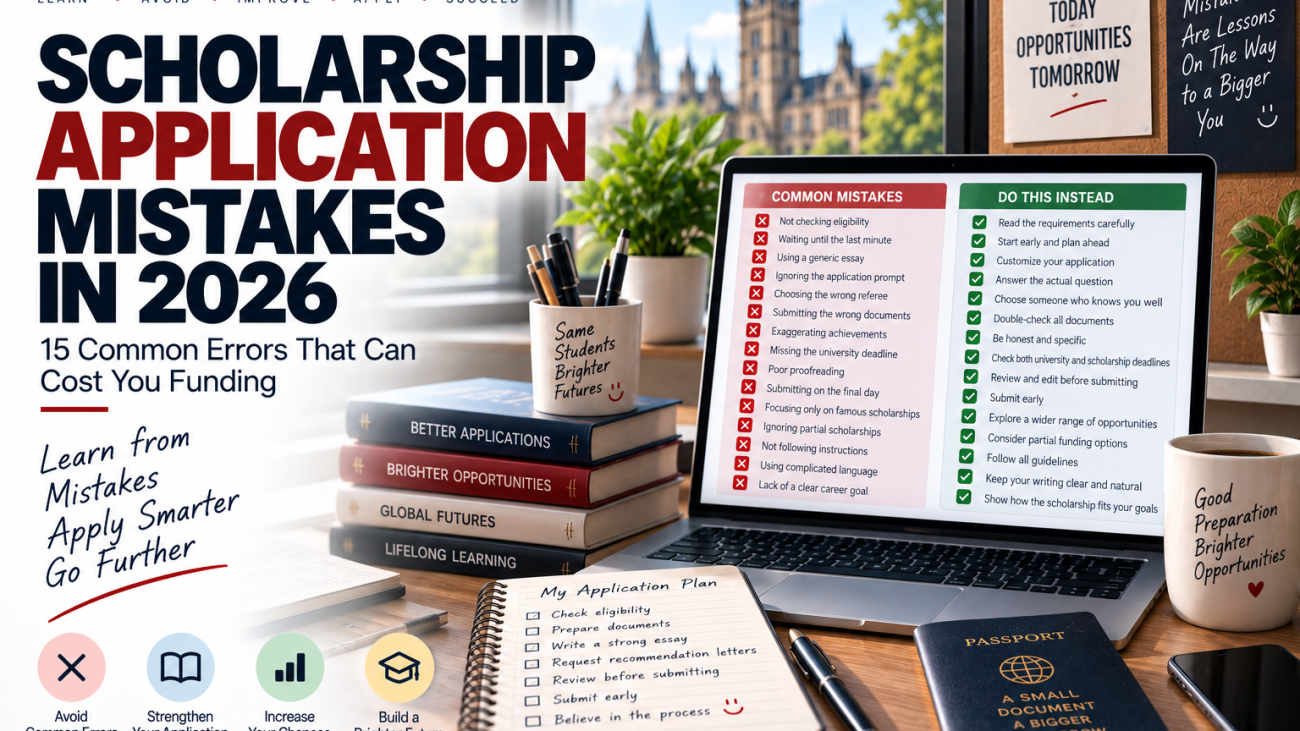
A scholarship application can be strong in many areas and still fail because of one avoidable mistake.
Sometimes the problem is obvious, like missing the deadline.
Other times, it is something smaller:
using the same essay for every scholarship, choosing the wrong referee, uploading the wrong file, or failing to answer the actual application question.
The frustrating part is that many of these mistakes have nothing to do with intelligence or academic ability.
They happen because students are rushed, disorganized, or trying to manage too many applications at once.
Understanding the most common scholarship application mistakes in 2026 can help you avoid losing opportunities for reasons that were completely preventable.
This guide covers the mistakes students make most often and what you should do instead.
1. Applying Without Checking Eligibility
This is probably one of the biggest wastes of time.
A student finds an attractive scholarship and immediately starts preparing the application.
Only later do they discover that the scholarship requires:
- A specific nationality
- A minimum GPA
- Two years of work experience
- A particular subject
- A completed degree
Check eligibility first.
Before you write anything, ask:
- Am I eligible?
- Do I meet the mandatory criteria?
- Is my degree accepted?
- Does my nationality qualify?
If the answer is clearly no, move on.
2. Waiting Until the Last Minute
Starting late creates unnecessary pressure.
You may need time for:
- Recommendation letters
- Transcripts
- English-language tests
- Research proposals
- Personal statements
- University admission
Some of these things are not completely under your control.
A professor may take a week to reply.
A transcript may take several days to issue.
A test date may already be full.
Starting early gives you room to solve problems.
3. Using the Same Personal Statement Everywhere
This is one of the easiest mistakes for scholarship committees to notice.
A generic statement might say:
I am applying because this scholarship will help me achieve my academic and professional goals.
That could be sent to almost any scholarship.
A stronger statement explains why that particular opportunity fits you.
Mention:
- The scholarship’s mission
- Your relevant experience
- Your future goals
- Why the program matters to you
You do not need to rewrite your entire life story every time, but your application should feel intentional.
4. Writing What You Think the Committee Wants to Hear
Students sometimes try too hard to sound like the “perfect applicant.”
They write:
My lifelong ambition has always been to transform society through education.
But maybe that is not actually their story.
Scholarship committees read many applications.
Generic ambition is easy to forget.
Real experiences are much more memorable.
Write about what you actually did, what you learned, and what you genuinely want to do next.
5. Focusing Only on Grades
Good grades can help.
But many scholarships consider more than academic performance.
They may also look at:
- Leadership
- Research
- Work experience
- Community involvement
- Communication
- Career plans
- Motivation
If your application only talks about your GPA, the committee may not understand what else you bring.
Show the full picture.
6. Listing Achievements Without Explaining Them
Students often write things like:
I was president of the student club.
I completed an internship.
I volunteered at an organization.
These are useful facts, but they do not explain much.
Add context.
For example:
As president of the student club, I coordinated a six-member team and organized three career workshops attended by more than 200 students.
Now the committee can see your contribution.
7. Choosing the Wrong Recommender
A senior professor is not automatically the best referee.
Neither is the CEO of a company.
The strongest recommender is usually someone who knows your work well enough to provide specific examples.
That could be:
- A lecturer
- Research supervisor
- Manager
- Project leader
- Volunteer supervisor
A detailed letter from someone who genuinely knows you is usually more useful than a generic letter from someone with a prestigious title.
8. Asking for Recommendation Letters Too Late
Do not email your professor two days before the deadline and expect a strong letter.
Good recommendations take time.
Ideally, ask several weeks in advance.
Give your referee:
- Your CV
- Scholarship information
- Deadline
- Personal statement
- Relevant achievements
- Submission instructions
Make the process easy for them.
9. Ignoring the Scholarship Prompt
A well-written essay can still fail if it answers the wrong question.
Suppose the prompt asks:
Describe one leadership challenge and explain what you learned.
If you spend most of the essay describing your academic achievements, you have not answered the question.
Before submitting, read the prompt again.
Then ask:
Does my answer actually respond to this?
It sounds simple, but it matters.
10. Writing Too Much
More writing does not automatically make an application stronger.
If the limit is 500 words, respect it.
Do not write 800 words because every detail feels important.
A strong scholarship essay should be focused.
Good editing often makes your application better.
11. Using Complicated Language
Some students believe formal writing needs to sound difficult.
So they write sentences such as:
This transformative academic journey substantially enhanced my multidisciplinary competencies and professional aspirations.
You could simply write:
The experience helped me improve my research skills and clarified the kind of work I want to pursue.
The second version is easier to read and easier to believe.
Clarity is not weakness.
12. Exaggerating Achievements
It can be tempting to make your experience sound bigger.
Do not.
If you helped organize a small event, do not claim that you “transformed the educational landscape.”
If you contributed to a project, do not claim you led the entire thing.
Scholarship applications may involve interviews and verification.
Be specific and truthful.
Real achievements are enough.
13. Uploading the Wrong Documents
This happens more often than you might expect.
Students accidentally upload:
- An old CV
- The wrong essay
- Another university’s SOP
- An incomplete transcript
- A document with the wrong scholarship name
Use clear file names.
For example:
Aisha_Rahman_CV_2026.pdf
Aisha_Rahman_Personal_Statement_Chevening.pdf
Then check every file before submitting.
14. Forgetting About the University Application
Scholarship and university admission are not always the same process.
Some scholarships require:
- University admission first
- Scholarship application afterward
Others allow both at the same time.
Do not assume.
Check:
- Admission deadline
- Scholarship deadline
- Whether an offer is required
- Whether there is a separate application
Missing the university deadline can make the scholarship irrelevant.
15. Submitting on the Final Day
Technically, submitting at 11:55 PM may still count as on time.
But it is risky.
You could face:
- Website problems
- Internet failure
- File upload errors
- Payment issues
- Timezone confusion
Try to submit at least a little earlier.
The peace of mind is worth it.
Bonus Mistake: Applying Only to Famous Scholarships
Many students focus on the biggest names.
That is understandable.
But famous scholarships often receive extremely high numbers of applications.
Also look at:
- University-specific scholarships
- Department funding
- Research assistantships
- Regional programs
- Smaller foundations
A less famous scholarship can still provide excellent support.
Bonus Mistake: Ignoring Partial Scholarships
Not every useful scholarship is fully funded.
A partial scholarship may still reduce your costs significantly.
The question is whether the remaining cost is realistic for you.
Calculate:
- Remaining tuition
- Living expenses
- Travel
- Insurance
- Visa
- Accommodation
Then decide whether the scholarship is worth applying for.
Bonus Mistake: Trusting Social Media Without Verification
A scholarship post may look legitimate.
That does not mean it is.
Use social media to discover opportunities.
Then verify them through:
- Official university websites
- Government portals
- Scholarship provider pages
Do not submit sensitive documents based only on a Facebook or Telegram post.
A Better Scholarship Application Process
A good application process can reduce most of these mistakes.
Try this order:
Step 1: Find the Scholarship
Discover the opportunity.
Step 2: Verify It
Check the official source.
Step 3: Confirm Eligibility
Do not proceed until you know you qualify.
Step 4: Check the Deadline
Add it to your tracker.
Step 5: Review Required Documents
Identify anything that takes time.
Step 6: Research the Scholarship
Understand what it values.
Step 7: Customize Your Application
Adapt your CV, essay, or SOP.
Step 8: Proofread
Check everything carefully.
Step 9: Submit Early
Avoid last-minute risk.
Step 10: Save Confirmation
Keep a copy of the application and confirmation email.
How to Review Your Application Before Submission
Before clicking submit, go through the application like you are reviewing someone else’s work.
Check:
- Is my name correct everywhere?
- Did I use the correct scholarship name?
- Did I answer every question?
- Are dates consistent?
- Are files readable?
- Are recommendation details correct?
- Did I stay within the word limit?
- Does my essay sound like me?
- Does the application show why I am a good fit?
This final review can catch surprisingly important mistakes.
Frequently Asked Questions About Scholarship Application Mistakes
What is the most common scholarship mistake?
Starting too late and submitting generic applications are both extremely common.
Can one mistake cause rejection?
Yes, especially if it involves eligibility, missing documents, or deadlines.
Is a small grammar mistake a big problem?
Usually not by itself. But repeated careless errors can make the application look rushed.
Can I reuse scholarship essays?
You can reuse ideas and parts of your story, but customize the final version to the new scholarship.
Should I apply if I only meet the minimum requirements?
Yes, if you are eligible and the scholarship fits your goals.
Is it bad to use AI for scholarship applications?
AI can help with planning, editing, and clarity, but your experiences and final message should remain accurate and personal.
Final Thoughts
Most scholarship application mistakes in 2026 are avoidable.
You do not need a perfect application.
You need a careful one.
Check eligibility.
Start early.
Use real examples.
Choose your referees carefully.
Customize your essays.
Review your documents.
And submit before the final minute.
Scholarship applications are competitive enough already.
Do not make the process harder by losing an opportunity over something you could have checked in advance.
Add a Comment