
You finally receive an email from your dream university.
The subject line says:
Congratulations! You have received an offer of admission.
You open it immediately.
Then you notice two words that make you pause:
Conditional offer.
Does this mean you have been accepted? Can you apply for a scholarship? Should you start preparing your visa? What happens if your final grades are lower than expected?
These questions are especially important for international students who are trying to coordinate university admission, scholarship funding, and travel arrangements.
Understanding the difference between a conditional offer and an unconditional offer in 2026 can help you avoid missed deadlines, unnecessary expenses, and confusion during the admission process.
This guide explains what each type of offer means, how to meet admission conditions, and what scholarship applicants should do before accepting an offer.
What Is a Conditional Offer?
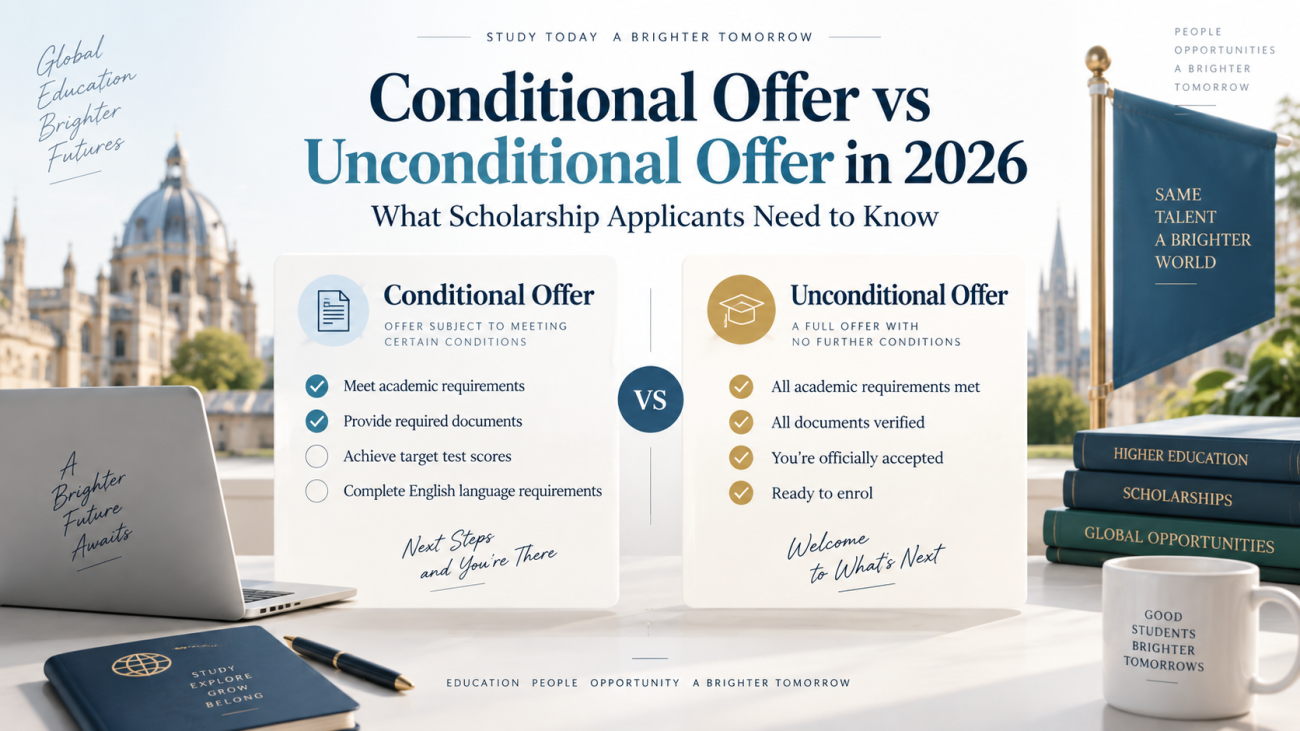
A conditional offer means a university is prepared to admit you, provided you meet certain requirements.
You have passed an important stage of the admission process, but your place is not fully confirmed yet.
For example, you may receive an offer that says:
We are pleased to offer you admission to the MSc Data Science program, subject to successful completion of your undergraduate degree.
This means the university wants you to join the program, but you must finish your current degree before your admission can be confirmed.
According to the official UCAS guide to university offers , a conditional offer means the applicant must meet specified requirements, which commonly involve examination results.
UCAS
For postgraduate applicants, conditions can also involve submitting final qualifications or meeting English-language requirements.
What Is an Unconditional Offer?
An unconditional offer means you have met the university’s academic admission requirements, and the institution is offering you a place.
Imagine that you have already graduated, submitted your final transcript, and provided an accepted English-language test result.
The university reviews your documents and confirms that you meet its admission requirements.
You may then receive an unconditional offer.
However, an unconditional offer does not necessarily mean every administrative task is complete.
UCAS explains that students with unconditional offers may still need to complete additional arrangements or checks, depending on the institution and program.
UCAS
You may still need to accept the offer, arrange funding, complete registration, or prepare immigration documents.
Conditional Offer vs Unconditional Offer: What’s the Difference?
Here is a simple comparison.
|
Conditional offer
|
Unconditional offer
|
| — | — |
|
You still need to meet specified admission requirements.
|
You have met the academic entry requirements.
|
|
Final grades or additional documents may be outstanding.
|
Your academic eligibility has been confirmed.
|
|
Your place depends on meeting the conditions.
|
Your place is available, subject to any remaining administrative requirements.
|
|
Scholarship eligibility depends on the funding program.
|
You may have the admission confirmation required by certain scholarships.
|
Both are positive admission decisions.
The difference is whether you still have conditions to satisfy before your place can be fully confirmed.
UCAS
What Are the Most Common Conditional Offer Requirements in 2026?
Every university has its own admission criteria.
Some conditions are straightforward. Others require additional preparation.
1. Completing Your Current Degree
This is common for students applying for postgraduate study during their final undergraduate year.
You may receive an offer before your final examination results are published.
The university might require you to complete your degree with a particular classification or minimum result.
Read the exact wording carefully.
Graduating may not be enough if your offer specifies a particular academic standard.
2. Meeting English-Language Requirements
Some applicants receive a conditional offer because they have not yet submitted acceptable evidence of English proficiency.
The university may require an approved test or another form of evidence.
For example, your offer might specify a particular IELTS score, including minimum scores for individual components.
Do not assume your university will automatically accept a medium-of-instruction certificate.
Check the institution’s official language policy and the conditions written in your offer.
3. Submitting Final Academic Documents
You may already meet the academic requirements but still need to provide official evidence.
The university might request your final transcript, degree certificate, or qualification verification.
For example, UCL’s graduate offer guidance explains that applicants can submit evidence through the document-upload section of their applicant portal. UCL also notes that certain applicants must complete degree verification before an unconditional offer can be issued.
Study at UCL
Your offer letter should explain exactly what evidence is required.
4. Completing Additional Program Requirements
Certain programs may have additional conditions.
These can include checks or documentation connected to professional training, placement requirements, or other course-specific obligations.
Do not assume every conditional offer is about grades.
Read every condition individually.
Can You Apply for a Scholarship With a Conditional Offer?
Yes, some scholarship programs allow it.
However, other programs require an unconditional admission offer before funding can be confirmed.
The correct answer depends on the scholarship provider.
For example, Chevening requires conditionally selected scholarship applicants to provide at least one unconditional university offer, or an offer conditional on funding only, by the deadline specified in their notification email.
Chevening
This means having a conditional offer does not automatically prevent you from progressing through the scholarship process.
You must still satisfy the provider’s specific requirements.
Read the scholarship’s official admission and funding rules before assuming that your university offer is sufficient.
What Does Conditional on Funding Only Mean?
This phrase can be confusing.
Suppose a university has reviewed your academic qualifications and English-language evidence.
You meet its academic requirements.
The only remaining condition is confirmation that your tuition fees will be funded.
Your university offer might therefore be conditional on funding only.
This is different from an offer that still requires you to achieve a particular GPA or submit a language-test result.
Chevening’s current applicant guidance explicitly recognizes offers that are unconditional or conditional on finance only for its relevant university-offer requirement.
Chevening
Not every scholarship follows this rule.
If your offer is conditional on funding, ask the scholarship provider whether it meets the program’s requirements.
How to Turn a Conditional Offer Into an Unconditional Offer
Receiving a conditional offer is the beginning of a practical process.
You need to understand the requirements, complete them, and provide acceptable evidence.
Step 1: Read Your Offer Letter Carefully
Open the official offer letter or university application portal.
Look for the section titled Conditions of Offer.
Write down every requirement.
Do not rely only on the congratulatory email.
The UCL graduate admissions FAQ confirms that applicants can find their offer status and conditions in their offer letter and applicant portal.
Study at UCL
Step 2: Create a Document Checklist
List the evidence you need.
For example:
- Final degree certificate
- Official academic transcript
- English-language test result
- Qualification verification
- Any additional documents requested by the university
Keep the checklist focused on your actual offer conditions.
Your scholarship application documents may already contain many of these files.
Step 3: Check the Deadline
Some universities require applicants to meet their offer conditions by a specific date.
A scholarship may also have its own deadline.
Record both dates separately.
Completing your university conditions after the scholarship deadline may not be enough to retain eligibility for the funding.
Step 4: Submit Documents Through the Correct Channel
Follow the institution’s instructions.
Do not assume emailing an admissions officer is the same as uploading evidence to the application portal.
UCL, for example, instructs graduate applicants to submit their condition-clearing documents through its applicant portal rather than emailing them directly to admissions.
Study at UCL
Submit the documents using the official method required by your university.
Step 5: Wait for the University to Review Your Evidence
Uploading a document does not necessarily mean the condition has been cleared.
The admissions team may need time to verify it.
UCL advises applicants that processing can take longer during busy periods and asks them not to submit duplicate documents unnecessarily.
Study at UCL
Keep checking your applicant portal and official email for updates.
What If You Cannot Meet the Conditions of Your Offer?
This can happen.
Maybe your final grades are slightly below the required result.
Maybe your English-language score is lower than expected.
Perhaps your university has delayed issuing your degree certificate.
The appropriate response depends on which condition you cannot meet.
Contact the admissions office and explain the situation.
Ask whether the university can review your results, accept alternative evidence, or advise you on another available option.
Do not assume the institution will automatically waive a requirement.
For example, UCL advises applicants who do not meet a degree condition to upload evidence of their final qualification and result so that the university can review their case.
Study at UCL
The institution will determine what happens next.
Should You Accept a Conditional Offer?
You can consider accepting it if the university allows you to do so and the program fits your goals.
Before accepting, make sure you understand your remaining requirements.
Ask yourself whether you can realistically meet the academic conditions and complete the outstanding documentation.
You should also check whether accepting the offer creates any financial obligations.
Some universities require tuition deposits.
Read the payment and refund conditions before committing money.
If you are still comparing offers from different universities, consider the course, scholarship funding, remaining costs, and admission requirements together.
Can You Hold More Than One Conditional Offer?
University application systems have different rules.
Some allow applicants to hold multiple offers during the decision-making process.
Others require students to select a preferred institution or respond within a specific timeframe.
Do not assume every university or national application system works the same way.
Check the rules of the platform through which you applied.
Keep your options organized until you are ready to make a decision.
What Happens If You Are Waitlisted for a Scholarship?
A conditional university offer can become particularly important when you are on a scholarship reserve list.
Some programs require reserve candidates to complete admission requirements before they can receive an award.
Chevening, for example, requires reserve scholarship applicants to provide evidence of a qualifying university offer by the deadline in their result notification.
Chevening
If you are currently waiting for a funding decision, read my Scholarship Waitlist in 2026 guide . It explains how to maintain your university offer while keeping other scholarship opportunities open.
Peggy Nelsen Design
Can You Defer a Conditional Offer?
Some universities allow applicants to request admission deferral.
The decision depends on the university’s policy, course availability, and your circumstances.
Your scholarship may have a separate deferral policy.
Do not assume that postponing admission automatically preserves your funding.
If you need to delay your studies, my scholarship deferral guide explains why university approval and scholarship-provider approval need to be considered separately.
Peggy Nelsen Design
Get written confirmation before changing your plans.
Does an Unconditional Offer Guarantee a Student Visa?
No.
University admission and immigration approval are separate processes.
An unconditional university offer can be an important part of preparing for a student visa, but it does not guarantee approval.
You may still need to meet immigration requirements relating to sponsorship, finances, identity, and other conditions.
Check the official immigration website for your destination country before applying.
Avoid booking expensive, non-refundable travel simply because your university offer has become unconditional.
Common Conditional Offer Mistakes to Avoid
A few practical errors can create unnecessary problems.
- Assuming a conditional offer is the same as confirmed admission.
- Ignoring the exact academic or language requirements.
- Forgetting that scholarship deadlines may be different from university deadlines.
- Uploading documents to the wrong portal.
- Assuming a document has been approved immediately after submission.
- Paying a non-refundable deposit without understanding the conditions.
- Beginning visa or travel arrangements without the required confirmations.
Most of these mistakes can be avoided by reading your offer letter carefully and keeping a clear record of what remains outstanding.
Conditional Offer Checklist for Scholarship Applicants
Before moving forward, confirm that you have:
- Read every condition in your offer letter.
- Identified the documents or results you still need.
- Recorded your university’s deadline.
- Checked your scholarship’s admission requirements.
- Submitted evidence through the official portal.
- Confirmed whether your documents have been reviewed.
- Understood any tuition deposit obligations.
- Saved your admission correspondence.
- Confirmed when your place becomes unconditional.
Keep this information in one place so you do not have to search through multiple emails every time you need an update.
Frequently Asked Questions About Conditional and Unconditional Offers
Is a conditional offer a rejection?
No. It means the university is offering you a place provided you meet the stated requirements.
UCAS
Can I get a scholarship with a conditional offer?
Some scholarships allow applicants to progress with conditional offers. Others require an unconditional offer, or one conditional on funding only, before the award is confirmed.
Chevening
Can I receive an unconditional offer before graduating?
It depends on the university and your application. If your offer requires completion of your current degree, you must satisfy that condition before your place can be confirmed.
What happens if my final grades are lower than required?
Contact the university and submit your final results according to its instructions. The admissions team will determine whether your place can still be confirmed.
Do I need IELTS if I already have a conditional offer?
If your offer includes an English-language condition, you must satisfy it using evidence the university accepts.
Does an unconditional offer mean my scholarship is confirmed?
Not necessarily. University admission and scholarship selection may involve separate decisions.
Final Thoughts
Receiving a conditional offer is good news.
It means your university application has progressed, and you have a clear opportunity to secure your place.
The important thing is understanding what still needs to happen.
Read your conditions, prepare the required evidence, and pay attention to both university and scholarship deadlines.
An unconditional offer brings you closer to beginning your studies. It does not automatically complete your funding, immigration, or enrollment arrangements.
Treat each stage separately.
A little organization now can prevent a lot of confusion when your scholarship and university plans start moving forward together.
Add a Comment