
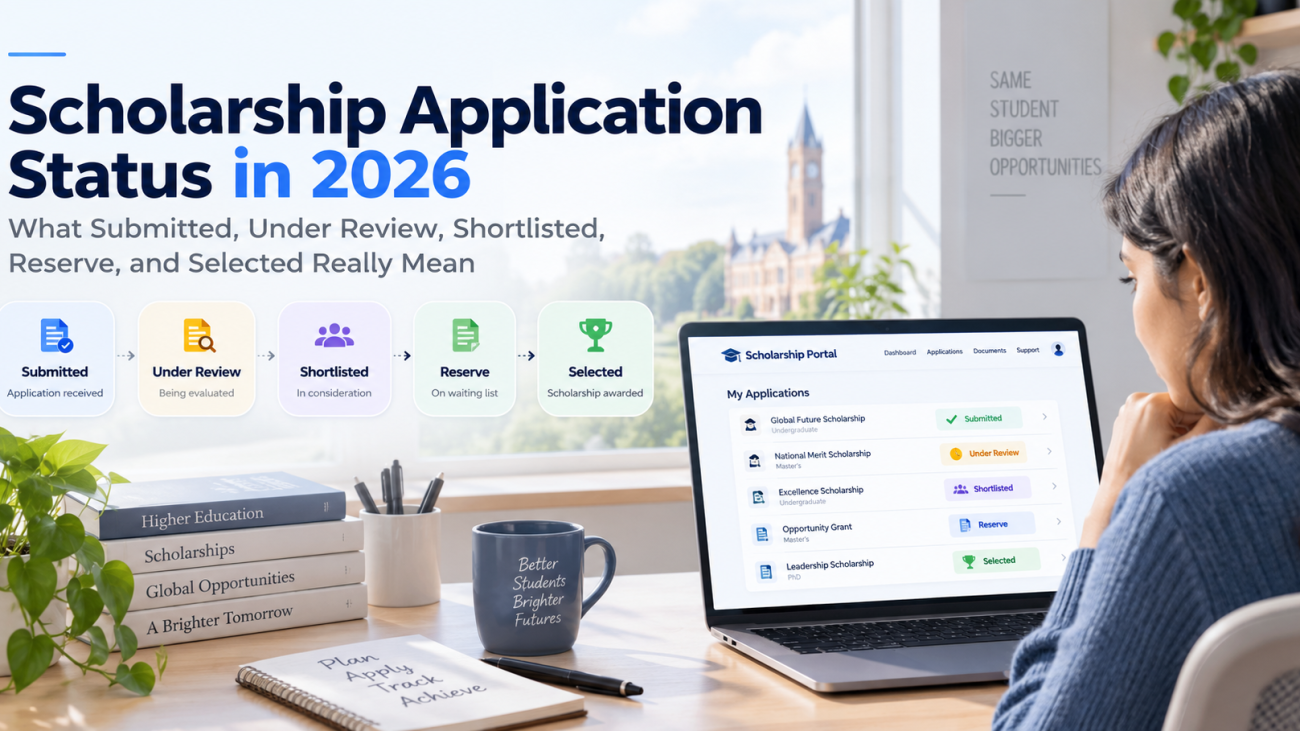
You submit your scholarship application.
For the first few days, you feel relieved.
The essays are finished. Your documents are uploaded. Your references are sorted.
Then you open the application portal.
The status says:
Submitted.
A few weeks later, it changes to:
Under Review.
Someone in a Facebook group says their application already says Shortlisted.
Another person says they received an interview invitation.
You immediately start wondering:
Does “under review” mean something is wrong with my application?
Why has my status not changed?
Does “shortlisted” mean I have won?
Is “reserve” basically a polite rejection?
Should I email the scholarship office and ask for an update?
Waiting for a scholarship decision can sometimes feel more stressful than writing the application itself.
The problem is that scholarship providers do not all use the same terminology. One program may say shortlisted, another may say semi-finalist, and another may simply invite you to an interview without showing a new portal status.
Understanding common scholarship application status meanings in 2026 can help you avoid unnecessary panic and know when action is actually required.
This guide explains what the most common scholarship statuses usually mean, what you should do at each stage, and why comparing your application portal with someone else’s is rarely useful.
What Does Scholarship Application Status Mean?
Your scholarship application status shows where your application currently sits within the provider’s selection process.
You may see terms such as:
- Draft
- Submitted
- Received
- Eligibility Check
- Under Review
- Longlisted
- Shortlisted
- Semi-Finalist
- Interview
- Selected
- Conditional Award
- Reserve
- Alternate
- Unsuccessful
- Withdrawn
The exact meaning depends on the scholarship.
A status is mainly an administrative indicator.
It does not always tell you how well the committee has scored your application.
Chevening, for example, allows applicants to confirm successful submission through its online system and also sends a confirmation email after the application has been submitted. Chevening
Check Chevening’s official application-system guidance
Status 1: Draft or Incomplete
If your application says Draft, the application has usually not been submitted.
You may have:
- Created an account
- Entered personal information
- Started your essays
- Uploaded some documents
but the scholarship provider may not yet consider you an applicant.
This distinction matters.
Saving an application is not the same as submitting it.
Chevening, for example, allows applicants to save progress and return to the application during the application period. Final submission requires completing the application and using the submit function. Chevening
Before the deadline, check for a clear confirmation that submission was successful.
Do not assume that because your application looks complete on the screen, it has been formally submitted.
Status 2: Submitted
Submitted usually means your application has successfully entered the scholarship system.
That is good.
It does not mean anyone has reviewed it yet.
Think of this stage as:
Your application is officially in the competition.
Chevening currently confirms successful submission both inside its online application system and by email. Applicants can also log in later to check the status shown in the system. Chevening
After submitting, save:
- Confirmation email
- Application PDF if available
- Application reference number
- Submission screenshot
- Copy of your essays
You may need these later.
Your site’s Scholarship Documents Checklist 2026 is useful here because scholarship documents often remain relevant long after the original application is submitted.
What If You Do Not Receive a Submission Email?
First, check:
- Spam
- Junk
- Promotions folder
Then log back into the scholarship portal.
Look for:
- Submitted
- Application received
- Complete
If the portal still shows Draft or Incomplete, investigate before the deadline passes.
Do not wait several weeks and assume the system probably received your application.
Status 3: Received
Some scholarship systems use Received instead of Submitted.
This generally means the provider has received the application.
It still does not necessarily mean:
- Eligibility has been confirmed
- Documents have been checked
- Essays have been scored
The provider may have thousands of applications waiting to enter the review process.
There is usually nothing you need to do unless the scholarship asks for additional documentation.
Status 4: Eligibility Check
Many scholarships perform an initial screening before sending applications to reviewers.
At this stage, the provider may check whether you meet basic requirements such as:
- Nationality
- Degree level
- Work experience
- Academic qualifications
- Age requirements where applicable
- Required documents
- Application deadline
Chevening’s current timeline shows that applications are first sifted against eligibility criteria before independent reading committees assess eligible applications. Chevening
This stage is important because a strong essay cannot compensate for failing a mandatory eligibility requirement.
That is why eligibility should always be checked before spending hours preparing an application.
Your Scholarship Shortlisting in 2026 guide explains how to filter opportunities before investing time in applications.
Status 5: Under Review
This is probably the status that causes the most anxiety.
Under Review usually means your application is being assessed or is waiting within an active assessment stage.
It does not automatically mean:
They found a problem.
It also does not mean:
I am almost selected.
The review process can include several stages.
Chevening explains that eligible applications are independently reviewed and scored before a shortlist is prepared by the relevant British embassy or high commission. Chevening
Other scholarships may assess:
- Academic merit
- Essays
- Leadership
- Research potential
- Financial need
- Program fit
- References
Review can take weeks or even months.
How Long Can “Under Review” Last?
There is no universal timeframe.
Some scholarships review applications within weeks.
Large international programs can take several months.
Chevening’s 2026–27 selection timeline provides a useful example. Applications closed on October 6, 2026, with eligibility screening followed by reading committee assessments running into January 2027. Interview shortlisting is scheduled for mid-February 2027. Chevening
A long review period therefore does not necessarily indicate a problem.
Check the scholarship’s official timeline before worrying.
Should You Email the Scholarship Office While Your Application Is Under Review?
Usually, not simply to ask:
Have you reviewed my application yet?
or:
What are my chances?
If the scholarship has published a decision timeline, wait until that period has passed.
Contact them when:
- The portal shows an obvious error
- A required document is missing despite being submitted
- Your contact information changes
- They specifically ask you for information
- The published notification period has passed significantly
Repeated status emails will not normally make your application move faster.
Status 6: Longlisted
Not every scholarship uses this term.
A longlist usually means you passed an earlier evaluation and remain among a reduced group of candidates.
Imagine:
10,000 applications
2,000 longlisted
300 shortlisted
100 interviewed
50 funded
These figures are only illustrative.
A longlist is positive because you have progressed.
It is not an award.
You should keep your other applications moving.
Status 7: Shortlisted
A shortlisted applicant has usually progressed far enough to receive more serious consideration.
This may lead to:
- Interview
- Additional documents
- Written assessment
- Reference checks
- Research evaluation
Chevening’s current timeline says shortlisted candidates are invited to interviews after applications have been reviewed. Chevening
Being shortlisted is a significant achievement.
It still does not mean you have won.
If your next stage is an interview, use your site’s Scholarship Interview in 2026 guide to prepare your leadership examples, career plan, course choice, and other common interview topics.
What Should You Do After Being Shortlisted?
Read the email completely.
Do not stop after:
Congratulations, you have been shortlisted.
Look for:
- Interview booking deadline
- Document upload deadline
- Reference deadline
- ID requirements
- Interview format
Chevening currently requires shortlisted interview candidates to upload specified supporting documents before their interview. Chevening
Missing a post-shortlisting deadline can damage an otherwise successful application.
Status 8: Semi-Finalist
Semi-finalist is common in some competitive scholarship programs.
The term usually means you have successfully passed a major selection stage but still need to undergo further review.
Fulbright provides a clear example.
For the Fulbright U.S. Student Program, applicants recommended by the National Screening Committee become Semi-Finalists and their applications move forward for host-country review. Fulbright Online
A Semi-Finalist can later become:
- Finalist
- Alternate
- Non-Select
Read Fulbright’s official information for Semi-Finalists
The terminology differs from Chevening, but the principle is similar:
You have progressed.
The final decision has not been made.
Shortlisted vs Semi-Finalist: Are They the Same?
Not exactly.
Different scholarships design their own selection systems.
A shortlist may lead to an interview.
A semi-finalist stage may lead to another national or international review.
Do not compare titles across completely different scholarship programs.
Instead, ask:
What does this status mean according to this scholarship’s official guidance?
That question will give you a much more accurate answer.
Status 9: Interview Invited
This one is straightforward.
Your written application has progressed and the provider wants to evaluate you further.
At this stage, the scholarship committee may want to understand:
- Motivation
- Leadership
- Communication
- Academic plans
- Career goals
- Program fit
Book the interview if the system requires you to select a slot.
Chevening currently advises shortlisted applicants to book their interview slot through its application system as soon as possible. Chevening
Do not spend the entire waiting period memorizing scripts.
Know your own application well.
Status 10: Interview Completed
The interview is over.
Now comes another waiting period.
This can be mentally difficult because there is very little you can change.
Avoid analyzing every answer for the next three weeks.
Instead:
- Write down the questions you remember
- Continue other scholarship applications
- Complete outstanding university requirements
- Monitor official emails
Chevening tells candidates that interview outcomes can be released on different dates and that receiving a result earlier or later than another applicant does not indicate the outcome. Chevening
That final point is important.
“Someone Else Got Their Result. I Didn’t. Is That Bad?”
Not necessarily.
Scholarship results are often released gradually.
Chevening explicitly tells applicants that candidates can receive results on different dates and that this does not reflect their application status. Chevening
Fulbright also releases many final decisions on a rolling basis. The timing can vary by country and award. Fulbright Online
Do not allow scholarship Facebook groups to turn different notification dates into conspiracy theories.
Different timing is often just different timing.
Status 11: Selected
This is the email everyone wants.
Selected generally means you have been chosen for the scholarship.
Celebrate.
Then read the conditions.
Selected does not always mean every requirement has been completed.
You might still need:
- Final admission
- Medical clearance
- Visa
- Required documents
- Funding confirmation
Fulbright, for example, describes a Finalist as someone offered an award subject to relevant requirements such as funding availability, placement, medical clearance, visa requirements where applicable, and required grant documentation. Fulbright Online
That is why selection and final administrative confirmation should not automatically be treated as identical.
Status 12: Conditional Award
A conditional award is excellent news, but it means something remains outstanding.
Possible conditions include:
- Unconditional university offer
- Final academic result
- Passport
- Scholarship agreement
- Medical documentation
Chevening conditionally selected candidates receive a task list that they must complete before their award can move toward final confirmation. Chevening
If you see this status, do not panic.
Read the conditions one by one.
Your Conditional Offer vs Unconditional Offer in 2026 guide explains how university admission conditions can interact with scholarship requirements.
Status 13: In Progress
This status often appears inside task-based scholarship portals.
It can mean:
You started something but have not submitted it.
Chevening’s post-selection task system currently defines In progress as a task that has been started and saved but not yet submitted for review. A task returned with feedback can also appear in this state. Chevening
This is different from an application being generally “under review.”
Always look at which specific task the status refers to.
Status 14: In Review
Again, context matters.
In Chevening’s conditional-award task system, In review means the candidate completed a task and submitted it so the Secretariat can review it. Chevening
This shows why you cannot interpret status terms in isolation.
“Under review” for an entire scholarship application and “in review” for one post-selection task may describe completely different stages.
Status 15: Complete
A task marked Complete usually means the provider has reviewed and accepted it.
For example, Chevening’s current post-selection system uses Complete when a submitted task has been reviewed and validated, with no further action required from the candidate. Chevening
That is different from the entire scholarship process being complete.
Check whether other tasks remain open.
Status 16: Reserve or Waitlist
This status creates mixed emotions.
You did not receive the initial award.
You were not fully rejected either.
A scholarship may use terms such as:
- Reserve
- Waitlist
- Alternate
Fulbright describes an Alternate as someone who may be promoted to Finalist if additional funding becomes available. Fulbright Online
Chevening also uses reserve candidates who may be upgraded when funding or places become available.
Your Scholarship Waitlist in 2026 guide explains this stage in much more detail. Peggy Nelsen Design
Is Reserve Basically a Rejection?
No.
But it is not a scholarship award either.
Treat it as:
Still possible, not guaranteed.
Keep:
- Your university offer active
- Required documents ready
- Other scholarship applications moving
Do not make expensive travel or accommodation decisions based only on reserve status.
Status 17: Alternate
This is very similar to reserve status.
Fulbright officially uses Alternate for candidates who can potentially be promoted if additional funding becomes available. Fulbright Online
Do not obsess over your exact ranking unless the scholarship provides it.
You may not know:
- How many alternates there are
- Your position
- How many Finalists will decline
Focus on what you can control.
Status 18: Unsuccessful, Non-Select, or Rejected
These terms generally mean the application is no longer being considered for that cycle.
Fulbright defines Non-Select as a candidate who is no longer under consideration for the award. Fulbright Online
This can be disappointing after months of work.
Do not immediately delete everything.
Save:
- Application
- Essays
- CV
- Interview notes
- Feedback if provided
Then review what can improve before your next application.
Your Scholarship Rejection in 2026 guide explains how to evaluate a rejection and prepare a stronger next attempt. Peggy Nelsen Design
Status 19: Withdrawn
This normally means the application has been removed from consideration.
You may have withdrawn it yourself.
In other cases, the provider may withdraw an application if required conditions are not completed.
Do not confuse withdrawal with rejection.
A rejection comes from the provider’s selection decision.
A withdrawal can happen because the application is no longer active in the process.
Check the reason shown in your portal or official communication.
Status 20: Finalist
A Finalist is usually at or near the final award stage.
Fulbright currently describes a Finalist as a candidate who has been offered a U.S. Student award, subject to remaining program requirements. Fulbright Online
At this stage, follow instructions carefully.
There may be deadlines for:
- Medical clearance
- Documents
- Placement
- Award paperwork
Do not assume the work ends the moment the word Finalist appears.
Scholarship Application Statuses Are Not Universal
This is probably the most important point in this entire article.
One scholarship’s:
Shortlisted
might roughly correspond to another scholarship’s:
Semi-Finalist
A third scholarship may not display either term.
It might simply email interview invitations.
Even large programs structure selection differently.
Chevening uses eligibility review, reading committees, shortlisting, interviews, results, and conditional award steps. Chevening
Fulbright uses National Screening Committee review, Semi-Finalist status, host-country review, and final designations such as Finalist, Alternate, or Non-Select. Fulbright Online
Do not create a universal ranking from terms that belong to different programs.
Why Your Status May Not Change for Weeks
Scholarship evaluation is rarely instant.
The committee may need to:
- Verify eligibility
- Read essays
- Score applications
- Compare candidates
- Review references
- Check funding
- Coordinate interviews
- Obtain approvals
Large international scholarships can involve several organizations and countries.
That takes time.
A static portal is not automatically a forgotten application.
Stop Refreshing the Portal Every Hour
Checking once in a while is sensible.
Refreshing twenty times a day will not change the decision.
A better routine is:
Check email daily.
Check spam occasionally.
Check the portal once or twice a week unless the provider says updates are imminent.
Use the rest of your time for other applications.
Scholarship waiting should not become a full-time occupation.
Be Careful With Facebook and WhatsApp Status Groups
Scholarship groups can be helpful.
They can also create unnecessary anxiety.
You may see:
Mine changed to shortlisted!
Then:
Mine still says under review 😭
Then thirty people begin speculating.
Remember:
Applicants may be:
- From different countries
- Applying for different courses
- Reviewed by different committees
- Receiving results in separate batches
Official guidance should always matter more than group speculation.
Why Someone Else’s Status May Change Before Yours
Possible reasons include:
- Different geographic region
- Different scholarship category
- Different review committee
- Different application stream
- Rolling decisions
Fulbright openly notes that final selection notifications can be released on a rolling basis and that timing varies by country and award. Fulbright Online
Different notification dates do not automatically tell you who performed better.
What If the Portal Status Looks Wrong?
Take a screenshot.
Check:
- Official email
- Application instructions
- FAQ
If there is an obvious contradiction, contact the provider.
For example:
You received a submission confirmation email.
The portal now says Draft.
That is worth asking about.
Write a short message containing:
- Full name
- Application number
- Scholarship name
- Explanation
- Screenshot if appropriate
Do not write a three-page email.
Keep Your Email Address Updated
Your scholarship portal status matters.
Your email matters just as much.
Fulbright explicitly tells applicants to update their permanent email address in the application system when it changes, since final status notifications are communicated electronically. Fulbright Online
Keep access to the email you used for your application.
Avoid using an institutional address that you may lose after graduation unless you can update it later.
Check Spam and Junk Folders
This sounds basic.
Important scholarship messages can still land there.
Interview invitation.
Document request.
Final result.
Check spam regularly while waiting for results.
Add official scholarship addresses to your contacts or safe-sender list where appropriate.
Do Not Miss a Deadline While Waiting for a Status Change
Your portal may say:
Under Review
while another university deadline is approaching.
Do not stop your entire study-abroad plan because one scholarship is still undecided.
Keep track of:
- Admission deadlines
- Tuition deposits
- Other scholarships
- Visa planning
- Document preparation
One pending scholarship should not make every other opportunity disappear.
A Simple Scholarship Status Tracker
You can create a small spreadsheet:
| Scholarship | Current status | Next expected update | Action needed |
|---|---|---|---|
| Scholarship A | Under Review | February | None |
| Scholarship B | Shortlisted | Interview Jan 22 | Prepare interview |
| Scholarship C | Reserve | June–August | Keep university offer active |
| Scholarship D | Selected | Accept by July 10 | Review award terms |
This gives you a clear picture without checking ten portals every day.
When Should You Take Action?
Some statuses require action immediately.
Draft: Finish and submit.
Submitted: Save confirmation.
Under Review: Usually wait.
Shortlisted: Check next-stage requirements.
Interview Invited: Book and prepare.
Conditional Award: Complete conditions.
Reserve: Keep backup options active.
Selected: Review terms and deadlines.
Rejected: Save materials and evaluate your next move.
Your response should match the stage.
Common Scholarship Application Status Mistakes
Assuming Submitted Means Eligible
It only means your application was received unless the program says otherwise.
Assuming Under Review Means Something Is Wrong
Review is a normal part of selection.
Assuming Shortlisted Means Selected
You still have another stage.
Treating Reserve as a Confirmed Scholarship
Funding is not guaranteed.
Treating Reserve as Rejection
You may still be upgraded.
Comparing Status Changes With Other Applicants
Timelines can differ.
Contacting the Provider Constantly
Follow the published notification timeline.
Ignoring Emails Because You Only Check the Portal
Scholarship providers often communicate through both.
Scholarship Application Status Checklist for 2026
Before you worry about your application, check:
- Submission confirmation received
- Portal status checked
- Official selection timeline saved
- Spam folder checked
- Email address still active
- Application reference number saved
- Additional document deadlines checked
- Interview requirements checked if shortlisted
- Backup scholarships still active
- University deadlines tracked separately
Most scholarship waiting becomes easier when you know what the next expected stage actually is.
Frequently Asked Questions About Scholarship Application Status
What does “submitted” mean for a scholarship application?
It normally means the application was successfully sent to the provider. It does not necessarily mean eligibility or selection has been confirmed. Chevening, for example, sends a submission confirmation and allows applicants to view status information in its online system. Chevening
What does “under review” mean?
It normally means the scholarship is assessing your application or it is active within the evaluation process. It does not automatically indicate whether your application is strong or weak.
Does shortlisted mean I won the scholarship?
No. Shortlisting normally means you have progressed to a later stage, often an interview or additional assessment. Chevening shortlisted applicants are invited to interview. Chevening
What does Semi-Finalist mean?
The exact meaning depends on the scholarship. Fulbright Semi-Finalists have passed its U.S. National Screening Committee stage and move forward for host-country review. Fulbright Online
What does Alternate mean?
In Fulbright’s process, an Alternate may later become a Finalist if additional funding becomes available. Fulbright Online
Is Reserve the same as rejected?
No. Reserve or waitlist status normally means you remain under consideration if a place or funding becomes available.
Why did another applicant receive a result before me?
Many scholarship programs release decisions gradually. Fulbright uses rolling final notifications, while Chevening notes that candidates may receive results on different dates without the timing reflecting the outcome. Fulbright Online
Should I contact the scholarship provider for a status update?
Check its published timeline first. Contact the provider when an expected notification period has passed or there is a genuine issue with your application.
Final Thoughts
Waiting for a scholarship result in 2026 can make every portal update feel important.
Try not to read more into a status than it actually says.
Submitted means you have entered the process.
Under Review means the evaluation is still happening.
Shortlisted or Semi-Finalist means you have progressed.
Selected or Finalist is excellent news, but conditions may remain.
Reserve or Alternate means there is still a possibility.
Unsuccessful or Non-Select means the current application cycle has ended.
The exact terminology changes from one scholarship to another.
Use the scholarship provider’s official definition rather than comparing one program with another.
Then focus on the part you can control:
Keep your documents ready.
Watch your deadlines.
Prepare if you reach the interview stage.
Continue applying elsewhere while you wait.
Your scholarship portal may not change today.
Your wider education plan should keep moving.
Add a Comment