
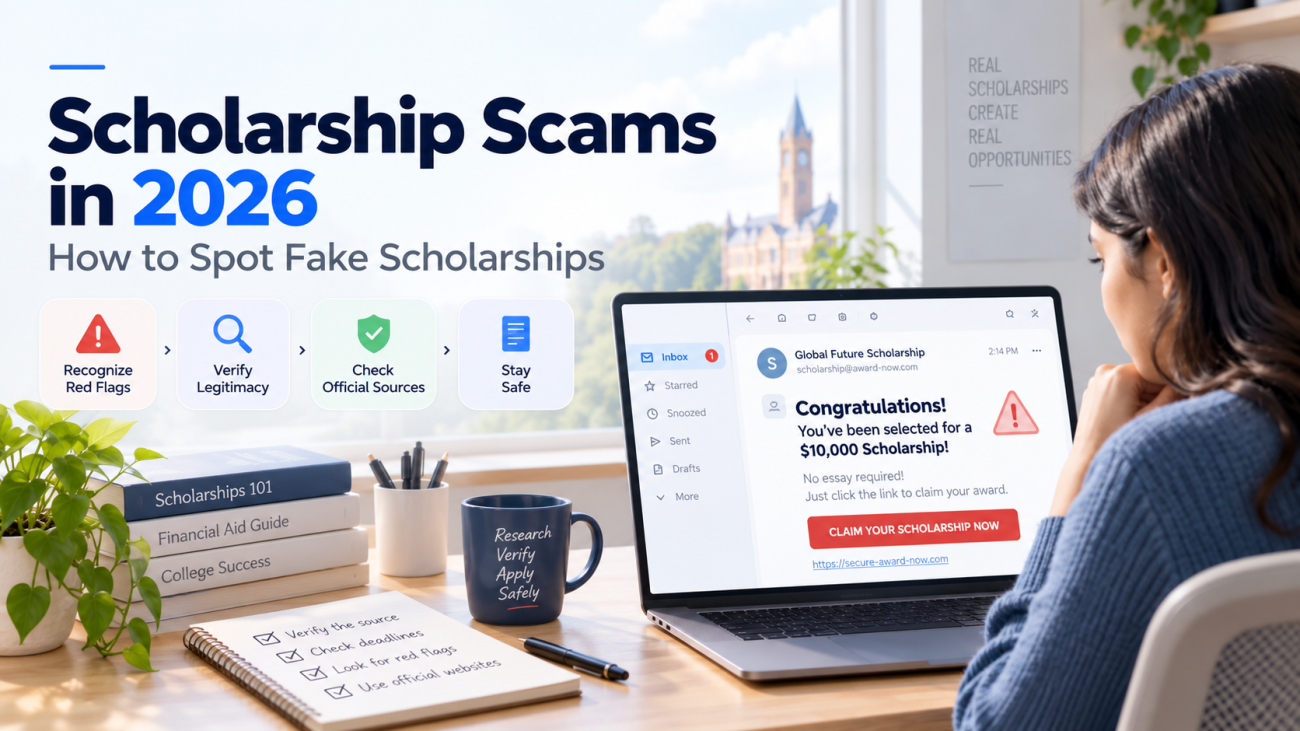
Finding a scholarship online can feel exciting.
You see a post that says:
“100% Fully Funded Scholarship 2026. No IELTS. Guaranteed Selection.”
The deadline is tomorrow.
The application link opens a professional-looking website.
There is a university logo.
There are photos of students.
Then you notice one small condition:
Pay a $75 processing fee to secure your scholarship application.
You start wondering whether the payment is normal.
Maybe the scholarship really does charge a small administrative fee.
Maybe you will lose the opportunity if you wait.
That pressure is exactly what makes scholarship scams dangerous.
Fake scholarship websites, impersonation emails, social media posts, and fraudulent agents can look convincing enough that even careful students hesitate.
Understanding scholarship scams in 2026 can help you verify opportunities before you send money, upload your passport, or share bank information.
This guide explains the most common warning signs, how to verify a scholarship, what information you should never share casually, and what to do if you think you have already paid a scammer.
What Is a Scholarship Scam?
A scholarship scam is a fraudulent offer designed to make students give away money, personal information, login credentials, or financial details.
The scammer may pretend to be:
- A university
- A government scholarship program
- A scholarship foundation
- An education consultant
- A financial aid service
- A scholarship search company
Some scams are obvious.
Others use real university names, copied logos, realistic emails, and professional websites.
The U.S. Federal Trade Commission warns that scholarship and financial-aid scams often begin through social media posts, emails, letters, phone calls, or events that appear to offer special scholarship opportunities. Consumer Advice
You can review the FTC’s official scholarship scam guidance before paying for an unfamiliar scholarship service.
Not Every Scholarship Fee Is Automatically a Scam
This distinction is important.
Universities can legitimately charge application fees for admission.
Credential evaluation services can charge fees.
English-language tests can charge fees.
Visa applications can charge fees.
That is different from someone saying:
Pay us $100 and we guarantee you a scholarship.
The FTC specifically warns against scholarship offers that require an upfront payment, “processing fee,” or “redemption fee” in exchange for guaranteed funding. Consumer Advice
Your site’s Scholarship Application Fee Waiver 2026 guide explains the difference between genuine university application fees and scholarship funding itself. Peggy Nelson Design
Red Flag 1: “Your Scholarship Is Guaranteed”
No legitimate scholarship committee can guarantee that you will win before evaluating your application.
Scholarships may consider:
- Academic results
- Essays
- Leadership
- Financial need
- Research potential
- Interviews
- References
That means a company promising:
“Guaranteed scholarship or your money back”
should immediately make you cautious.
The FTC specifically identifies guaranteed scholarship claims as a common scam sign. Consumer Advice
A real scholarship can explain its eligibility and selection criteria.
It cannot honestly promise every applicant an award.
Red Flag 2: You Won a Scholarship You Never Applied For
Imagine receiving an email:
Congratulations! You have been selected as a finalist for the International Excellence Scholarship.
You have never heard of the scholarship.
You never submitted an application.
The email then asks you to pay $50 to release the award.
That is a major warning sign.
The FTC warns about scammers telling people they are finalists for competitions they never entered. Consumer Advice
Before responding, search for the scholarship independently.
Do not click the link inside the email first.
Red Flag 3: You Must Pay to Release the Scholarship
This is one of the clearest warning signs.
Scammers may call the payment:
- Processing fee
- Registration fee
- Award activation fee
- Release fee
- Redemption fee
- Verification fee
The amount may be intentionally small.
$20 feels less suspicious than $2,000.
But the logic is the same.
The FTC’s current guidance says students should not pay upfront to apply for or claim a scholarship award and specifically warns about scholarships that require payment before funding is released. Consumer Advice
Red Flag 4: They Ask for Your Card or Bank Details to “Hold” the Scholarship
A fake provider may say:
We only need your card number to confirm eligibility.
or:
Enter your banking details so we can reserve the award.
Stop.
Banking information should only be provided through verified official systems when there is a legitimate reason.
The FTC warns that scholarship scammers sometimes ask for bank-account or credit-card information and later make unauthorized charges. Consumer Advice
Never provide financial details because someone is pressuring you to “secure” an opportunity.
Red Flag 5: Extreme Urgency
Scammers want you to act before you think.
Common messages include:
Offer expires in 30 minutes.
Last scholarship slot.
Pay immediately.
You will lose the funding if you contact the university directly.
Urgency does not automatically make something fake.
Real scholarships have deadlines.
The difference is that genuine programs normally publish deadlines in advance and give clear instructions.
The FTC advises students not to let high-pressure tactics force them into immediate payments or financial decisions. Consumer Advice
Red Flag 6: The Email Address Does Not Match the Organization
Suppose the scholarship claims to come from:
University of Example
but the email comes from:
That deserves verification.
Many legitimate universities use official institutional domains.
A real message might come from something like:
Still, do not rely only on the email domain.
Email addresses can be spoofed.
Go to the university’s official website independently and find the scholarship from there.
Red Flag 7: The Website Looks Almost Like the Real University Site
This is becoming more difficult to detect.
A scam website can copy:
- University logo
- Colors
- Staff photos
- Scholarship descriptions
The domain may be only slightly different.
For example:
Real:
university.edu
Fake:
university-scholarships2026.com
or:
universlty.edu
where one letter is changed.
Always check the full domain carefully.
Do not judge legitimacy from design quality.
A beautiful website can still be fake.
Red Flag 8: WhatsApp Is the Only Official Contact Method
WhatsApp itself is not automatically suspicious.
Universities and education organizations sometimes use messaging services.
The warning sign appears when:
- No official website exists
- No institutional email exists
- All payments happen through chat
- They refuse to communicate through official channels
For high-value scholarship funding, you should be able to verify the organization outside a messaging app.
Your Scholarship Overpayment in 2026 guide already warns students not to send supposed scholarship repayments through WhatsApp, cryptocurrency, gift cards, or unrelated personal accounts. Peggy Nelson Design
The same caution applies before you receive funding.
Red Flag 9: They Ask You to Pay a Person Instead of an Institution
Imagine receiving these payment instructions:
Send the application fee to Mr. John Smith’s personal account.
That is unusual for an official university scholarship.
A real institution may use:
- Official payment gateway
- University bank account
- Recognized payment platform
- Applicant portal
Before paying, verify the instructions from the university’s official website.
Your site’s accommodation guide makes the same point for housing deposits: verify the recipient before transferring money. Scholarship Accommodation in 2026 discusses how international students can be targeted by payment scams when arranging housing abroad. Peggy Nelson Design
Red Flag 10: The Scholarship Has No Clear Eligibility Criteria
Real scholarship programs usually explain who can apply.
You should be able to find information such as:
- Nationality requirements
- Study level
- Academic requirements
- Course restrictions
- Selection process
- Deadline
A fake scholarship may simply say:
Open to everyone worldwide.
No GPA required.
No documents.
Everyone has a high chance of winning.
Scholarships can have broad eligibility.
A complete absence of selection criteria is still worth questioning.
Your Scholarship Shortlisting in 2026 article explains why eligibility should be one of the first things students verify before applying. Peggy Nelson Design
Red Flag 11: The Award Amount Sounds Unrealistic
Be cautious with headlines such as:
$100,000 scholarship for every international student
or:
Full tuition + $5,000 monthly stipend, no academic requirements
Large scholarships exist.
Generous fully funded programs exist.
The issue is whether you can verify the offer through a credible institution.
Do not decide that something is real because the funding is exciting.
Confirm the source.
Red Flag 12: The Scholarship Has No History Anywhere Else
Search the scholarship name.
Look for:
- Official university page
- Government website
- Previous recipients
- Established foundation
- Independent references
A brand-new scholarship can be legitimate.
Still, if you find absolutely nothing beyond one suspicious website and several identical social media posts, be careful.
Search for the organization too.
How to Verify a Scholarship Step by Step
When you find an opportunity, do not start by uploading your passport.
Use a simple verification process.
Step 1: Search for the Scholarship Independently
Type the scholarship name into a search engine.
Do not rely only on the link from:
- Telegram
- TikTok
Try to find the official organization.
Step 2: Find the Scholarship Through the Official Website
If it claims to be a university scholarship, visit the university’s main website.
Then navigate to:
Admissions → Scholarships
or:
Financial Aid → International Students
If the scholarship exists only on a completely separate domain, investigate further.
Step 3: Check the Contact Information
Look for:
- Official email
- Phone number
- Physical institution
- Scholarship office
Compare them with the organization’s main website.
Step 4: Read the Eligibility Rules
Real opportunities normally explain who can apply.
Step 5: Check the Application Process
Does the application use:
- Official university portal?
- Recognized government portal?
- Established application platform?
Or does it simply say:
Send your passport and payment receipt through WhatsApp?
That difference matters.
Verify Before Uploading Your Passport
Scholarship applications sometimes legitimately require identity documents.
Still, a passport contains highly sensitive information.
Do not upload it to a website you have not verified.
A fake scholarship can collect passports for identity theft.
The same applies to:
- National ID
- Birth certificate
- Bank statement
- Academic transcript
Your Scholarship Document Translation in 2026 article advises students to submit academic and identity documents through official scholarship portals, university systems, verified institutional emails, or approved credential services rather than random channels.
Be Careful With Bank Statements
International scholarship applicants may legitimately need bank statements for:
- Admission
- Visa
- Proof of funds
That does not mean every scholarship application should ask for them.
If a scholarship asks for detailed financial records very early in the process, understand why.
Your Scholarship Proof of Funds in 2026 guide explains where financial evidence is actually used in university and immigration processes. Peggy Nelson Design
Never Share Account Passwords
No legitimate scholarship provider needs your:
- Gmail password
- University portal password
- Banking password
For U.S. federal aid, the FTC specifically warns students never to share their FSA ID username and password with companies or consultants. Consumer Advice
Treat login credentials like your bank PIN.
Keep them private.
What About Scholarship Consultants?
Not every consultant is a scammer.
A legitimate consultant might charge for services such as:
- Application review
- University counseling
- Document preparation
The dangerous claim is:
Pay us and we guarantee you the scholarship.
The FTC notes that legitimate scholarship search services may charge for access to databases or matching services, but they should not guarantee that a student will receive a scholarship. Consumer Advice
If you use a consultant, understand what you are paying for.
You are paying for a service.
Not guaranteed selection.
What About Scholarship Search Websites?
Many are legitimate.
A scholarship directory may collect opportunities from universities and foundations.
Still, always confirm the final details on the original provider’s website before applying.
Scholarship listings can become outdated.
A deadline may change.
Funding may change.
Eligibility may change.
Use directories to discover opportunities.
Use official sources to verify them.
What About Scholarships Advertised on Facebook?
A Facebook post is not proof of legitimacy.
It can still lead to a real opportunity.
The correct process is:
Social post → Find official organization → Verify scholarship → Apply through official route
Do not go:
Social post → WhatsApp agent → Pay immediately
Treat social media as discovery, not verification.
What About Telegram Scholarship Groups?
The same rule applies.
These groups can be useful for:
- Opportunity sharing
- Deadline reminders
- Student experiences
They should not become your final authority.
Someone saying:
This scholarship is guaranteed. I paid this agent.
does not make it official.
AI Can Make Scholarship Scams More Convincing
This is increasingly important.
Scammers can now create:
- Professional websites
- Polished emails
- Fake support chats
- Realistic scholarship letters
- Fake testimonials
Language quality is no longer a reliable scam detector.
Older advice often said:
Scam emails have bad grammar.
Some still do.
Many no longer do.
Verification matters more than grammar.
Fake Scholarship Award Letters
A scammer may send you a PDF saying:
Congratulations. You have received a $40,000 scholarship.
The document may contain:
- Logo
- Signature
- Stamp
- Reference number
Then it asks for a fee.
Do not assume the PDF proves anything.
Contact the scholarship provider using contact information you found independently.
Your Scholarship Award Letter in 2026 guide explains what genuine award letters often contain and what students should verify before accepting funding. Peggy Nelson Design
Fake “Scholarship Overpayment” Scams
The scam can continue even after someone claims you have won.
A fake scholarship might send you money or a fraudulent payment.
Then someone says:
We accidentally sent too much. Send part of it back.
This can be extremely dangerous.
If the original payment is later reversed or turns out to be fraudulent, you may lose the money you sent back.
Never return supposed scholarship money through unofficial channels.
Your Scholarship Overpayment in 2026 article explains how to verify genuine overpayment requests before returning funds. Peggy Nelson Design
Fake Agents Pretending to Represent Universities
Someone may introduce themselves as:
Official admission representative.
Ask for proof.
Then verify it with the university.
Do not rely only on:
- Business card
- Facebook page
- LinkedIn title
Contact the institution.
Ask:
Is this person or organization an authorized representative?
A two-minute verification can protect a large amount of money.
What If the Scholarship Has an Application Fee?
Do not automatically assume fraud.
Instead, verify:
Who charges the fee?
Why?
Is it on the official site?
Is payment made through the official portal?
Some admission applications have legitimate fees.
A scholarship itself requiring payment to “unlock” funding is much more suspicious.
Keep those two processes separate.
What If a Scholarship Asks for Money After You Win?
Read the award carefully.
A genuine funded student may still need to pay expenses such as:
- Visa
- Housing deposit
- University deposit
- Insurance
Whether the scholarship reimburses those expenses depends on the award.
That is very different from:
Pay us a scholarship activation fee.
Your Scholarship Budget Planning in 2026 guide helps students identify legitimate expenses that can remain even after receiving funding. Peggy Nelson Design
Ask the Scholarship Office Directly
When in doubt, write:
Dear Scholarship Team,
I found an advertisement for the [Scholarship Name] and would like to verify whether it is an official scholarship offered by your institution. The advertisement is requesting a [amount] processing fee. Could you please confirm whether this is legitimate and whether the application link is officially associated with your organization?
Thank you.
Use an email address found on the institution’s real website.
Do not reply to the suspicious email itself.
Search the Exact Email Address
You can sometimes discover scam reports by searching:
in quotation marks.
Also search:
Scholarship Name scam
Organization Name reviews
Be careful with reviews too.
Scammers can create fake positive testimonials.
Official verification is still stronger.
Check the Domain Age and Organization
Technical checks can sometimes help.
A university that has existed for decades is unlikely to have launched its main website last week.
You do not need to become a cybersecurity expert.
If something feels inconsistent, investigate.
Still, domain age alone does not prove legitimacy or fraud.
Use it as one signal.
What to Do If You Already Paid a Scholarship Scammer
Act quickly.
The FTC recommends contacting the company or payment service you used as soon as possible because recovery may become harder with time. Consumer Advice
Depending on how you paid, contact:
- Bank
- Credit-card company
- Payment app
- Money-transfer service
Tell them you believe the transaction was fraudulent.
Ask whether it can be reversed.
If You Shared Your Card Details
Contact your bank immediately.
Ask whether the card should be:
- Frozen
- Replaced
- Monitored
Review your transactions.
Do not wait for the scammer to use the card.
If You Shared a Password
Change it immediately.
Also change the password anywhere else you reused it.
Enable two-factor authentication where possible.
If the account contains university or financial information, check for unauthorized changes.
If You Shared Your Passport or Identity Documents
The situation is more serious.
Keep records of what you sent.
Contact relevant authorities or institutions if there is evidence of misuse.
Monitor for:
- Fake accounts
- Suspicious banking activity
- Unauthorized applications
Identity theft can appear later.
Report the Scam
In the United States, the FTC asks people to report scholarship and financial-aid fraud through its official fraud-reporting system. Consumer Advice
If you are outside the U.S., report the incident to the relevant cybercrime, consumer-protection, police, or financial authority in your country.
You can also inform the real university or scholarship organization if scammers are using its name.
Keep Evidence
Save:
- Emails
- Screenshots
- Website address
- Payment receipt
- Phone numbers
- Messages
- Account information
Do not delete everything because you feel embarrassed.
The evidence may help your bank or authorities investigate.
Do Not Feel Pressured to Hide the Mistake
Smart people get scammed.
Scholarship scams work because they target something students care deeply about:
Education.
Funding.
A better future.
A person who has spent months searching for scholarships may be more willing to believe an offer when it finally appears.
The useful response is to act quickly once you notice the warning signs.
A 60-Second Scholarship Verification Test
Before applying, ask yourself:
| Question | What you want to see |
|---|---|
| Can I find the scholarship on the official institution website? | Yes |
| Are the eligibility rules clearly published? | Yes |
| Is there a real application deadline? | Yes |
| Is the application portal connected to the official organization? | Yes |
| Can I verify contact details independently? | Yes |
| Am I being promised guaranteed selection? | No |
| Am I being pressured to pay immediately? | No |
| Am I being asked to pay a person privately? | No |
If several answers look wrong, stop and verify before proceeding.
Scholarship Scam Checklist for 2026
Before sending money or sensitive documents, make sure:
- I found the scholarship on an official source.
- I checked the full website domain.
- I verified the organization’s contact information.
- The eligibility rules are clear.
- The deadline is published.
- There is no guaranteed-selection promise.
- I am not paying an unexplained “award release” fee.
- Payment instructions come from an official source.
- I am not sharing passwords.
- I know why any passport or financial documents are required.
- I checked suspicious emails independently.
- I saved evidence of important transactions.
If you still feel uncertain, do not rush.
A legitimate scholarship will survive a few minutes of verification.
Frequently Asked Questions About Scholarship Scams
Do legitimate scholarships charge application fees?
Some university admission applications charge legitimate fees, but genuine scholarships should not promise funding in exchange for an upfront “processing” or “release” payment. The FTC specifically warns against pay-to-win scholarship offers. Consumer Advice
How can I tell if a scholarship website is fake?
Check whether the scholarship appears on the official university, government, or foundation website. Verify the domain and contact details independently.
Is a scholarship advertised on Facebook automatically fake?
No. Social media can promote legitimate opportunities. Verify the scholarship through the official provider before applying or sending money.
Can a real scholarship ask for bank details?
A legitimate provider may eventually need banking information to pay an award. That information should be requested through a verified official process, not simply to “reserve” a scholarship.
What if I receive a scholarship offer without applying?
Treat it cautiously. The FTC specifically warns about fake awards claiming applicants are finalists for competitions they never entered. Consumer Advice
Are scholarship consultants legitimate?
Some are. A legitimate consultant may charge for advice or application services. Be cautious when anyone guarantees that paying them will result in a scholarship.
Can fake scholarships steal identity documents?
Yes. Fraudsters may collect passports, banking information, and personal details through fake applications.
What should I do if I already sent money?
Contact your bank or payment provider immediately, preserve evidence, and report the suspected fraud to the relevant authorities.
Final Thoughts
Scholarship scams in 2026 are becoming harder to judge by appearance alone.
A fake opportunity can have:
A professional website.
A convincing logo.
A polished email.
A realistic scholarship letter.
The best protection is not trying to decide whether the design “looks real.”
Verify the source.
Find the scholarship through the official institution.
Check the domain.
Read the eligibility criteria.
Question guaranteed awards.
Never pay unexplained activation or processing fees.
Protect your passwords and identity documents.
Most importantly, do not let urgency make the decision for you.
A real scholarship opportunity is worth applying for.
A fake one is not worth risking your money or identity.
Add a Comment