
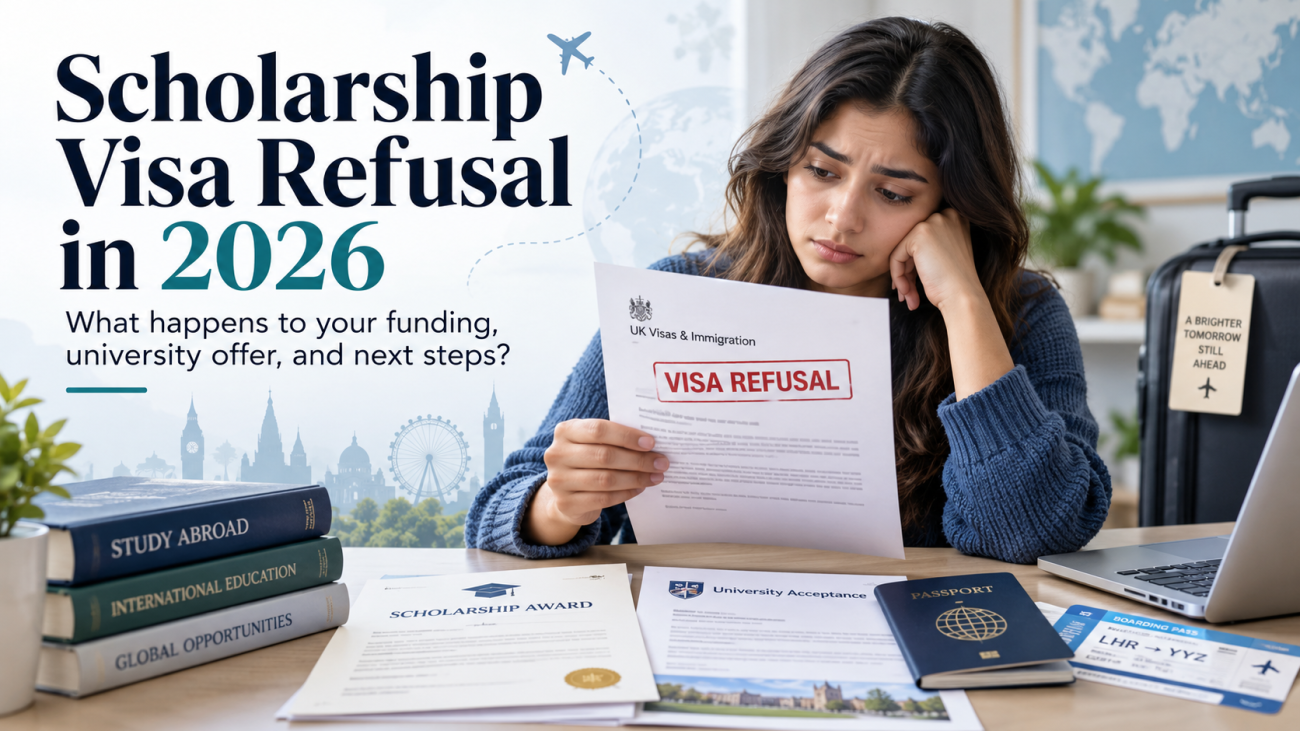
You win the scholarship.
Your university place is confirmed.
You receive your CAS or admission documents.
You arrange accommodation.
Your family starts preparing for your departure.
Then the visa decision arrives.
Refused.
For a few minutes, everything can feel as though it has collapsed at once.
You may immediately start wondering:
Have I lost my scholarship?
Should I apply for the visa again?
Can I ask the embassy to reconsider?
Will my university keep my place?
What happens to the tuition deposit I already paid?
Can the scholarship be moved to next year?
A scholarship visa refusal in 2026 does not always mean the end of your study-abroad plan.
It does mean you need to respond carefully.
The next step depends on why the visa was refused, which country you planned to study in, how much time remains before your course begins, and whether your scholarship permits delayed arrival, a new visa application, or deferral.
This guide explains what to do after a student visa refusal, how to protect your scholarship and university place, when a review may be possible, what happens to tuition deposits, and why you should never rush into a second visa application without first understanding what went wrong.
A Scholarship Does Not Guarantee a Student Visa
This is one of the most important things to understand before applying abroad.
Winning a prestigious scholarship can strengthen parts of your financial documentation.
It does not remove immigration requirements.
The immigration authority still decides whether you qualify for the visa.
For example, Chevening tells scholars that they must personally apply for their UK Student visa and that Chevening cannot apply on their behalf. Scholars need both their Final Award Letter and Confirmation of Acceptance for Studies before submitting the application. Chevening
Chevening also specifically warns applicants to complete the form fully, honestly, and accurately and provide evidence in the format required by UK Visas and Immigration. Chevening
So these are two different decisions:
Scholarship decision: The funding organization wants to support you.
Visa decision: The immigration authority decides whether you can legally enter and study in the country.
Receiving the first does not automatically guarantee the second.
First, Read the Visa Refusal Letter Properly
Do not start a new application five minutes after receiving the refusal.
Open the decision letter and read the exact reason.
A visa refusal is not simply:
Your application was unsuccessful.
The letter should explain the basis for the decision and, depending on the immigration system, what review or appeal rights may be available.
For a UK visa refusal, the decision letter should tell you whether you can request an administrative review. GOV.UK currently says an administrative review is intended to determine whether an eligible immigration decision was wrong because of a caseworking error. GOV.UK
That means your first task is understanding:
What exactly did the decision-maker believe was wrong?
Only then can you decide what to do next.
Common Reasons a Student Visa Can Be Refused
The specific reasons vary by country and application.
A refusal might relate to financial evidence, incorrect documents, insufficient evidence, inconsistencies in information, immigration history, credibility concerns, missing documents, or another eligibility requirement.
For scholarship recipients, financial evidence can sometimes be simpler because qualifying official sponsorship may cover part of the requirement.
That does not mean the rest of the application can be careless.
A mismatch between your passport, university documents, scholarship letter, and visa form can create unnecessary problems.
Your existing Scholarship Documents Checklist is useful before the visa stage because many documents originally prepared for the scholarship are needed again for university and immigration processes. Scholarship Documents Checklist 2026
Do Not Guess Why You Were Refused
Suppose your refusal letter says:
The submitted financial evidence did not satisfy the requirement.
Do not immediately assume:
I need more money.
The actual issue might be:
The statement covered the wrong dates.
The account was not accepted.
The scholarship letter did not contain the required information.
The evidence did not meet the format rules.
There is a big difference between:
Not having enough money
and
failing to prove the money correctly.
Fixing the wrong problem can lead to another refusal.
Tell Your Scholarship Provider Immediately
Once you understand the refusal, contact your scholarship provider.
Do not hide it.
Your scholarship may have:
A latest arrival date.
A visa deadline.
A pre-departure process.
A policy for immigration problems.
A condition stating that the award depends on being able to obtain the required visa.
Current Chevening terms, for example, make the award dependent in part on the scholar’s ability to obtain the relevant UK entry clearance. Chevening
That means a visa problem can directly affect whether the scholarship can proceed.
The faster the scholarship team knows, the more time there may be to identify realistic options.
Tell Your University Too
Your scholarship office is not the only organization that needs to know.
Contact your university’s international or admissions team.
Tell them:
Your visa was refused.
The date of the decision.
The reason given.
Whether you plan to request a review or make a new application.
Ask:
What is the latest date I can arrive and still enroll?
This question is extremely important.
Even if a new visa is possible, it may be useless if the university will no longer allow you to begin the course.
Your university may also need to advise you about your CAS or equivalent immigration document.
Do not assume the same document can automatically be reused.
Scholarship, University, and Immigration Timelines Must All Match
Think of the situation as three clocks.
Clock 1: Scholarship start requirements.
Clock 2: University enrollment and latest-arrival requirements.
Clock 3: Visa processing or review.
Your solution only works if all three clocks still fit.
Imagine:
University latest arrival: September 30
Scholarship latest arrival: October 2
New visa decision expected: October 20
Even if your second visa application succeeds, you may no longer be able to take up the course.
This is why visa strategy cannot be separated from university and scholarship deadlines.
What Is a UK Administrative Review?
If you applied for a UK visa from outside the UK and your decision is eligible, you may be able to request an administrative review.
GOV.UK currently says applicants outside the UK generally have 28 days after receiving the refusal decision to request an administrative review. The fee is currently £80. GOV.UK
An administrative review is not simply:
Please give me another chance.
Its purpose is to challenge an eligible decision where you believe there was a caseworking error.
That distinction matters.
If the refusal happened because you forgot to provide required evidence, administrative review may not necessarily be the correct solution.
If you believe the decision-maker made an error despite the correct evidence already being provided, review may be more relevant.
Administrative Review Can Take a Long Time
This is particularly important for scholarship students.
Current GOV.UK guidance warns that an administrative review requested from outside the UK can take 12 months or more to receive a decision. It says the Home Office will provide an update if there is no decision within six months. GOV.UK
Now think about that timeline.
Your master’s course begins in September.
Your review might take many months.
This is why the fact that a review is legally available does not automatically mean it is the practical best option for your scholarship.
You need to discuss the timeline with:
Your university.
Your scholarship provider.
A qualified immigration adviser if necessary.
Administrative Review Deadlines Are Different Inside the UK
For eligible refusal decisions made on applications submitted from inside the UK, current GOV.UK guidance normally gives 14 days from receiving the decision to request an administrative review. GOV.UK
This differs from the 28-day period for eligible applications refused outside the UK.
Always use the rules matching your actual circumstances.
Do not rely on:
My friend had 28 days.
Your friend may have applied from a different location or through a different immigration route.
Should You Request Administrative Review or Apply Again?
This is one of the most difficult questions.
There is no universal answer.
The decision depends on:
Why you were refused.
Whether a review is available.
Whether the decision contains an actual caseworking error.
Whether the problem can be fixed more easily with a new application.
How much time remains before university enrollment closes.
For an outside-UK administrative review, GOV.UK currently warns that making another immigration or visa application while an administrative review is pending will cause the review to be withdrawn. GOV.UK
That means you should not casually do both at the same time.
This is a situation where professional immigration advice can be worthwhile.
A New Visa Application Does Not Erase the Previous Refusal
Suppose your first application is refused.
You decide to reapply.
Your second application should address the original problem directly.
Do not simply upload the same documents and hope another caseworker reaches a different conclusion.
If the refusal involved financial evidence, correct the evidence.
If information was inconsistent, resolve the inconsistency.
If a required document was missing, provide it properly.
Where the new application asks about previous immigration refusals, answer honestly.
Trying to hide a previous refusal can create a much bigger problem than the original refusal.
Never Alter a Document to Fix the Refusal
You may feel desperate.
That is exactly when bad decisions become tempting.
Do not:
Edit a bank statement.
Change employment dates.
Modify an academic transcript.
Create a fake sponsorship letter.
Alter a CAS or university document.
A document problem can often be fixed.
Document fraud can damage current and future immigration applications.
Chevening’s current visa guidance specifically instructs scholars to complete their visa applications fully, honestly, and accurately. Chevening
That principle applies regardless of the scholarship.
What Happens to Your Scholarship After a Visa Refusal?
It depends on the scholarship terms.
Possible outcomes include:
The scholarship remains active while you resolve the visa issue.
You receive additional time to obtain the visa.
You are unable to begin that intake and must withdraw.
The scholarship considers a deferral.
The award is cancelled because immigration clearance cannot be obtained.
Do not assume any one of these outcomes.
Chevening is a useful example of why award terms matter. Its current bilateral award terms state that the scholarship depends on the scholar being able to obtain relevant UK entry clearance. Chevening
This means visa approval is not merely an optional administrative detail.
It can be part of the conditions required to use the award.
Can You Defer the Scholarship After a Visa Refusal?
Sometimes, depending on the scholarship.
But university deferral and scholarship deferral are separate.
Your university might say:
We can move your admission to September 2027.
Your scholarship might say:
The funding cannot be moved.
Now you have admission without funding.
That is why you should never defer your university place first and tell the scholarship provider later.
Your existing deferral guide explains this distinction in detail and is worth linking directly from this section. Can You Defer a Scholarship in 2026?
Ask the scholarship provider first:
If I cannot obtain my visa in time because of the refusal, can the award be deferred to the next intake?
Get the answer in writing.
Chevening Deferral Is Particularly Restricted
Do not assume a Chevening award can simply move to next year because of a visa problem.
Current Chevening bilateral award terms say deferral is generally limited, with pregnancy forming the stated basis for deferral under those terms. Other selected candidates who cannot take up the award normally need to withdraw and reapply in a future year. Chevening
The exact terms governing your own award cycle should always be checked.
This is why scholarship conditions should be read before accepting, not only when something goes wrong.
What Happens to Your University Offer?
A visa refusal does not always cancel the admission offer immediately.
The university may give you time to resolve the issue.
But there will normally be a practical deadline.
The university cannot necessarily allow you to arrive halfway through a course.
Ask for these details immediately:
Latest permitted arrival date
Whether the existing CAS remains valid
Whether a new CAS would be needed
Whether deferral is available
Whether tuition or deposit payments are refundable
Get specific dates.
“Come as soon as possible” is not a useful immigration plan.
What Happens to Your Tuition Deposit?
This depends on the university’s refund policy.
Some universities allow deposit refunds when a genuine visa application is refused and another application is not realistically possible.
UCL’s current deposit FAQ lists a good-faith failure to secure the necessary clearance to enter the UK as one of the circumstances in which a tuition fee deposit can be refundable. University College London
Other UCL course guidance similarly requires evidence such as the formal refusal of entry-clearance letter for relevant visa-based refund claims. University College London
This does not mean every university has the same rule.
Before paying any university deposit, read the refund policy.
Keep Your Visa Refusal Letter
Do not delete it because the result is disappointing.
The refusal document may later be needed for:
A university deposit refund.
A new visa application.
An administrative review.
A scholarship explanation.
Immigration advice.
Create a folder containing:
Your original visa application documents.
Visa refusal letter.
Scholarship award letter.
University offer.
CAS or equivalent document.
Relevant financial evidence.
Emails with the university and scholarship provider.
Your existing post-win guide is useful here because it covers the broader sequence from scholarship acceptance to visa and arrival. What to Do After Winning a Scholarship in 2026
What If You Already Paid Tuition?
Suppose you paid:
Deposit: £3,000
First tuition installment: £8,000
Then the visa was refused.
Do not assume both amounts follow the same refund rule.
A university can treat:
Deposit
and
Tuition payment
differently.
Check the university’s formal student-fee and refund policies.
UCL, for example, distinguishes its tuition-fee payment and refund process from the specific tuition-deposit refund process. University College London
Contact the university finance team and provide the refusal evidence they request.
What If Your Scholarship Paid the Tuition Already?
Contact the scholarship provider and university.
Do not try to request the scholarship-funded tuition as a personal refund.
The scholarship provider may need to recover the money directly from the university.
Scholarship funds do not automatically become your personal money simply because you could not travel.
Your award agreement should determine what happens.
This is exactly why understanding your funding letter matters. Scholarship Award Letter in 2026
What If Your Visa Is Delayed Rather Than Refused?
A delay is a different problem.
You still need to consider:
University latest-arrival date.
Scholarship start date.
Accommodation booking.
Flight.
But you do not yet have a negative immigration decision to correct.
Contact both the university and scholarship provider if the delay begins threatening your arrival timeline.
Chevening also makes clear that it does not control the speed or outcome of the UK visa process. Chevening
Do not assume your scholarship provider can simply call immigration and approve the visa.
Do Not Book a Non-Refundable Flight Too Early
A scholarship winner may feel confident enough to book immediately.
Be careful.
Until your visa or travel authorization is secured, expensive non-refundable travel can create unnecessary risk.
If you need to book before receiving the visa, understand:
Cancellation rules.
Change fees.
Travel insurance.
Scholarship reimbursement rules.
An airline ticket does not influence the visa decision.
What Happens to Accommodation After a Visa Refusal?
This depends on your contract.
University accommodation may have specific visa-refusal clauses.
Private landlords may not.
Before paying a large housing deposit, ask:
What happens if my student visa is refused?
Get the answer in writing.
Some accommodation providers may accept an official refusal letter.
Others may retain part or all of the deposit depending on the contract.
Do not assume scholarship status protects you from an ordinary housing contract.
What Happens to Your Family’s Plans?
Visa refusal affects more than the scholar when dependants are involved.
Your spouse may have:
Resigned from a job.
Applied for a dependant visa.
Booked travel.
Your child may have school plans.
Do not continue spending on dependant arrangements until you know whether your own visa situation can be resolved.
Your family applications may depend on the main student’s immigration status.
This is one reason family planning should follow confirmed immigration progress rather than only scholarship selection.
Can a Scholarship Provider Get Your Visa Approved?
Normally, no.
A scholarship provider can provide supporting documents.
It can confirm:
Funding.
Award status.
Program dates.
It does not replace the immigration authority.
Chevening explicitly states that it cannot apply for the visa on a scholar’s behalf. It also says it has no influence over the speed or outcome of the visa process. Chevening
If someone tells you:
Pay me and I can ask the scholarship office to guarantee your visa,
be extremely cautious.
Your Scholarship Scams guide covers this kind of payment pressure and impersonation risk. Scholarship Scams in 2026
Can Your University Reverse the Refusal?
No.
Your university can provide documents and guidance.
It cannot directly reverse an immigration decision.
It may help you identify:
CAS errors.
Course information.
Incorrect sponsor information.
It may issue new immigration documentation when appropriate.
The actual immigration decision belongs to the government authority.
Keep the responsibilities separate.
Check Whether the Refusal Came From Your Error or Their Error
This distinction is useful when deciding your next move.
Imagine two cases.
Case A
You uploaded an incorrect bank statement.
A fresh application with correct evidence may be relevant, subject to current immigration advice and deadlines.
Case B
You submitted the correct evidence, but the refusal appears to misunderstand information already provided.
An administrative review might be relevant if the decision is eligible and there appears to be a caseworking error.
This is why copying another student’s solution can be dangerous.
Two refusal letters can look similar while requiring completely different responses.
Do Not Copy Visa Advice From Facebook Comments
You post:
UK student visa refused. What should I do?
Within ten minutes:
Reapply immediately.
Never reapply. Do administrative review.
Change the bank account.
Appeal.
Email the embassy.
These people have not seen your decision letter.
Immigration strategy should be based on the actual refusal reason.
Use official immigration guidance and qualified professional advice where needed.
Administrative Review Is Not a Full New Application
This matters.
A review examines an eligible decision under the applicable rules.
A new application asks immigration to assess a new application based on the materials submitted.
They serve different purposes.
Current UK Immigration Rules describe administrative review as determining whether an eligible decision was wrong because of a caseworking error. GOV.UK
Do not use the phrase:
appeal the visa
when the actual process available to you is something different.
Read the refusal letter.
Do Not Miss the Review Deadline While You Decide
If an administrative review is available, record the deadline immediately.
For eligible outside-UK cases, current guidance uses a 28-day deadline.
For eligible in-country cases, current guidance generally uses 14 days. GOV.UK
Do not spend three weeks asking Facebook what to do and then discover the legal deadline has expired.
Even if you ultimately decide not to request review, know how much time you have to make that decision.
Do You Need an Immigration Lawyer?
Not every refusal requires one.
A straightforward documentary issue may be manageable with official guidance and university immigration support.
Professional advice becomes more useful when:
The refusal reason is complicated.
There is an allegation of deception.
Your immigration history is complex.
You are uncertain whether review or reapplication is better.
Your scholarship depends on resolving the issue urgently.
If using an adviser, verify that they are properly authorized in the relevant jurisdiction.
Do not send sensitive documents and large fees to a stranger from a WhatsApp group.
What If the Refusal Mentions False Information?
Treat this seriously.
There is a major difference between:
You forgot a document
and
Immigration believes false information or deception was involved.
Do not send another application without understanding the implications.
Seek qualified immigration advice.
Future applications may ask about the refusal and the issue could affect more than the current course.
Never attempt to fix an allegation of false information by submitting more false information.
What If the Refusal Was Caused by a University Error?
Contact the university immediately.
Imagine your CAS contains:
Wrong course dates.
Incorrect tuition information.
Wrong scholarship payment.
If that contributed to the refusal, you may need corrected sponsorship documentation.
Ask the university international office to review the refusal letter.
Save all correspondence.
Do not edit university documents yourself.
What If Your Scholarship Letter Was Incorrect?
The same principle applies.
Suppose the award letter shows:
£15,000 tuition coverage
but your actual scholarship is:
Full tuition of £30,000
If the incorrect funding information affected the application, contact the scholarship provider.
Ask for a corrected official document.
Do not modify the PDF yourself.
What If the Visa Refusal Comes Very Close to the Course Start?
Time becomes the main problem.
Ask the university immediately:
What is my absolute latest arrival date?
Then work backward.
If you cannot realistically receive a new immigration decision before that date, continuing to spend money on travel and accommodation may not make sense.
You may need to discuss withdrawal or deferral.
Your scholarship provider must be part of that decision.
A Visa Refusal Can Affect Scholarship Acceptance Conditions
Some scholarship awards remain conditional until specific requirements are completed.
Chevening candidates, for example, should not apply for their visa until they have received their Final Award Letter and their university CAS. Chevening
This ordering matters.
Trying to rush into a visa application before the scholarship and university documents are finalized can create avoidable problems.
Always follow the sequence provided by the scholarship.
Can You Reapply for the Scholarship Next Year?
Potentially, depending on the scholarship.
If a visa problem means you cannot take up the award and deferral is unavailable, a future scholarship application might still be possible.
Do not assume your previous selection guarantees another award.
You may need to compete again from the beginning.
If you are eventually unable to proceed, save:
Your essays.
CV.
References.
Scholarship application.
Interview notes.
These can make a future application much easier.
Does a Visa Refusal Mean Your Scholarship Application Was Weak?
No.
These are separate assessments.
You already won the scholarship.
A visa refusal means an immigration requirement was not satisfied or the immigration authority reached a negative decision.
Do not rewrite your scholarship CV because your visa was refused unless the underlying problem actually relates to information used across both processes.
Focus on the reason stated in the decision.
What If You Lose the Scholarship Because of the Visa?
That is painful.
But you still have useful assets.
You may have:
A strong university admission profile.
A successful scholarship application.
Good recommendation letters.
A strong personal statement.
Interview experience.
These can all help in another funding cycle.
Your Scholarship Rejection guide focuses on unsuccessful scholarship outcomes, but its broader principle applies here too: preserve strong application materials and identify what can be improved rather than starting emotionally from zero. Scholarship Rejection in 2026
A Practical Example
Imagine you are awarded a fully funded UK scholarship.
You have:
University unconditional offer
Scholarship confirmation
CAS
Scholarship funding letter
You apply for the visa.
The application is refused because the decision says an important financial document did not meet the requirement.
Your course starts September 20.
University latest arrival is October 5.
The wrong response is:
I will immediately submit the same visa application tomorrow.
A better process is:
Read the refusal carefully.
Send it to the university immigration team.
Notify the scholarship provider.
Confirm whether the financial requirement should have been satisfied by your official sponsorship.
Check whether the decision is eligible for administrative review.
Compare review timing against October 5.
Determine whether a corrected new application is permitted and more realistic.
Only then choose the next route.
The purpose is not to move quickly.
It is to move correctly.
What to Do in the First 48 Hours After a Scholarship Visa Refusal
Here is the one checklist worth saving:
- Read the complete refusal letter and identify every stated reason.
- Save the refusal letter and your original application documents.
- Check whether the decision gives you review or appeal rights.
- Record the exact review deadline.
- Notify your scholarship provider.
- Notify the university’s international or visa team.
- Ask for the university’s latest permitted arrival date.
- Check whether your CAS or equivalent document remains valid.
- Do not submit a second visa application until you understand the first refusal.
- Check accommodation and flight cancellation policies.
- Check tuition-deposit refund rules.
- Get regulated immigration advice if the refusal is complex or alleges deception.
This is much safer than panicking and starting over immediately.
Frequently Asked Questions About Scholarship Visa Refusal
Will I automatically lose my scholarship if my visa is refused?
Not necessarily. The outcome depends on the scholarship’s conditions, the reason for refusal, and whether the visa problem can be resolved before the required start date. Some awards are conditional on obtaining immigration clearance, so you should contact the scholarship provider immediately.
Can a scholarship guarantee my student visa?
No. A scholarship can provide funding and supporting documents, but immigration authorities make the visa decision. Chevening explicitly states that scholars apply for their own visa and that Chevening does not control the outcome. Chevening
Can I request an administrative review after a UK Student visa refusal?
If your decision is eligible, the refusal letter should tell you. Current GOV.UK guidance gives eligible applicants outside the UK 28 days to request an administrative review. GOV.UK
How much does a UK administrative review cost?
Current GOV.UK guidance lists the fee as £80. GOV.UK
How long does UK administrative review take?
Current government guidance warns that outside-UK administrative reviews can take 12 months or more. That timing can make them impractical for a course starting soon, so discuss your situation with your university, scholarship provider, and qualified immigration adviser where appropriate. GOV.UK
Can I submit a new UK visa application while administrative review is pending?
Current GOV.UK guidance says making another immigration or visa application while an outside-UK administrative review is pending will cause the review to be withdrawn. GOV.UK
Can I get my tuition deposit back if my visa is refused?
Possibly. Policies differ by university. UCL currently includes good-faith failure to obtain the necessary entry clearance among circumstances in which its tuition deposit can be refundable, subject to its conditions. University College London
Can I defer my scholarship because of visa refusal?
Possibly for some scholarships, but never assume. University deferral does not automatically defer scholarship funding. Check both organizations before changing your admission date.
Should I reapply immediately after visa refusal?
Not until you understand why the first application failed. A second application that repeats the same problem can result in another refusal.
Should I tell future visa applications about this refusal?
Where an application asks about previous refusals, answer truthfully. Do not hide immigration history.
Final Thoughts
A scholarship visa refusal in 2026 is serious.
It is not always final.
The biggest mistake is treating the refusal as an emergency that must be fixed within hours.
First understand the decision.
Then connect the three systems involved:
Immigration
University
Scholarship
Your visa strategy needs to fit your university’s latest arrival date.
Your university plan needs to fit your scholarship conditions.
Your scholarship needs to remain valid while the immigration problem is resolved.
For the UK, an eligible administrative review can sometimes challenge a caseworking error, but current guidance warns that the process may take 12 months or more. GOV.UK
That makes timing especially important for students whose course begins in a few weeks.
Read the refusal.
Save your documents.
Contact the scholarship provider.
Contact the university.
Do not falsify or alter anything.
Do not blindly copy another student’s solution.
And do not submit the same application again without understanding why it failed.
Winning a scholarship means you already completed one of the hardest stages.
If the visa creates a problem afterward, your best chance of protecting that opportunity comes from responding carefully, accurately, and early.
Add a Comment