
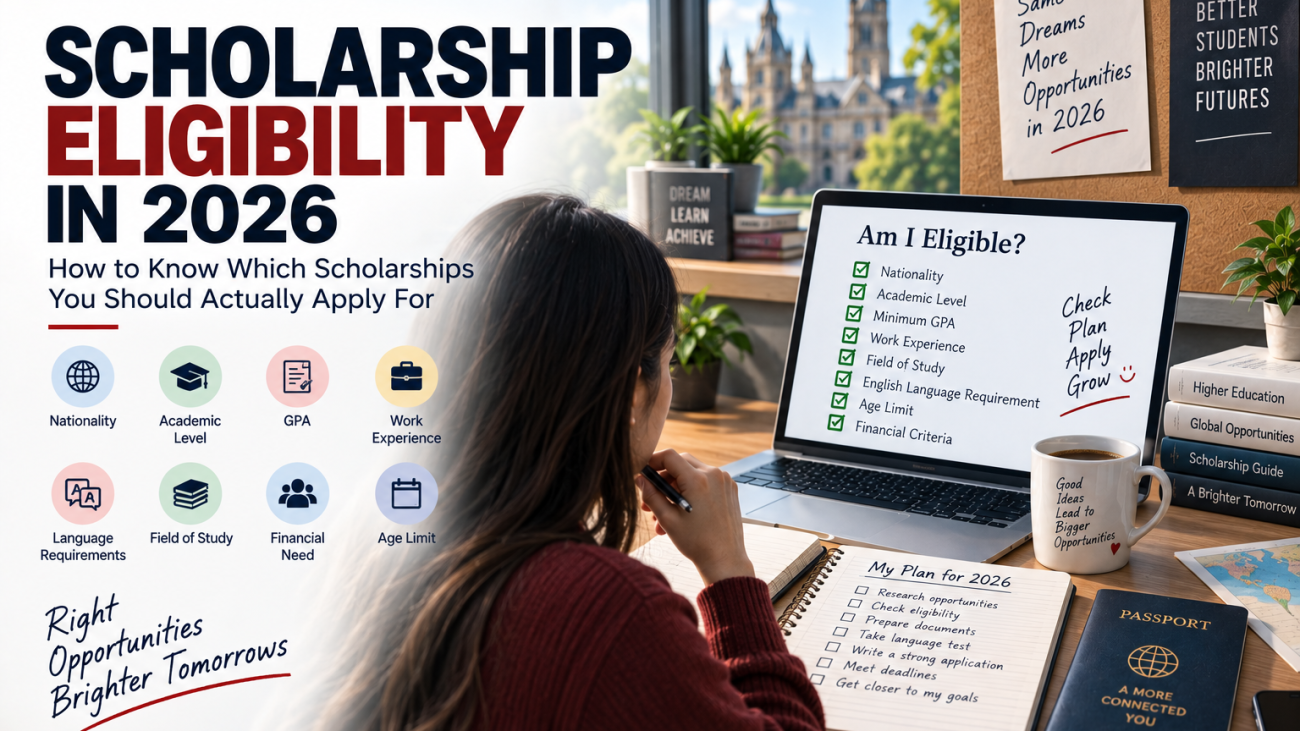
One of the biggest mistakes students make when searching for scholarships is applying to everything they see.
At first, that approach can feel productive.
You find a list of 50 scholarships, open 20 tabs, save a few posts from Facebook or LinkedIn, and start thinking:
“Maybe I should just apply to all of them.”
But scholarship applications take time.
You may need to prepare essays, recommendation letters, transcripts, test scores, CVs, research proposals, and application forms.
If you spend that time on scholarships you were never eligible for, you are not improving your chances. You are just creating more work.
Understanding scholarship eligibility in 2026 can help you focus on opportunities where you actually have a realistic chance.
This guide explains how to read eligibility requirements properly, which criteria matter most, how to avoid wasting time, and how to decide whether a scholarship is worth applying for.
What Does Scholarship Eligibility Mean?
Scholarship eligibility simply means the conditions you must meet before your application can be considered.
These conditions may include:
- Nationality
- Academic level
- GPA
- Age
- Work experience
- English-language proficiency
- Subject area
- Financial need
- Leadership experience
- Country of residence
- Admission status
Every scholarship is different.
Some have very strict rules.
Others are more flexible.
The important thing is to understand the difference between:
required criteria
and
preferred criteria
If something is required and you do not meet it, your application may be rejected automatically.
If something is preferred, you may still be eligible even if you do not have it.
Why Scholarship Eligibility Matters
Imagine spending three days writing a personal statement for a scholarship.
You submit everything.
Then your application is rejected because the program requires two years of work experience and you only have six months.
That is frustrating.
But it is also avoidable.
Checking eligibility first helps you:
- Save time
- Avoid unnecessary applications
- Focus on stronger opportunities
- Prepare better essays
- Improve your overall application quality
A smaller number of well-matched applications is often better than dozens of random ones.
The Most Common Scholarship Eligibility Requirements
Most scholarships use a combination of criteria.
Here are the ones you will see most often.
Nationality Requirements
Some scholarships are open to students from every country.
Others are restricted to specific regions or nationalities.
For example, a scholarship may say:
Applicants must be citizens of eligible developing countries.
Or:
Applicants must be nationals of participating countries.
Do not assume your country is included.
Check the official list.
Sometimes eligibility is based on citizenship.
Other times it is based on current residence.
These are not always the same thing.
Academic Level
Scholarships are usually designed for a specific level of study.
Examples include:
- Undergraduate
- Master’s
- MBA
- PhD
- Postdoctoral research
A scholarship for master’s students will not normally fund an undergraduate degree.
Make sure the program matches the level you want to study.
Academic Results and GPA
Many scholarships have minimum academic requirements.
You may see:
- Minimum GPA
- Minimum percentage
- Required degree classification
- Specific academic rank
For example:
Applicants must have a minimum CGPA of 3.0 out of 4.0.
If the requirement is clear, take it seriously.
Do not assume a strong essay will automatically compensate for missing a mandatory GPA threshold.
At the same time, not every scholarship is based entirely on grades.
Some programs also evaluate:
- Leadership
- Work experience
- Research
- Community involvement
- Financial need
Subject or Field of Study
Some scholarships fund all subjects.
Others only support certain fields.
For example:
- Engineering
- Public health
- Agriculture
- Artificial intelligence
- Climate science
- Education
- Development studies
If you want to study marketing but the scholarship only funds STEM programs, it is probably not the right opportunity.
Always check the eligible subject list.
Work Experience Requirements
This is common for postgraduate and leadership scholarships.
You may need:
- One year of experience
- Two years
- Three years
- A specific number of working hours
Work experience may include:
- Full-time employment
- Part-time employment
- Internships
- Volunteering
But not every scholarship counts these in the same way.
Read the official definition.
Age Requirements
Some scholarships have age limits.
You may see rules such as:
Applicants must be under 30 years old.
or:
Applicants must have been born after a specific date.
Do not rely on old blog posts.
Age rules can change.
Always confirm them from the current application cycle.
English-Language Requirements
Many international scholarships ask for proof of English ability.
This may include:
- IELTS
- TOEFL
- PTE
- Cambridge English
- Previous education in English
Some universities offer waivers.
Others do not.
This is one area where students often misunderstand eligibility.
A scholarship may not require IELTS directly, but the university may still require English-language evidence for admission.
You need to check both.
Admission Requirements
Some scholarships require you to already have an offer from a university.
Others allow you to apply for the scholarship first.
You may see requirements such as:
Applicants must hold an unconditional admission offer.
or:
Scholarship and university applications must be submitted separately.
Pay attention to the order.
Applying for the scholarship at the wrong stage can make you ineligible.
Financial Need
Need-based scholarships may require evidence of financial circumstances.
This can include:
- Household income
- Family income
- Bank records
- Tax documents
- Financial statements
Do not assume that simply saying:
“I cannot afford international tuition.”
is enough.
Need-based programs may ask for documentation.
Leadership Experience
Some scholarships specifically look for future leaders.
This does not always mean you need to be president of an organization.
Leadership can come from:
- University clubs
- Work
- Volunteering
- Community projects
- Entrepreneurship
- Research teams
The key is showing responsibility and impact.
Research Experience
Research scholarships may require:
- Previous thesis work
- Research projects
- Publications
- Research assistant experience
- A research proposal
For PhD funding, research fit can be one of the most important factors.
How to Read Scholarship Eligibility Requirements Properly
Do not skim the page.
Read it carefully.
A useful approach is to divide requirements into three categories.
Must Have
These are mandatory.
Examples:
- Specific nationality
- Minimum degree
- Required GPA
- Required work experience
- Eligible subject area
If you do not meet a must-have condition, applying may not be worthwhile.
Preferred
These improve your application but may not be mandatory.
Examples:
- Leadership
- Community service
- Research experience
- Professional achievements
You can still apply if you are weaker in one of these areas.
Supporting Requirements
These are things you may need to provide.
Examples:
- Passport
- Transcript
- Recommendation letters
- CV
- Personal statement
- Test score
You may be eligible but still unable to submit a complete application without these documents.
Should You Apply If You Do Not Meet Every Requirement?
It depends on the requirement.
If the scholarship says:
Minimum GPA: 3.5
and your GPA is 3.2, you may not be eligible.
But if it says:
Preference will be given to applicants with leadership experience
and you have limited leadership, you may still apply.
The words matter.
Look for language such as:
- Must
- Required
- Eligible applicants must
- Preference
- Desirable
- Advantageous
Do not treat preferred criteria as mandatory.
Do not treat mandatory criteria as optional.
How to Know If You Are a Strong Fit
Eligibility only tells you whether you can apply.
It does not tell you whether you are a strong candidate.
A scholarship may be technically open to you, but you still need to ask:
- Does my background match the program?
- Do my goals fit the scholarship mission?
- Do I have evidence of achievement?
- Can I explain why this scholarship makes sense for me?
Think about fit, not only eligibility.
Use a Scholarship Eligibility Checklist
Before applying, create a simple checklist.
For each scholarship, confirm:
- Nationality
- Academic level
- GPA
- Subject
- Age
- Work experience
- Language requirement
- Admission requirement
- Financial criteria
- Required documents
Mark each one as:
Yes
No
Need to confirm
This makes decision-making much easier.
How to Compare Multiple Scholarships
Suppose you find five scholarships.
Instead of applying randomly, score them.
You can rate each scholarship based on:
- Eligibility match
- Funding quality
- Program fit
- Competition
- Application workload
- Deadline
- Career value
For example:
Scholarship A
Eligibility match: Strong
Funding: Full
Program fit: Strong
Application workload: Medium
Scholarship B
Eligibility match: Weak
Funding: Full
Program fit: Average
Application workload: High
Scholarship A is probably worth prioritizing.
Red Flags in Scholarship Eligibility Pages
Be cautious if a scholarship page:
- Has no clear eligibility rules
- Says everyone is guaranteed acceptance
- Does not explain who can apply
- Uses vague language
- Has no official institution listed
- Requests payment before explaining requirements
Legitimate programs usually explain eligibility clearly.
What If the Eligibility Information Is Confusing?
Contact the scholarship provider.
A short email can save you hours.
For example:
Dear Scholarship Team, I am interested in applying for the 2026 program. I completed a three-year bachelor’s degree and would like to confirm whether this meets the academic eligibility requirement. Thank you for your guidance.
Keep the question specific.
Do not send:
Am I eligible?
Give them the information they need.
Should You Trust Scholarship Eligibility Information on Blogs?
Blogs and scholarship websites can be useful for discovering opportunities.
But eligibility rules should always be confirmed through the official source.
Why?
Because:
- Rules change
- Deadlines change
- Eligible countries change
- Funding changes
- Language requirements change
A blog may be accurate when it is published and outdated six months later.
Use third-party sites for discovery.
Use official sites for decisions.
Scholarship Eligibility for International Students
International students often need to check additional conditions.
These may include:
- Country eligibility
- Visa requirements
- International tuition status
- English-language evidence
- Degree recognition
- Financial documentation
You should also check whether the scholarship is available to:
- All international students
- Students from selected countries
- Students from low-income countries
- Students from partner institutions
Do not assume “international scholarship” means every nationality is eligible.
Can You Apply With a Low GPA?
Sometimes.
It depends on whether the GPA requirement is mandatory.
If the scholarship has no strict cutoff, other strengths may help.
These might include:
- Work experience
- Research
- Leadership
- Community involvement
- Strong recommendations
- Clear career goals
If there is a hard minimum, however, your application may not pass the first screening stage.
Can You Apply Without Work Experience?
Yes, for many scholarships.
Work experience is especially common in professional and leadership programs.
Academic scholarships may focus more on:
- Grades
- Research
- Potential
- Academic interests
Always check the specific program.
Can Final-Year Students Apply?
Often, yes.
Some scholarships allow students who have not yet graduated to apply if they will complete their degree before the funded program begins.
They may ask for:
- Provisional transcripts
- Expected graduation letter
- Enrollment certificate
Other scholarships require a completed degree at the time of application.
Check carefully.
Common Scholarship Eligibility Mistakes
Applying Before Reading the Requirements
This wastes time.
Eligibility should be the first thing you check.
Trusting Old Information
Always look at the 2026 cycle.
Confusing Admission Eligibility With Scholarship Eligibility
You may qualify for the university but not the scholarship.
Or the opposite.
Check both separately.
Ignoring Work Experience Definitions
Some scholarships count internships.
Others do not.
Assuming Language Waivers Are Automatic
A university may allow a waiver, but the scholarship may have different rules.
Applying Because Someone Else Was Eligible
Your friend’s background may be different from yours.
Eligibility is personal.
A Simple Rule for Choosing Scholarships
Ask yourself three questions.
Am I eligible?
Am I a good fit?
Is the scholarship worth the effort?
If the answer to all three is yes, apply.
If you are clearly ineligible, move on.
There will always be other opportunities.
Frequently Asked Questions About Scholarship Eligibility
How do I know if I am eligible for a scholarship?
Read the official eligibility section and compare each requirement with your own background.
Can I apply if my GPA is slightly below the requirement?
If the GPA is a strict minimum, you may not be eligible. If it is only preferred, you may still apply.
Can international students apply for all scholarships?
No. Some scholarships are restricted by nationality, region, or residency.
Can I apply before graduating?
Some scholarships allow final-year students to apply. Others require a completed degree.
Do all scholarships require IELTS?
No. Requirements vary by program and university.
Should I apply if I meet only the minimum criteria?
Yes, if you are eligible and the scholarship matches your goals. However, meeting the minimum requirements does not guarantee selection.
Final Thoughts
Understanding scholarship eligibility in 2026 can save you an enormous amount of time.
Do not begin with the essay.
Do not begin with the recommendation letter.
Begin with the requirements.
Check whether you qualify.
Then check whether the scholarship fits your goals.
Only then decide whether the application deserves your time.
You do not need to apply to every scholarship you find.
You need to find the scholarships where your background, experience, and goals actually make sense.
That is a much smarter application strategy.
Add a Comment