
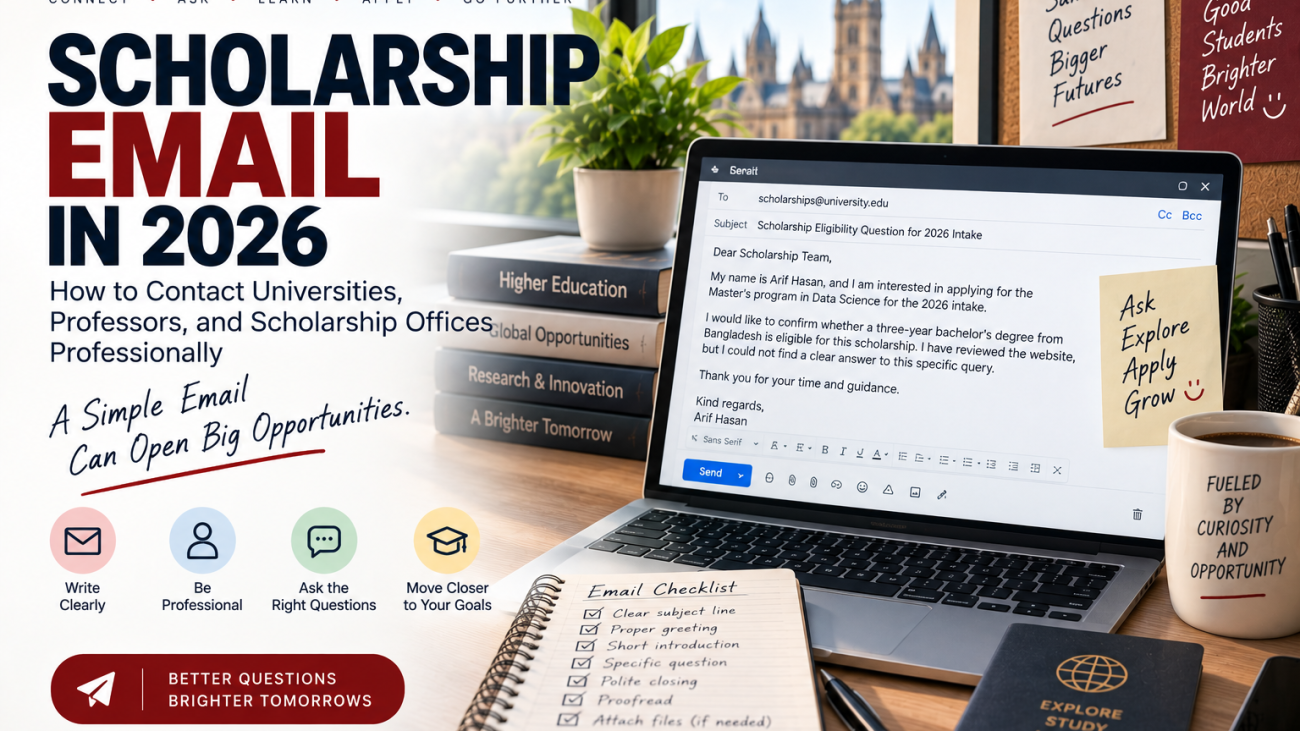
Sending an email about a scholarship sounds easy until you actually have to write one.
Then suddenly you start wondering:
Should I write “Dear Sir/Madam”?
Should I explain my whole background?
Should I attach my CV?
Is it okay to ask if I am eligible?
What if nobody replies?
For many students, email is the first direct contact they have with a university, professor, or scholarship office. That means a short message can quietly shape how professional and prepared you appear.
The good news is that you do not need to write a long or overly formal email.
A good scholarship email in 2026 should be clear, respectful, specific, and easy to answer.
This guide explains how to write scholarship emails naturally, what subject lines to use, when to contact professors, what mistakes to avoid, and how to follow up without sounding impatient.
Why Scholarship Emails Matter
Scholarship applications are full of questions.
You may need to confirm:
- Eligibility
- Required documents
- Language requirements
- Admission status
- Funding coverage
- Recommendation rules
- Research supervision
- Application deadlines
Sometimes the official website answers everything.
Sometimes it does not.
That is when a good email becomes useful.
The goal is not to impress the recipient with complicated language.
The goal is to make it easy for them to understand your question and respond.
Before You Send Any Scholarship Email
Before writing, check the official website carefully.
This matters because many scholarship offices receive hundreds of emails asking questions that are already answered online.
If the website clearly says:
Applicants must have at least two years of work experience.
do not email:
Do I need work experience?
Instead, email only when something genuinely needs clarification.
That shows that you have done your research.
Who Should You Email?
The right person depends on your question.
Scholarship Office
Contact the scholarship office for questions about:
- Eligibility
- Funding
- Deadlines
- Required documents
- Selection process
- Scholarship terms
Admissions Office
Contact admissions for questions about:
- Course requirements
- Application status
- Degree eligibility
- English-language requirements
- University admission
Professor or Potential Supervisor
Contact a professor if you are applying for:
- PhD funding
- Research scholarships
- Master’s by research
- Lab-based programs
Your email should focus on research fit, not general scholarship questions.
International Student Office
This office may help with:
- Visa guidance
- International entry requirements
- Country-specific documents
- Enrollment support
How to Write a Good Scholarship Email Subject Line
Your subject line should be simple.
Good examples:
- Scholarship Eligibility Question for 2026 Intake
- Question About 2026 Scholarship Application Requirements
- Prospective MSc Applicant — Funding Question
- PhD Applicant 2026 — Research Supervision Inquiry
Avoid vague subjects such as:
- Hello
- Important
- Urgent
- Please Reply
- Scholarship Help
A clear subject helps the recipient understand the purpose immediately.
How to Start a Scholarship Email
If you know the person’s name, use it.
For example:
Dear Dr. Ahmed,
or:
Dear Ms. Smith,
If you do not know the name, you can write:
Dear Scholarship Team,
or:
Dear Admissions Team,
This often sounds better than:
Dear Sir/Madam,
because it feels more direct and modern.
Keep the Introduction Short
You do not need to explain your entire life story.
A simple introduction is enough.
For example:
My name is Rahim, and I am preparing an application for the MSc Data Science program for the 2026 intake.
That immediately gives context.
Ask One Clear Question
A strong scholarship email usually has one main purpose.
For example:
I completed a three-year bachelor’s degree in Computer Science and would like to confirm whether this meets the academic eligibility requirement for the scholarship.
That is easy to answer.
A weak email might say:
Please tell me everything about the scholarship and whether I can get it.
That creates more work for the recipient and may not get a useful reply.
A Simple Scholarship Email Structure
You can use this structure:
Greeting
Address the correct person or team.
Short Introduction
Say who you are and what you are applying for.
Specific Question
Ask what you need to know.
Thank You
Keep the ending polite.
Signature
Include your full name.
Example: Scholarship Eligibility Email
Subject: Scholarship Eligibility Question for 2026 Intake
Dear Scholarship Team,
My name is Arif Hasan, and I am interested in applying for the 2026 Master’s Scholarship.
I completed a three-year bachelor’s degree in Business Administration and would like to confirm whether this meets the academic eligibility requirement for the program.
I have reviewed the eligibility page but could not find clarification regarding three-year degrees.
Thank you for your time and guidance.
Kind regards,
Arif Hasan
This email works because it is short and specific.
Example: Asking About IELTS Requirements
Subject: English Language Requirement for 2026 Scholarship
Dear Admissions Team,
I am preparing an application for the MSc Public Health program for the 2026 intake.
My previous degree was fully taught in English. Could you please confirm whether this may be accepted as evidence of English proficiency, or whether IELTS is still required?
Thank you for your help.
Kind regards,
Nadia Rahman
Notice that the question is direct.
Example: Asking a Professor About PhD Supervision
Emails to professors should be slightly different.
They should show research fit.
For example:
Subject: Prospective PhD Applicant 2026 — Medical Imaging Research
Dear Professor Lee,
My name is Fahim Ahmed, and I am preparing a PhD application for the 2026 intake.
My current research focuses on deep learning for chest X-ray classification, particularly explainability and region-based feature analysis. I recently read about your work in medical image interpretation and found the overlap with my interests very relevant.
I would like to ask whether you expect to accept new PhD students for 2026 and whether my research background may fit your group.
I have attached my CV for reference.
Thank you for your time.
Kind regards,
Fahim Ahmed
This is much stronger than:
Dear Professor, please give me scholarship in your lab.
Should You Attach Your CV?
Sometimes.
Attach your CV when:
- Contacting a potential supervisor
- Asking about research positions
- The scholarship office requests it
- Your background helps explain your question
Do not attach multiple files unless necessary.
A first email should not contain ten documents.
Should You Attach Your Transcript?
Usually not unless requested.
If you are asking whether your academic background is eligible, you can describe your degree briefly.
If they need the transcript, they can ask.
What File Names Should You Use?
Use professional file names.
Good:
Fahim_Ahmed_CV.pdf
Better than:
cvfinalnew2updated.pdf
Small details help your application look organized.
How Long Should a Scholarship Email Be?
Short.
For most general scholarship questions, around 80–150 words is enough.
Professor emails may be slightly longer because you need to explain research fit.
Avoid sending a full personal statement in the email body.
The recipient should understand your question quickly.
How Formal Should You Sound?
Professional but natural.
You do not need to write:
I humbly beseech your esteemed office to provide clarification regarding the aforementioned matter.
You can simply write:
Could you please confirm whether this requirement applies to international applicants?
Simple language sounds more confident.
Common Scholarship Email Mistakes
Writing Without Researching First
Do not ask questions already answered clearly on the website.
Sending the Same Email to Many Professors
Generic mass emails are easy to recognize.
Personalize research emails.
Writing Extremely Long Messages
A long email can hide the actual question.
Using Informal Language
Avoid:
- Hey
- Bro
- Plz
- ASAP
- Kindly reply fast
Professional communication matters.
Using All Capital Letters
Do not write:
I NEED INFORMATION ABOUT FULL SCHOLARSHIP URGENTLY.
It sounds aggressive.
Asking for a Guaranteed Scholarship
Avoid:
Can you guarantee me full funding?
Scholarship selection usually happens through a formal process.
Asking Someone to Review Your Entire Application
Unless they offer this service, scholarship staff are unlikely to review your CV, SOP, essay, and transcripts before you apply.
Ask specific questions instead.
Should You Mention Your GPA?
Only if it is relevant to your question.
For example:
My CGPA is 3.25/4.00, while the page states that strong academic performance is preferred. Could you please confirm whether there is a formal minimum GPA?
That gives useful context.
How to Ask If You Are Eligible
Do not simply write:
Am I eligible?
Give them enough information.
Better:
I am a Bangladeshi citizen with a four-year bachelor’s degree in Economics and two years of full-time work experience. Could you please confirm whether applicants from Bangladesh are eligible for the 2026 program?
Specific questions produce better answers.
How to Email a Professor Without Sounding Desperate
This is important for PhD applicants.
Do not write:
I desperately need a scholarship and want to join your lab.
Focus on academic fit.
Mention:
- Your research background
- Their research
- The connection
- Your question
Professors usually care more about research alignment than financial need in the first email.
Should You Mention Their Research Paper?
Yes, if you have genuinely read it.
But do not write:
I have read all your excellent research papers and I am deeply impressed.
That sounds generic.
Instead:
Your recent work on weakly supervised lesion localization is closely related to the direction of my final-year research.
That sounds real.
How to Follow Up on a Scholarship Email
Sometimes you will not get a reply.
That does not necessarily mean they are ignoring you.
University staff and professors can be extremely busy.
A polite follow-up after about 5–7 working days is reasonable.
You can write:
Dear Dr. Smith,
I am following up on my previous email regarding the 2026 scholarship eligibility requirement. I understand you may be busy, but I would be grateful for any clarification when convenient.
Thank you.
Keep it short.
How Many Times Should You Follow Up?
Usually one follow-up is enough.
For important research inquiries, a second follow-up may sometimes be reasonable after additional time.
Do not send daily emails.
Repeated messages can create a negative impression.
What If You Receive No Reply?
Try another official contact.
For example:
- Department administrator
- Graduate admissions office
- Scholarship team
- International office
For professor outreach, lack of response can simply mean they are not accepting students or do not have capacity.
Do not take it personally.
When Should You Not Email?
Do not email if the website clearly answers your question.
For example, if the page says:
Application deadline: December 1, 2026
there is no need to email asking for the deadline.
Also avoid emailing just to ask:
Can you tell me how to win the scholarship?
There is usually no useful answer to that.
How to Thank Someone Who Helped You
A short reply is enough.
For example:
Thank you for the clarification. This is very helpful and answers my question.
You do not need to write a long message.
Should You Use AI to Write Scholarship Emails?
AI can help you improve grammar and structure.
But be careful.
Overly polished AI-generated emails can sound strange, especially when they use unnecessary formal language.
Use AI to make your email clearer, not more complicated.
A good test is to read the message aloud.
If it sounds like something no normal person would say, simplify it.
Scholarship Email Checklist
Before sending, check:
- Am I emailing the correct person?
- Did I read the official website first?
- Is the subject line clear?
- Is my question specific?
- Is the email short?
- Did I use the correct scholarship or program name?
- Are attachments actually necessary?
- Are file names professional?
- Did I proofread the email?
- Did I include my name?
A two-minute check can prevent avoidable mistakes.
Frequently Asked Questions About Scholarship Emails
How do I email a scholarship office?
Introduce yourself briefly, explain what you are applying for, and ask one specific question.
Can I ask a professor for a scholarship?
You can ask about available funding or research positions, but do not assume the professor directly controls every scholarship.
Should I attach my CV when emailing a professor?
Usually, yes, if you are contacting them about research supervision or a PhD position.
How long should I wait before following up?
Around five to seven working days is generally reasonable.
What if I do not know the person’s name?
Use a greeting such as “Dear Scholarship Team” or “Dear Admissions Team.”
Is it okay to use ChatGPT to write the email?
Yes, but make sure the final version reflects your actual question and sounds natural.
Final Thoughts
A good scholarship email in 2026 does not need to sound impressive.
It needs to be easy to understand.
Research first.
Ask a specific question.
Keep the message short.
Be respectful.
And make it easy for the person receiving your email to help you.
Professional communication is a small part of the scholarship process, but it can make everything else smoother.
Sometimes the difference between confusion and clarity is simply knowing how to ask the right question.
Add a Comment