
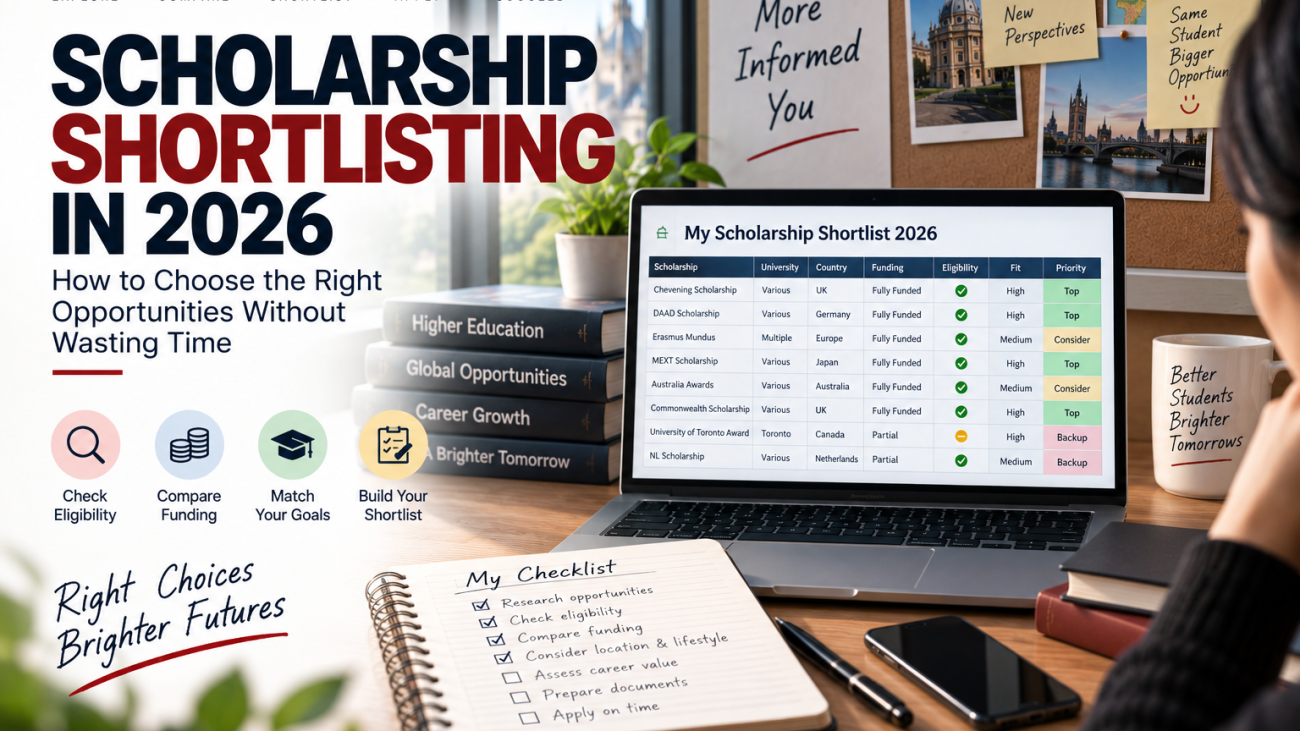
Finding scholarships is not always the hardest part.
Choosing which ones are actually worth applying for is often harder.
You may find dozens of opportunities that look attractive at first. Some are fully funded. Some have excellent universities attached to them. Some seem perfect until you read the eligibility rules closely.
Then the questions begin.
Should I apply even if my GPA is only slightly above the minimum?
Is a partial scholarship still worth it?
Should I prioritize a famous scholarship or one that fits my profile better?
How many applications should I realistically prepare?
This is where scholarship shortlisting in 2026 becomes important.
A good shortlist helps you focus your time on opportunities where you are eligible, competitive, and genuinely interested.
The goal is not to apply to the largest number of scholarships.
The goal is to apply to the right ones.
Why Scholarship Shortlisting Matters
Scholarship applications take time.
A serious application may require:
- Personal statement
- Scholarship essay
- CV
- Recommendation letters
- Transcript
- English-language score
- Research proposal
- Interview preparation
- University application
If you apply to too many scholarships without a clear strategy, the quality of your applications may fall.
You may start copying the same personal statement everywhere.
You may miss important details.
You may even spend days applying for an opportunity you were never a strong match for.
A shortlist helps prevent that.
What Does Scholarship Shortlisting Mean?
Scholarship shortlisting means reviewing available opportunities and deciding which ones deserve your attention.
You evaluate each scholarship based on factors such as:
- Eligibility
- Funding
- Course fit
- Country
- University
- Deadline
- Competition
- Required documents
- Career value
- Application workload
Then you prioritize the strongest matches.
Think of it as filtering.
You are not asking:
Is this scholarship good?
You are asking:
Is this scholarship good for me?
That is a much better question.
Start With Your Own Profile
Before comparing scholarships, understand what you bring to the application.
Write down your current profile.
For example:
- Nationality
- Degree level
- Academic subject
- GPA
- Work experience
- Research experience
- Leadership experience
- English-language score
- Preferred countries
- Career goals
- Financial needs
This helps you judge opportunities more realistically.
A scholarship may be excellent but still not fit your background.
Step 1: Check Eligibility First
Eligibility should always come before excitement.
Before reading everything else, check whether you meet the basic requirements.
Look at:
- Nationality
- Academic level
- GPA
- Degree subject
- Age
- Work experience
- English-language requirement
- Graduation status
If you clearly do not meet a mandatory requirement, remove that scholarship from your shortlist.
Do not spend hours on a personal statement for an opportunity that will reject you automatically.
Step 2: Check the Funding
Not all scholarships provide the same level of support.
Look at exactly what is covered.
This may include:
- Full tuition
- Partial tuition
- Monthly stipend
- Accommodation
- Airfare
- Health insurance
- Visa support
- Research costs
Do not assume that “scholarship” means fully funded.
For some students, a 50% tuition scholarship may still leave an unaffordable amount.
For others, a partial scholarship may be enough.
Your financial situation matters.
Step 3: Check the Course Fit
A scholarship is only useful if the program helps you reach your goals.
Ask:
- Does the course match my field?
- Are the modules relevant?
- Is there a research area I care about?
- Does the program help with my career direction?
Avoid applying only because the university has a famous name.
A less famous university with a better program fit may be more valuable for you.
Step 4: Check the Country
Think beyond the scholarship amount.
Different countries have different:
- Living costs
- Visa rules
- Language environments
- Job markets
- Academic cultures
- Post-study opportunities
Ask yourself whether you would actually be comfortable studying there.
You are not only choosing a scholarship.
You may be choosing where you will live for one, two, or even four years.
Step 5: Check the University
Research the university itself.
Look at:
- Strength in your field
- Research environment
- Career support
- Alumni network
- International student services
- Location
- Graduate outcomes
Do not rely only on global rankings.
A university can rank lower overall but be excellent in your specific subject.
Step 6: Look at the Deadline
Deadlines affect your strategy.
Suppose you find two great scholarships.
One closes in six weeks.
The other closes in four months.
You may need to prioritize the first one.
Keep track of:
- Scholarship deadline
- University application deadline
- Recommendation deadline
- English-test deadline
Some opportunities require you to apply for admission before the scholarship.
Others use a combined process.
Step 7: Consider the Application Workload
Some applications are simple.
Others require:
- Multiple essays
- Recommendation letters
- Research proposal
- Video submission
- Interview
- Separate university application
Ask yourself whether the opportunity is worth the effort.
This does not mean avoiding difficult applications.
It means being strategic.
If you have limited time, prioritize applications with a good balance between fit and effort.
Step 8: Estimate How Competitive You Are
You will never know exactly who else is applying.
But you can still assess your own position.
Ask:
- Do I meet only the minimum requirements?
- Is my academic record strong?
- Do I have relevant experience?
- Do my goals match the scholarship mission?
- Can I provide strong examples of leadership or research?
You do not need to be perfect.
But you should understand whether you are a strong, medium, or weaker fit.
Use Three Scholarship Categories
A useful way to organize your shortlist is by category.
High-Priority Scholarships
These are scholarships where:
- You meet the requirements well
- The course fits your goals
- The funding is suitable
- You have a strong profile match
These deserve your best effort.
Competitive but Possible Scholarships
These are more challenging opportunities.
Maybe your profile is good, but the scholarship attracts a large number of strong applicants.
Apply if the opportunity is valuable.
Just do not depend on it as your only option.
Backup Scholarships
These may include:
- Smaller university awards
- Partial scholarships
- Lower-competition opportunities
- Alternative universities
Backups are important.
A good scholarship strategy should not depend on winning one famous award.
Create a Scholarship Scorecard
You can make shortlisting easier by scoring each scholarship.
Use a scale from 1 to 5.
For example:
| Factor | Score |
|---|---|
| Eligibility | 5 |
| Program fit | 5 |
| Funding | 4 |
| University fit | 4 |
| Career value | 5 |
| Application effort | 3 |
| Deadline flexibility | 4 |
Then compare your options.
You do not need a complicated formula.
The purpose is simply to make your decision less emotional.
Give Eligibility the Highest Weight
Not all factors should be treated equally.
For example, a scholarship may offer amazing funding.
But if you are not eligible, that funding does not matter.
A simple priority order could be:
- Eligibility
- Program fit
- Funding
- Career value
- University fit
- Deadline
- Application effort
You can adjust this based on your goals.
Should You Apply to Famous Scholarships?
Yes, if you are a good fit.
But do not apply only because everyone else is talking about them.
Famous scholarships often receive huge numbers of applications.
They can still be worth applying to, but they should be part of your strategy, not your entire strategy.
Look for:
- Government scholarships
- University scholarships
- Departmental awards
- Research funding
- Regional programs
Less famous does not mean less valuable.
Should You Apply to Partial Scholarships?
Sometimes.
This depends on your finances.
Suppose tuition is $20,000 per year and a scholarship covers 50%.
You still need $10,000 plus living costs.
If you cannot realistically cover that amount, the scholarship may not solve your problem.
Before applying, calculate the remaining cost.
Look at:
- Tuition after scholarship
- Rent
- Food
- Insurance
- Transport
- Visa
- Travel
A scholarship should be evaluated as part of the full financial picture.
How Many Scholarships Should You Apply For?
There is no perfect number.
For some students, five strong applications may be realistic.
For others, ten may be manageable.
The important thing is quality.
A useful approach is:
- 2–3 high-priority applications
- 2–4 competitive applications
- 2–3 backup opportunities
You can adjust this based on your time.
Do not apply to 30 scholarships if every application becomes rushed.
How to Know When a Scholarship Is Not Worth Applying For
You may want to skip an opportunity if:
- You do not meet mandatory requirements
- The remaining cost is unaffordable
- The program does not fit your goals
- The deadline is unrealistic
- The scholarship has unclear or suspicious information
- The application requires major effort for very little benefit
- The location does not work for you
Saying no to one scholarship can give you more time to improve another application.
Keep a Scholarship Tracker
A simple tracker can keep your shortlist organized.
Useful columns include:
- Scholarship name
- University
- Country
- Degree
- Funding
- Deadline
- Eligibility
- Program fit
- Application status
- Priority
- Notes
You can mark priority as:
High
Medium
Backup
Update the tracker regularly.
Do Not Let Social Media Decide Your Shortlist
Social media is useful for discovering opportunities.
But popularity is not the same as relevance.
A scholarship may go viral because it sounds attractive.
That does not mean it fits your profile.
Use social media to discover.
Use official information to decide.
How to Compare Two Similar Scholarships
Suppose you have two options.
Scholarship A offers:
- Full tuition
- Small stipend
- Excellent program
- Expensive city
Scholarship B offers:
- Full tuition
- Larger stipend
- Good program
- Lower living costs
Do not automatically choose A because the university is more famous.
Compare the full experience.
Think about:
- Academic fit
- Total cost
- Research opportunities
- Career outcomes
- Personal preference
The better option depends on your goals.
Scholarship Shortlisting Mistakes to Avoid
Applying Based Only on Funding
Money matters, but so does program quality and fit.
Ignoring Eligibility
Always check requirements first.
Choosing Only Famous Universities
Look at your subject, not only the university name.
Applying to Too Many Programs
More applications can reduce quality if you are overwhelmed.
Ignoring Smaller Scholarships
Smaller awards can still make a major difference.
Waiting Too Long to Shortlist
If you wait until deadlines are close, you may rush everything.
Not Calculating the Remaining Cost
Partial funding can still leave a large financial gap.
A Simple Scholarship Shortlisting Example
Imagine you are applying for a master’s in data science.
You find three scholarships.
Scholarship A
Eligibility: Strong
Funding: Full
Program fit: Excellent
Deadline: 2 months
Competition: High
Priority: High
Scholarship B
Eligibility: Strong
Funding: 50% tuition
Program fit: Good
Living cost: High
Priority: Medium
Scholarship C
Eligibility: Unclear because of nationality restriction
Funding: Full
Program fit: Excellent
Priority: Verify first
This approach helps you decide what to do next.
When Should You Start Shortlisting Scholarships?
Ideally, start around 8–12 months before your intended intake.
At the beginning, your shortlist can be broad.
Then gradually narrow it.
For example:
Initial list: 30 opportunities
After eligibility check: 18
After funding and program fit: 12
Final serious shortlist: 6–8
This is much easier to manage.
Frequently Asked Questions About Scholarship Shortlisting
How many scholarships should I shortlist?
A final shortlist of around 5–10 serious opportunities can be manageable for many students, but the right number depends on your available time.
Should I apply if I only meet the minimum requirements?
Yes, if the scholarship fits your goals. Just understand that eligibility does not guarantee competitiveness.
Is a partial scholarship worth applying for?
Yes, if the remaining cost is affordable.
Should I prioritize ranking or funding?
Neither automatically. Consider program fit, funding, career value, and your personal situation together.
Can I apply to several scholarships at once?
Usually yes, but check whether any program restricts holding multiple awards.
What is the most important shortlisting factor?
Eligibility comes first. After that, program fit and funding are usually among the most important factors.
Final Thoughts
Good scholarship shortlisting in 2026 is about making better decisions before you start writing applications.
You do not need every scholarship.
You need the right scholarships.
Check your eligibility.
Understand the funding.
Look at the course.
Think about the country.
Compare the university.
Consider the application effort.
Then focus your energy on the opportunities where your background and goals genuinely fit.
A thoughtful shortlist will not guarantee that you win a scholarship.
But it will give each application a much better chance of being your best work.
Add a Comment