
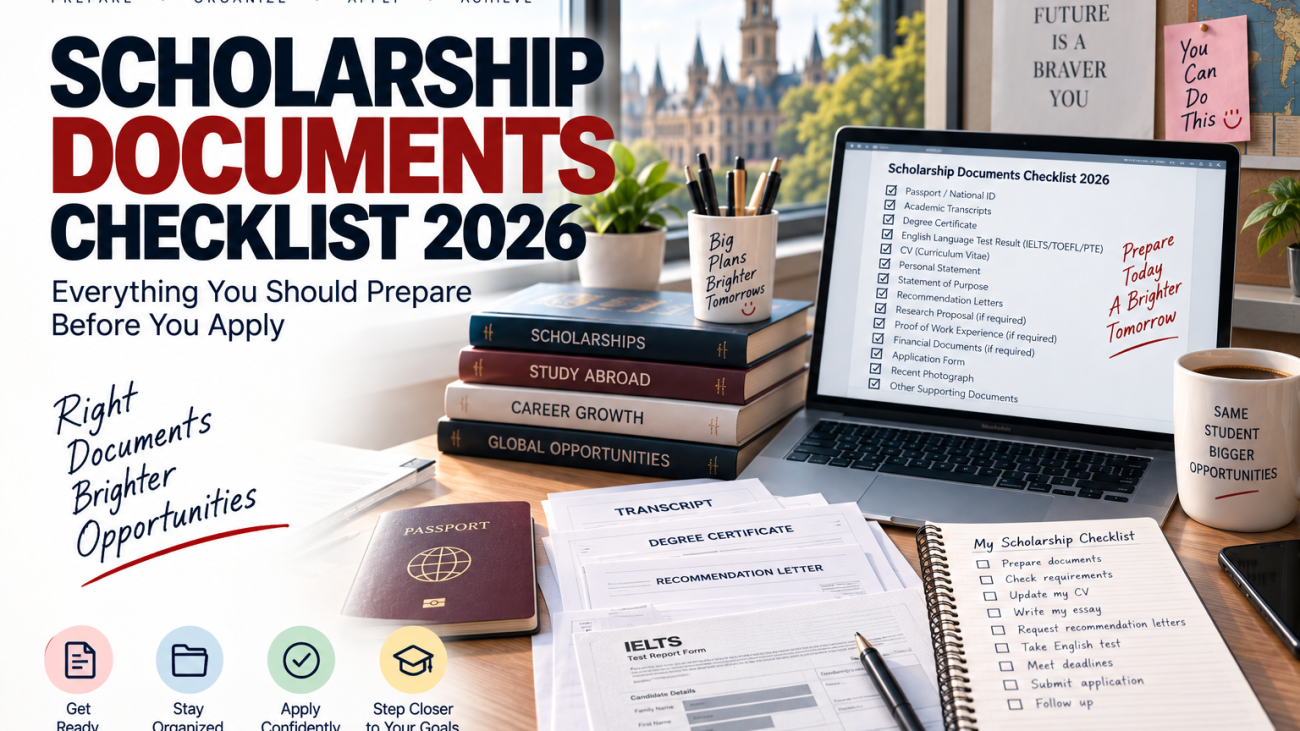
Scholarship applications become stressful very quickly when your documents are not ready.
You find a good opportunity.
The deadline looks manageable.
Then you realize you need a transcript, two recommendation letters, a passport copy, an English-language score, a CV, a personal statement, and maybe even a research proposal.
Suddenly, what looked like a simple application becomes a race against time.
That is why preparing your scholarship documents in 2026 before deadlines start piling up can make a huge difference.
You do not need to prepare every possible document for every scholarship. But there are several documents that appear again and again, and having them organized early can save you days of unnecessary stress.
This guide explains which scholarship documents you may need, how to prepare them properly, what mistakes to avoid, and how to create a simple system so you are always ready to apply.
Why Scholarship Documents Matter
Scholarship committees usually evaluate more than one part of your application.
Your documents help them understand:
- Your academic history
- Your achievements
- Your identity
- Your professional experience
- Your motivation
- Your financial background
- Your research potential
A strong application can be weakened by missing or incorrect documents.
Even something simple, like uploading the wrong transcript or forgetting a signature, can delay or invalidate an application.
Good preparation reduces those risks.
The Most Common Scholarship Documents in 2026
Different scholarships ask for different things.
But these are some of the most common documents students should expect.
Passport or National ID
International scholarships often require proof of identity.
This may include:
- Passport
- National ID
- Birth certificate
For international applications, a passport is usually the most useful document.
Check the expiry date.
If your passport will expire soon, renewing it early can save you problems later.
Do not wait until the scholarship deadline to discover that your passport is no longer valid.
Academic Transcripts
Your transcript shows your academic results.
It may include:
- Course names
- Grades
- Credits
- GPA
- Degree progress
Some scholarships accept unofficial transcripts during the first stage.
Others require official copies.
Check whether the document must be:
- Signed
- Sealed
- Certified
- Digitally verified
Do not assume a screenshot of your student portal will be accepted.
Degree Certificate
If you have already graduated, you may need to provide your degree certificate.
This proves that you completed the qualification you listed in your application.
For postgraduate scholarships, this is commonly required.
If you are still studying, you may be asked for:
- Provisional certificate
- Enrollment letter
- Expected graduation letter
English-Language Test Result
Some scholarships require proof of English-language proficiency.
This may include:
- IELTS
- TOEFL
- PTE
- Cambridge English
Some universities may also accept previous education in English.
The important thing is to check whether the scholarship and university use the same rule.
A university may waive IELTS, but the scholarship may still have separate requirements.
Scholarship CV
Your CV gives the scholarship committee a quick overview of your background.
It may include:
- Education
- Work experience
- Research
- Leadership
- Volunteering
- Awards
- Skills
- Publications
Keep it relevant.
Your scholarship CV should not be filled with unrelated information just to make it longer.
Personal Statement
A personal statement explains your motivation, background, experiences, and future goals.
A good one should answer questions such as:
- Why are you applying?
- What shaped your interests?
- What have you achieved?
- What do you want to do next?
Avoid writing one generic statement and submitting it everywhere.
Customize it.
Statement of Purpose
Some scholarships ask for an SOP instead of a personal statement.
Your SOP usually focuses more on:
- Academic background
- Research
- Program fit
- Career goals
If both are requested, do not submit the same document twice under different names.
Recommendation Letters
Many scholarships ask for one or more references.
These may come from:
- Professors
- Research supervisors
- Employers
- Managers
- Volunteer supervisors
Choose people who actually know your work.
A detailed recommendation from someone who knows you well is usually stronger than a generic letter from someone with a prestigious title.
Research Proposal
Research scholarships may require a proposal.
This is especially common for:
- PhD applications
- Research master’s programs
- Funded research positions
A proposal may include:
- Research title
- Background
- Research problem
- Objectives
- Methodology
- Expected contribution
This document often takes more time than students expect.
Start early.
Motivation Letter
Some scholarships specifically ask for a motivation letter.
This may overlap with a personal statement or SOP, but the focus is usually on why you want the opportunity.
Read the prompt carefully.
Do not assume all application essays are the same.
Proof of Work Experience
Professional scholarships may ask for evidence of employment.
This may include:
- Employment letter
- Experience certificate
- Contract
- Employer reference
If the scholarship requires two years of work experience, they may want proof.
Financial Documents
Need-based scholarships may ask for evidence of financial circumstances.
This could include:
- Family income documents
- Salary statements
- Bank statements
- Tax records
- Financial declaration
Only submit these through official systems.
Financial documents are sensitive.
Scholarship Application Form
Some scholarships have a separate application form.
Do not rush through it.
Check:
- Names
- Dates
- Contact information
- Education history
- Work experience
Inconsistencies between the form and your CV can create unnecessary questions.
Photograph
Some programs ask for a recent photograph.
Use a clear, professional image.
Avoid heavily edited selfies unless the instructions allow them.
How to Organize Your Scholarship Documents
A simple folder system can make applications much easier.
For example:
Scholarships 2026
Inside it:
- Passport
- Transcripts
- Degree Certificates
- CV
- Personal Statements
- SOP
- Recommendation Letters
- English Test
- Research Proposal
- Financial Documents
You can also create a separate folder for each scholarship.
Use Professional File Names
Avoid file names like:
documentfinal2new.pdf
Use clear names.
For example:
Rahim_Hasan_CV.pdf
Rahim_Hasan_Transcript.pdf
Rahim_Hasan_Personal_Statement.pdf
This helps you stay organized.
It also looks more professional.
Keep Master Versions
Create a master version of your:
- CV
- Personal statement
- SOP
- Research proposal
Then create customized copies for each application.
Do not overwrite the original.
For example:
Master_CV_2026.pdf
CV_DAAD_2026.pdf
CV_Chevening_2026.pdf
This makes customization easier.
Check Document Format
Scholarships may ask for:
- JPG
- DOCX
- Specific file size
Do not ignore these instructions.
A portal may reject a file if it is too large.
PDF is usually a safe option for documents unless the application says otherwise.
Check File Size
A scholarship portal may limit uploads to:
- 1 MB
- 2 MB
- 5 MB
If your scanned transcript is too large, compress it carefully.
Make sure the text remains readable.
Do You Need Certified Documents?
Sometimes.
A scholarship may ask for:
- Certified copies
- Notarized copies
- Official translations
Do not pay for certification unless it is actually required.
Some scholarships only require certified documents after selection.
Read the instructions first.
What If Your Documents Are Not in English?
You may need an official translation.
Check whether the translation must be:
- Certified
- Notarized
- Issued by your university
- Completed by an approved translator
Do not rely on your own translation unless the scholarship explicitly allows it.
How to Prepare Recommendation Letters Early
Recommendation letters are one of the hardest documents to control because someone else has to write them.
Contact referees early.
Give them:
- Your CV
- Scholarship description
- Deadline
- Submission instructions
- Personal statement if relevant
- Key achievements
Make their job easier.
How to Prepare Your CV Early
Your CV should be updated before scholarship season begins.
Review:
- Dates
- Education
- Achievements
- Research
- Work
- Volunteering
Remove outdated or irrelevant information.
Then customize the order for each scholarship.
How to Prepare Your Personal Statement Early
You do not need to write the final version months in advance.
But you can prepare a strong base.
Write down:
- Your academic journey
- Important experiences
- Leadership examples
- Career goals
- Challenges
- Motivation
Then customize the final version for each scholarship.
Create a Scholarship Document Tracker
A simple spreadsheet can help.
Useful columns include:
- Scholarship
- Passport
- Transcript
- CV
- Personal statement
- Recommendations
- English test
- Research proposal
- Deadline
- Status
Mark each document as:
Ready
Needs Update
Waiting
Not Required
This gives you a clear picture.
Common Scholarship Document Mistakes
Uploading the Wrong File
Always check before submission.
Using an Outdated CV
Update your achievements and dates.
Sending a Generic Personal Statement
Customize it.
Forgetting Signatures
Some forms require them.
Submitting Blurry Scans
Make sure everything is readable.
Using Inconsistent Names
Your name should match your passport and application.
If different documents use different spellings, clarify if necessary.
Missing Translation Requirements
Check whether documents need official translation.
Waiting Too Long for Recommendation Letters
Ask early.
Should You Scan Documents With Your Phone?
Yes, if the quality is good.
Modern scanning apps can produce clear PDFs.
Make sure:
- The whole page is visible
- Text is readable
- There are no shadows
- Pages are in the correct order
Avoid photos taken at awkward angles.
Should You Watermark Scholarship Documents?
Only if you have a reason and the scholarship allows it.
Do not add large watermarks that make the document hard to read.
If privacy is a concern, check whether the application system is official before uploading sensitive documents.
Protect Your Sensitive Documents
Be especially careful with:
- Passport
- National ID
- Bank statements
- Financial records
Only upload them through verified scholarship or university systems.
Do not send sensitive documents to unknown contacts on WhatsApp or Telegram.
What to Prepare Before Scholarship Season
A practical early-preparation list is:
- Valid passport
- Updated CV
- Academic transcripts
- Degree certificate
- English-language test
- List of referees
- Personal statement base draft
- SOP base draft
- Research proposal outline if needed
These documents cover a large percentage of scholarship applications.
How Early Should You Prepare Documents?
Start around 6–12 months before your intended intake.
You do not need everything immediately.
But you should identify which documents take time.
For example:
- Passport renewal
- Transcript requests
- English tests
- Recommendation letters
- Certified translations
These can cause delays.
Scholarship Documents Checklist
Before submitting, confirm:
- Passport is valid
- Transcript is correct
- Degree certificate is included
- CV is updated
- Personal statement is customized
- SOP is customized
- Recommendation letters are ready
- English test is valid
- Research proposal is complete
- Financial documents are correct
- Files use proper names
- Formats match the application rules
- File sizes are within limits
- All scans are readable
Frequently Asked Questions About Scholarship Documents
What documents are usually required for scholarships?
Common documents include a passport, transcript, degree certificate, CV, personal statement, recommendation letters, and English-language results.
Do I need all documents before I start applying?
Not always. Some scholarships allow certain documents to be submitted later.
Can I use the same CV for several scholarships?
Yes, but it is better to customize it.
Do recommendation letters need to be signed?
Some scholarships require signatures or official letterhead. Check the instructions.
Can I submit unofficial transcripts?
Some scholarships allow them initially. Others require official copies.
Do documents need to be translated into English?
If the scholarship requires English documents, yes.
Final Thoughts
Preparing your scholarship documents for 2026 early can make the application process much less stressful.
Do not wait until the deadline.
Organize your files.
Update your CV.
Request transcripts.
Contact your referees.
Prepare base drafts of your essays.
Then, when a good opportunity appears, you can focus on improving the application instead of trying to find missing documents.
A strong scholarship application is not only about writing well.
It is also about being prepared.
Add a Comment