
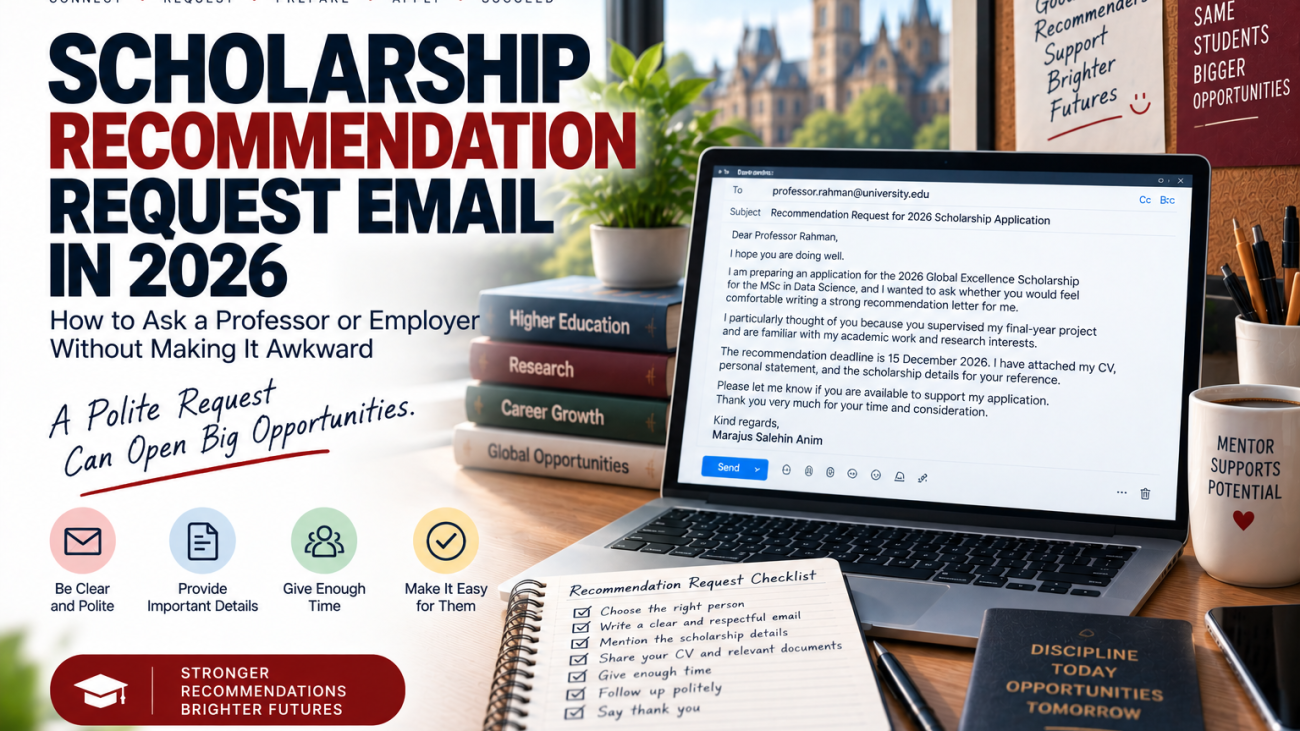
Asking someone for a recommendation letter can feel uncomfortable.
You may worry that you are bothering them.
You may not know what to say.
You may even delay sending the message because you want it to sound “perfect.”
The truth is, most professors, supervisors, and managers are familiar with recommendation requests. What matters is how you ask.
A good scholarship recommendation request email in 2026 should be polite, specific, easy to understand, and easy for the other person to act on.
You do not need to write a long emotional message.
You need to give the recommender enough context, enough time, and the right information.
This guide explains how to ask naturally, who to choose, what to include, how to follow up, and what mistakes to avoid.
Why the Recommendation Request Matters
The recommendation letter itself is important, but the way you ask also matters.
A rushed message like:
Sir, I need a recommendation letter urgently. Please send by tomorrow.
creates unnecessary pressure.
A stronger request gives the person:
- Context
- Time
- Scholarship details
- Submission instructions
- Useful supporting documents
That makes it easier for them to write something specific.
Who Should You Ask?
Choose someone who actually knows your work.
Good options may include:
- University professor
- Research supervisor
- Thesis supervisor
- Employer
- Manager
- Internship supervisor
- Volunteer coordinator
The best recommender is not always the most senior person you know.
A lecturer who taught you closely may write a stronger letter than a department head who barely remembers you.
What Makes Someone a Good Recommender?
A strong recommender should be able to speak about things such as:
- Your academic performance
- Work ethic
- Research ability
- Leadership
- Communication
- Reliability
- Growth
- Future potential
Specific examples matter.
A useful recommendation says more than:
He is a hardworking student.
It might say:
During his final-year project, he consistently took initiative in data collection and helped the team solve several technical problems.
That is much stronger.
When Should You Ask?
Ask early.
Ideally, give the recommender at least 3–4 weeks before the deadline.
For major scholarships or busy academic periods, even more time is better.
Do not wait until the final week unless you genuinely have no other choice.
People are more likely to write thoughtful letters when they are not rushed.
How to Start the Email
Use a professional greeting.
For example:
Dear Professor Rahman,
or:
Dear Ms. Ahmed,
If you know the person well, you can still be warm while staying professional.
Keep the Opening Natural
You do not need an overly formal introduction.
For example:
I hope you are doing well. I am preparing an application for the XYZ Scholarship for the 2026 intake, and I wanted to ask whether you would feel comfortable writing a strong recommendation letter for me.
That is clear and respectful.
Ask for a Strong Recommendation
This wording is useful:
Would you feel comfortable writing a strong recommendation for me?
Why?
Because it gives the person an easy way to decline if they do not know you well enough.
A weak recommendation can hurt more than a polite refusal.
What Information Should You Include?
Your email should usually include:
- Scholarship name
- Program or university
- Deadline
- Why you are applying
- Why you chose them
- Submission method
You do not need to write your entire life story.
Example: Asking a Professor
Subject: Recommendation Request for 2026 Scholarship Application
Dear Professor Karim,
I hope you are doing well.
I am preparing an application for the 2026 Global Excellence Scholarship for the MSc in Data Science, and I wanted to ask whether you would feel comfortable writing a strong recommendation letter for me.
I particularly thought of you because you supervised my final-year project and are familiar with my academic work and research interests.
The recommendation deadline is 15 December 2026, and the letter needs to be submitted through the university portal.
I would be happy to send my CV, personal statement, scholarship details, and any other information that would be helpful.
Thank you very much for considering my request.
Kind regards,
Your Name
Example: Asking an Employer
Subject: Recommendation Request for Scholarship Application
Dear Mr. Hasan,
I hope you are well.
I am applying for a master’s scholarship for the 2026 intake and would like to ask whether you would feel comfortable providing a recommendation for me.
Because you supervised my work during the past two years, I believe you could speak about my professional performance, teamwork, and responsibility.
The deadline is 20 November 2026.
I can send my CV, scholarship information, and submission instructions if you are available to support the application.
Thank you for your time.
Kind regards,
Your Name
What Should You Send After They Agree?
Once they say yes, send useful supporting materials.
You can provide:
- Updated CV
- Scholarship description
- Personal statement
- SOP
- Relevant achievements
- Deadline
- Submission instructions
Do not make them search for everything themselves.
Should You Send a Draft Letter?
Only if the recommender asks for one or the institution allows it.
Sometimes a professor may say:
Send me a draft or some bullet points.
In that case, help them.
But do not assume you should write the entire recommendation yourself.
It is better to provide factual bullet points they can use.
What Kind of Bullet Points Can You Send?
You might send:
- Final-year project topic
- GPA or academic result
- Research contribution
- Leadership example
- Internship achievement
- Class performance
- Relevant scholarship goals
Keep them factual.
For example:
- Completed final-year project on pneumonia detection using deep learning
- Led a four-member project team
- Presented research findings at department seminar
- Interested in graduate study in medical AI
This gives the recommender useful material.
How to Explain Why You Chose Them
This can make the request feel more personal.
You might write:
I thought of you because you supervised my research project and saw my work throughout the semester.
or:
I am asking you because you directly managed my work during the internship and are familiar with my contributions.
This is much better than sending the same generic message to several people.
Should You Ask in Person or by Email?
Either can work.
If you see the person regularly, you can ask briefly in person and then follow up by email with the details.
For example:
Professor, I am applying for a scholarship and wanted to ask whether you might be comfortable writing a recommendation for me. I can email you all the details.
Then send the formal information afterward.
How to Follow Up Without Being Annoying
If the deadline is approaching and the letter has not been submitted, send a polite reminder.
A good time is around 5–7 days before the deadline.
For example:
Dear Professor Karim,
I wanted to send a gentle reminder that the recommendation deadline for the XYZ Scholarship is 15 December. I completely understand you may be busy, and I appreciate your support. Please let me know if you need any additional information from me.
Thank you again.
Short and respectful.
What If They Do Not Reply?
Wait a few working days.
Then send one follow-up.
If there is still no response and the deadline is getting close, contact another potential recommender.
Do not keep sending daily messages.
What If They Say No?
Do not take it personally.
They may be:
- Too busy
- Unavailable
- Not comfortable writing
- Unable to meet the deadline
- Unsure they know you well enough
A simple reply is enough:
Thank you for letting me know. I appreciate your time and consideration.
Then ask someone else.
Can You Use the Same Recommender for Multiple Scholarships?
Usually, yes.
If they are willing.
Just make sure they know:
- Which scholarships you are applying for
- Different deadlines
- Whether each letter needs customization
Do not surprise them with five portal invitations without warning.
Should the Recommendation Be Different for Each Scholarship?
Ideally, yes, especially when scholarships value different qualities.
A research scholarship may need more focus on:
- Research ability
- Academic potential
A leadership scholarship may need more focus on:
- Initiative
- Teamwork
- Community impact
Even small adjustments can make a letter stronger.
Common Recommendation Request Mistakes
Asking Too Late
This is one of the biggest mistakes.
Give people time.
Sending a Vague Message
Do not write:
Sir, need recommendation.
Explain what it is for.
Choosing Someone Who Barely Knows You
Status is less important than relevance.
Forgetting the Deadline
Always include the exact date.
Sending No Supporting Information
Help the recommender help you.
Being Too Informal
Avoid:
Bro, can you write me a recommendation?
Even if you know the person well, keep the scholarship request professional.
Sending Too Many Reminders
One polite reminder is usually enough.
How Long Should the Request Email Be?
Usually 100–180 words is enough.
Your email should answer:
- What are you applying for?
- Why are you asking them?
- When is the deadline?
- What do they need to do?
That is enough for the first message.
Should You Mention the Scholarship Value?
Usually not necessary.
You do not need to say:
This scholarship is worth $50,000, so it is very important.
Focus on the academic opportunity and why you are applying.
What If the Recommender Wants You to Write the Letter?
This happens sometimes.
If they ask you to prepare a draft, keep it honest.
Do not write exaggerated praise such as:
He is the greatest student I have ever taught.
Instead, draft specific factual points based on real experience.
The recommender should review, edit, and submit the final version themselves.
How to Thank Your Recommender
Once they submit the letter, send a short thank-you message.
For example:
Thank you very much for submitting the recommendation. I really appreciate your time and support.
If you later receive the scholarship, update them.
People usually appreciate knowing the outcome.
Scholarship Recommendation Request Checklist
Before sending your email, check:
- Correct recommender
- Professional subject line
- Scholarship name included
- Program included
- Deadline included
- Reason for choosing them included
- Submission method explained
- Supporting documents ready
- Email proofread
- Enough time given
Frequently Asked Questions
How early should I ask for a recommendation letter?
Around three to four weeks before the deadline is a good minimum when possible.
Should I ask by email?
Yes. Email works well because the recommender can easily refer back to the details.
Can I ask my employer instead of a professor?
Yes, if the scholarship accepts professional referees and your employer can speak meaningfully about your work.
How many recommenders should I ask?
Ask only the number required by the scholarship, plus perhaps one backup if you are unsure about availability.
Should I send my personal statement?
Yes, if it helps the recommender understand your goals.
Can I remind my professor?
Yes. A polite reminder near the deadline is completely appropriate.
Final Thoughts
A good scholarship recommendation request email in 2026 does not need to be complicated.
Choose someone who knows your work.
Ask early.
Be specific.
Give them the information they need.
And make the process easy.
Most recommenders are more willing to help when the request feels organized and respectful.
The goal is not to pressure someone into writing a letter.
The goal is to give the right person enough context to support your application well.
Add a Comment