
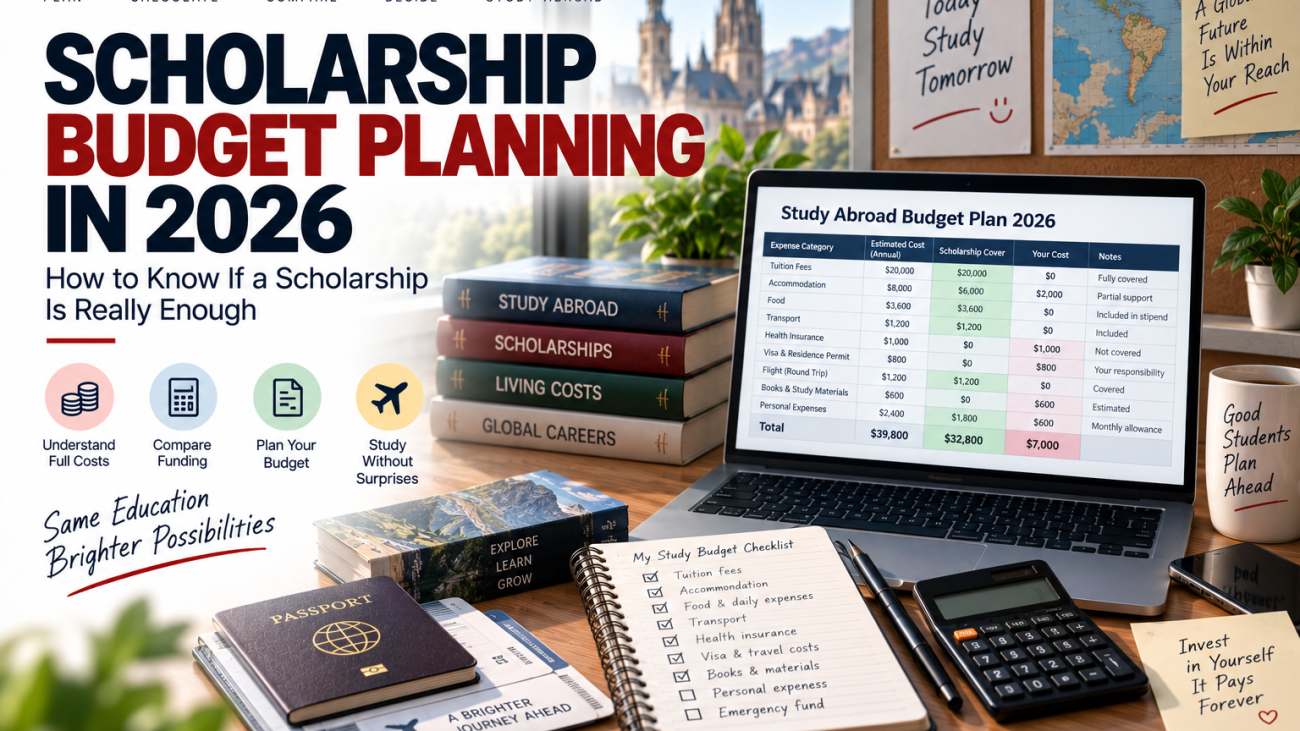
A scholarship can look amazing on paper.
It may say:
50% tuition waiver.
Or:
Monthly stipend included.
Or even:
Fully funded.
At first glance, that sounds like the financial problem is solved.
But studying costs more than tuition.
You may still need to pay for rent, food, transport, insurance, visa fees, flights, books, deposits, and everyday expenses.
That is why scholarship budget planning in 2026 is so important.
Before accepting or even applying for a scholarship, you should understand what the funding actually covers and what you may still need to pay yourself.
This guide explains how to calculate the real cost of studying, compare scholarship offers, avoid hidden expenses, and decide whether an opportunity is financially realistic.
Why Scholarship Budget Planning Matters
Students often focus only on the scholarship amount.
But the scholarship amount by itself does not tell you whether the opportunity is affordable.
For example:
University A offers a 70% tuition scholarship.
University B offers a 50% tuition scholarship plus accommodation and a monthly stipend.
At first, University A may sound better.
But after you calculate everything, University B could actually cost you much less.
The real question is not:
How big is the scholarship?
The better question is:
How much will I still need to pay after the scholarship?
Start With the Full Cost of Study
Before calculating the value of a scholarship, list the total expected cost.
This usually includes:
- Tuition fees
- Accommodation
- Food
- Transport
- Health insurance
- Visa fees
- Airfare
- Books
- Study materials
- Mobile and internet
- Personal expenses
Depending on the country, you may also need to consider:
- Residence permits
- Medical tests
- Security deposits
- Winter clothing
- Local registration fees
These small costs add up.
Understand the Difference Between Full Tuition and Fully Funded
This is one of the most common misunderstandings.
A full tuition scholarship may cover only tuition.
You may still need to pay for:
- Rent
- Food
- Travel
- Insurance
- Visa
- Personal expenses
A fully funded scholarship usually covers much more, but even then, you should still read the details.
Do not assume.
Check.
How to Calculate the Real Scholarship Value
Use a simple formula:
Total Cost of Study − Scholarship Support = Your Remaining Cost
For example:
Tuition: $20,000
Living costs: $12,000
Insurance: $1,500
Travel and visa: $1,500
Total cost:
$35,000
Scholarship covers:
- $20,000 tuition
- $8,000 living stipend
Total scholarship support:
$28,000
Your estimated remaining cost:
$7,000
This gives you a much clearer picture.
Check Whether the Stipend Matches the Cost of Living
A monthly stipend sounds attractive.
But you need to know whether it is enough for the city.
For example, a stipend of $1,000 per month may be comfortable in one place and too low in another.
Compare the stipend with:
- Average rent
- Food costs
- Public transport
- Utilities
- Personal expenses
Always judge the stipend in context.
Accommodation Can Change Everything
Housing is often the biggest living expense.
Check whether the scholarship:
- Provides free accommodation
- Gives a housing allowance
- Includes accommodation inside the stipend
- Offers discounted university housing
- Provides nothing for housing
These are very different situations.
If accommodation is not included, research realistic rent prices.
Do Not Forget Initial Costs
Even when a scholarship pays monthly, you may need money before the first payment arrives.
Common upfront expenses include:
- Visa fee
- Flight
- Deposit
- First month’s rent
- Residence permit
- Medical checks
- Temporary accommodation
You may need a financial buffer.
This is something many students overlook.
How Much Emergency Money Should You Keep?
If possible, keep some emergency savings.
There is no universal amount, but having enough for at least a few weeks of living costs can help.
Unexpected expenses may include:
- Medical costs
- Travel changes
- Laptop repair
- Housing issues
- Delayed scholarship payment
A scholarship reduces financial pressure, but it does not remove every risk.
Check Whether the Scholarship Is Paid Monthly or Upfront
Funding schedules matter.
A scholarship may provide:
- Monthly stipend
- Quarterly payments
- One annual payment
- Reimbursement
Reimbursement can be difficult if you must pay first.
For example, if the scholarship reimburses airfare after arrival, you still need enough money to buy the ticket initially.
Check Currency and Exchange Rates
If your scholarship is paid in a different currency, exchange rates can affect your budget.
Also check:
- Bank charges
- International transfer fees
- ATM fees
Small financial costs can become noticeable over time.
How to Compare Two Scholarship Offers
Use the same categories for both.
For example:
| Cost / Benefit | Scholarship A | Scholarship B |
|---|---|---|
| Tuition covered | 100% | 70% |
| Monthly stipend | $700 | $1,200 |
| Accommodation | No | Yes |
| Airfare | Yes | No |
| Insurance | Yes | Yes |
Now calculate the remaining cost.
Do not compare scholarships only by the tuition percentage.
Fully Funded Does Not Always Mean Zero Cost
Even strong scholarships may not cover:
- Passport renewal
- Clothing
- Laptop
- Personal travel
- Family visits
- Entertainment
- Some administrative fees
That is normal.
The key is understanding these costs before you accept.
What If the Scholarship Is Partial?
Partial scholarships can still be valuable.
Suppose tuition is $15,000 and the scholarship covers $7,500.
That may be enough if:
- You have savings
- Family can support you
- Living costs are low
- You can legally work part-time
But do not assume you can easily cover the remaining amount.
Calculate first.
Can You Work While Studying?
This depends on visa rules.
Some countries allow international students to work a limited number of hours.
Others have stricter restrictions.
Part-time work can help with living costs, but it should not be your only financial plan unless you understand the local rules and job market.
Do not assume you will immediately find work.
Build a Monthly Student Budget
A simple monthly budget might include:
- Rent
- Food
- Transport
- Phone
- Internet
- Insurance
- Study materials
- Personal spending
- Emergency savings
Then compare it to your stipend.
For example:
Monthly stipend: $1,200
Estimated costs:
Rent: $600
Food: $250
Transport: $80
Phone/internet: $50
Personal: $120
Emergency savings: $100
Total:
$1,200
In this case, the budget is tight.
There is little room for unexpected expenses.
Create a Scholarship Cost Tracker
You can use a spreadsheet.
Useful columns include:
- Scholarship name
- Tuition
- Tuition covered
- Monthly stipend
- Accommodation
- Travel support
- Insurance
- Estimated living cost
- Remaining annual cost
- Notes
This makes comparisons much easier.
Questions to Ask Before Accepting a Scholarship
Before saying yes, confirm:
- Is tuition fully covered?
- Is the stipend monthly?
- When is the first payment?
- Is housing included?
- Is insurance included?
- Is airfare included?
- Are visa costs reimbursed?
- Are there hidden fees?
- Is the scholarship renewable?
- Are there academic conditions?
These questions can prevent surprises later.
Check Renewal Conditions
Some scholarships continue only if you maintain:
- Minimum GPA
- Full-time enrollment
- Attendance
- Academic progress
If you lose the scholarship, your financial situation could change dramatically.
Read the conditions carefully.
Scholarship Budget Mistakes to Avoid
Looking Only at Tuition
Living costs matter just as much.
Assuming “Fully Funded” Covers Everything
Always check the details.
Ignoring Upfront Costs
You may need money before the first scholarship payment.
Depending Completely on Part-Time Work
Employment is not guaranteed.
Forgetting Insurance
International student health insurance can be expensive.
Ignoring the Cost of the City
The same stipend can have very different value in different locations.
A Simple Scholarship Budget Example
Imagine you receive a scholarship in Germany.
Annual costs:
Tuition: €0
Living costs: €11,000
Insurance: €1,500
Travel and setup: €1,000
Total:
€13,500
Scholarship provides:
Monthly stipend: €1,000 × 12 = €12,000
Remaining estimated cost:
€1,500
This is a very different situation from simply saying:
I received a scholarship.
Numbers help you make better decisions.
How to Reduce Study-Abroad Costs
You can sometimes reduce expenses by:
- Choosing university housing
- Cooking at home
- Using student transport discounts
- Buying used books
- Avoiding unnecessary subscriptions
- Comparing mobile plans
- Sharing accommodation
Small savings matter over a full year.
Should You Choose a Cheaper Country?
Not necessarily.
You should consider:
- Program quality
- Funding
- Career value
- Cost of living
- Research opportunities
- Personal goals
A more expensive country can still be affordable if the scholarship is strong.
A cheaper country can still be difficult if the funding is weak.
Frequently Asked Questions About Scholarship Budget Planning
Is a fully funded scholarship enough for everything?
Usually it covers most major costs, but you may still have personal or administrative expenses.
How do I know if the stipend is enough?
Compare it with realistic monthly living costs in the destination city.
Should I apply for partial scholarships?
Yes, if you can realistically cover the remaining cost.
Can I rely on part-time work?
It can help, but it should not be your only financial plan.
Do scholarships cover visa fees?
Some do. Others do not.
Should I keep emergency savings?
Yes, if possible. It can help with unexpected expenses or delayed payments.
Final Thoughts
Good scholarship budget planning in 2026 is about looking beyond the scholarship headline.
Do not focus only on:
50% tuition.
or:
Fully funded.
Calculate the full cost.
Check what is covered.
Estimate your remaining expenses.
Think about upfront costs.
Compare the stipend with the actual cost of living.
A scholarship should make education more accessible, not create a financial problem you discover after arrival.
The best scholarship is not always the one with the biggest number.
It is the one that makes the full study experience financially realistic for you.
Add a Comment