
You find a scholarship that fits your goals.
Your CV is ready.
Your personal statement is almost done.
Then the application asks for two recommendation letters.
At first, this sounds easy.
You know a professor who taught you.
You also know your internship supervisor.
You send them a message, they agree, and you think the difficult part is finished.
But then another question appears:
What actually makes a strong scholarship recommendation letter?
A recommendation letter can be much more than:
He is a hardworking and sincere student.
A strong reference gives the scholarship committee an outside view of your abilities, character, academic potential, leadership, and readiness for the opportunity.
The challenge is that you normally should not write the recommendation yourself.
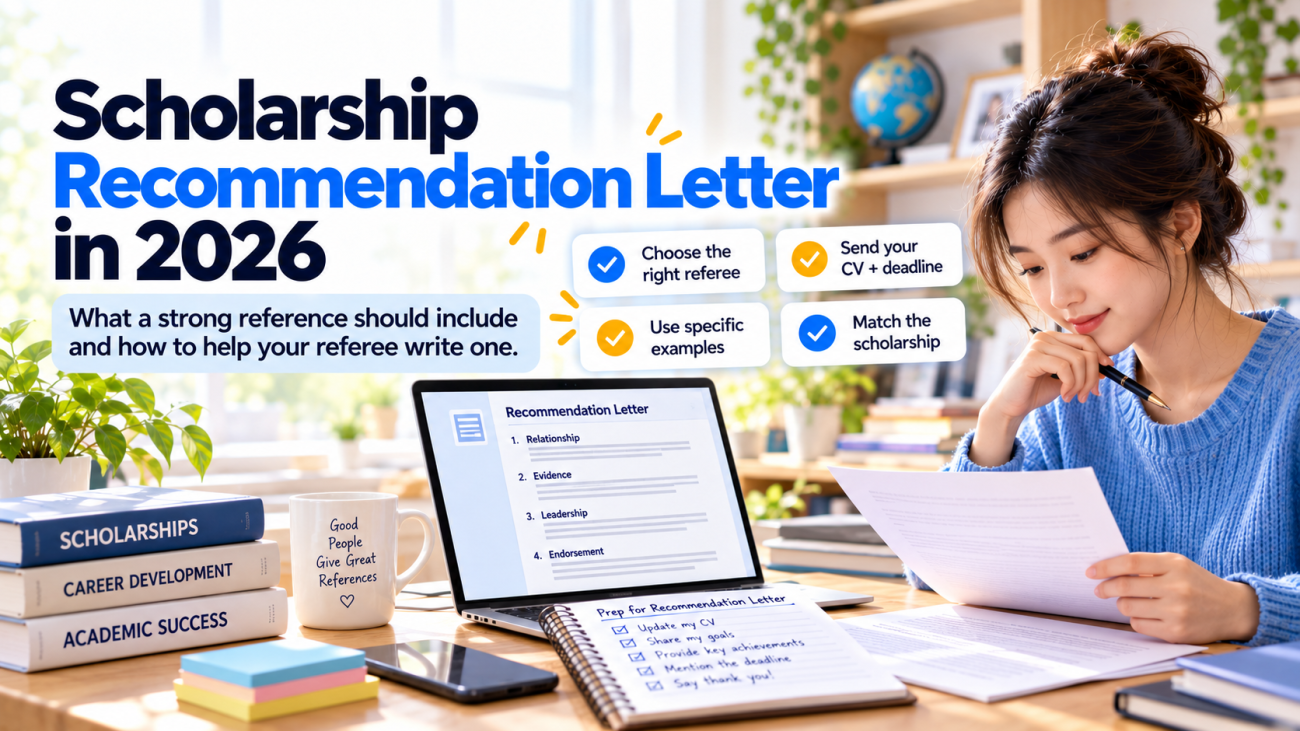
Your role is to choose the right referee, give them useful information, understand the scholarship’s requirements, and make it easier for them to write something specific.
This guide explains how a scholarship recommendation letter in 2026 should work, what strong references usually include, who you should ask, what information to give your referee, and what mistakes can weaken an otherwise good application.
What Is a Scholarship Recommendation Letter?
A scholarship recommendation letter is a reference written by someone who knows you well enough to comment on your abilities and potential.
Depending on the scholarship, that person could be:
- Professor
- Research supervisor
- Thesis adviser
- Employer
- Manager
- Internship supervisor
- Volunteer coordinator
- Professional mentor
The letter gives the selection committee information that is difficult to prove through your own application.
Your personal statement tells the committee how you see yourself.
Your recommendation shows how someone else who has worked with you sees you.
That difference matters.
Chevening’s current reference guidance asks referees to explain how they know the applicant and comment on areas such as leadership, networking ability, personal and intellectual qualities, interpersonal skills, and the applicant’s ability to complete a demanding academic program. Chevening
Why Scholarship Recommendation Letters Matter
A scholarship application is largely written by you.
You choose which achievements to highlight.
You explain your goals.
You describe your strengths.
A referee gives the committee independent context.
The Rhodes Trust describes references as a crucial part of its selection process and notes that they can significantly influence the outcome of an application. Rhodes House
A strong recommendation can help confirm that the experiences in your CV and essays are real.
It can also reveal qualities that may not be obvious from grades.
For example:
Your transcript shows that you earned a high grade in a research course.
Your professor’s recommendation explains that you regularly stayed after class to discuss methodology, helped classmates troubleshoot their analyses, and independently improved the final project beyond the course requirement.
Those details make the academic result more meaningful.
Who Should Write Your Scholarship Recommendation?
The most impressive job title is not always the best choice.
Imagine you can choose between:
Professor A: Head of the department, but taught you once and barely remembers you.
Professor B: Assistant professor who supervised your final-year research for eight months.
Professor B may be able to write the stronger recommendation.
Why?
Because they can provide details.
Fulbright advises applicants to choose recommenders who can meaningfully discuss their intellectual and professional preparation, ability to complete the proposed project, adaptability, community engagement, and potential impact. Fulbright Online
The person needs something real to say about you.
Choose Someone Who Knows Your Work
A strong referee should ideally be able to explain:
- How long they have known you
- In what capacity they know you
- What work they have seen you complete
- What makes you stand out
- How you have developed
- Why they believe you are ready for the scholarship
Rhodes’ current applicant guidance similarly encourages students to select referees who know them and their work well enough to provide meaningful personal insight instead of generic praise. Rhodes House
This matters more than prestige.
Academic Referee vs Professional Referee
The right choice depends on the scholarship.
Academic referee
Useful when the scholarship wants evidence of:
- Academic ability
- Research
- Intellectual curiosity
- Postgraduate potential
- Classroom performance
Good options include:
- Course professor
- Thesis supervisor
- Research adviser
Professional referee
Useful when the scholarship focuses on:
- Leadership
- Professional impact
- Responsibility
- Career development
- Teamwork
Good options include:
- Manager
- Supervisor
- Employer
- Internship mentor
Some scholarships allow a combination.
Chevening currently accepts two professional referees, two academic referees, or one of each. Chevening
Check your scholarship’s exact requirements before choosing.
Do Not Ask a Friend or Relative
A personal relationship does not usually provide the kind of independent evidence a scholarship committee needs.
Chevening says a referee should know the applicant in a professional or personal capacity but should not be a relative or friend. Chevening
Fulbright also explicitly prohibits recommendations from relatives. Fulbright Online
Choose someone who can evaluate you based on real academic, professional, or community experience.
Ask Yourself One Question Before Choosing a Referee
Ask:
What specific story could this person tell about me?
Maybe your professor could discuss:
- Your thesis
- Research initiative
- Improvement over the semester
Your manager could discuss:
- A client problem you solved
- A project you led
- How you handled responsibility
Your volunteer coordinator could discuss:
- Community work
- Team leadership
- Reliability
If you cannot think of anything specific they could say, they may not be the strongest referee.
A Strong Recommendation Should Explain the Relationship
The reader needs context.
A useful letter might say:
I have known Sarah for two years as her lecturer in Machine Learning and later as the supervisor of her final-year research project.
Now the committee understands the basis for the recommendation.
Compare that with:
I am pleased to recommend Sarah for your scholarship.
The second version provides no context.
Chevening specifically asks referees to state how long they have known the applicant, the capacity in which they know them, and when they last had regular contact. Chevening
Strong Recommendations Use Evidence
Generic recommendation:
Ahmed is a hardworking student and an excellent leader.
Stronger recommendation:
During his final-year project, Ahmed coordinated a four-member team after the original project timeline fell behind. He introduced weekly progress reviews, reassigned technical tasks based on each member’s strengths, and helped the team complete the prototype before the final submission.
The second version proves the claim.
The same principle you use in a strong Scholarship Personal Statement in 2026 applies here too: evidence is more convincing than adjectives. Peggy Nelsen Design
What Should a Scholarship Recommendation Letter Include?
Every scholarship can set different requirements.
A strong letter will often include several elements.
Relationship with the applicant
How does the referee know you?
Academic or professional strengths
What have they personally observed?
Specific examples
What situations demonstrate those strengths?
Personal qualities
How do you work with other people?
Potential
Why are you ready for further study or the scholarship opportunity?
Overall endorsement
Why does the referee support your application?
Chevening’s official referee instructions specifically ask for an overall endorsement covering leadership and networking, personal and interpersonal qualities, intellectual ability, and readiness for demanding postgraduate study. Chevening
Fulbright has a different emphasis: its study/research recommendation guidance asks referees to consider both academic excellence and personal attributes relevant to the applicant’s proposed project and role as a cultural ambassador. Fulbright Online
This is why the same reference should not automatically be reused everywhere.
The Recommendation Should Match the Scholarship
Suppose you are applying to two programs.
Scholarship A
Focuses heavily on research potential.
Your recommendation should ideally discuss:
- Academic ability
- Research independence
- Analytical thinking
- Writing
- Research methods
Scholarship B
Focuses on leadership and public impact.
The letter may need more emphasis on:
- Initiative
- Teamwork
- Influence
- Community impact
- Professional responsibility
Your referee does not need to rewrite everything from zero.
They should understand what the scholarship is selecting for.
Give Your Referee the Scholarship Criteria
Do not simply say:
Please write me a recommendation.
Send the actual criteria.
You can provide:
- Scholarship webpage
- Selection criteria
- Program description
- Reference instructions
If the scholarship wants leadership evidence, your referee should know that.
If it wants research ability, that matters too.
Fulbright specifically tells applicants to give recommenders relevant application materials, including the Statement of Grant Purpose and short answers, so the referee can write an informed recommendation. Fulbright Online
Send Your Updated CV
Your referee may know you well.
They probably do not remember every award, project, or internship.
An updated CV gives them useful context.
Send your final or near-final version.
Your Scholarship CV in 2026 should ideally include the academic, professional, research, and leadership experiences most relevant to the scholarship. Peggy Nelsen Design
That makes it easier for your referee to identify useful examples.
Send Your Personal Statement When Appropriate
This can be extremely helpful.
Your professor may know that you performed well academically.
They may not know that your long-term goal is to work in public-health AI.
Sending your personal statement helps them understand the bigger picture.
It also allows their recommendation to complement your application.
The recommendation should not copy your essay.
It should provide independent evidence supporting the same overall direction.
Give the Referee a Short Achievement Summary
This is not the same as writing the letter for them.
Create a short document with factual reminders.
For example:
Scholarship: Global Excellence Scholarship
Program: MSc Data Science
Deadline: 15 December 2026
Relevant experiences with you:
- Final-year thesis supervised by you
- Received A grade in Machine Learning
- Presented research at departmental seminar
- Coordinated four-member project team
Career goal: Health data science
Now your referee has information without needing to search through old records.
Do Not Write the Recommendation Yourself
This deserves its own section because it happens often.
A professor says:
I’m busy. Write the letter and send it to me. I’ll sign it.
That may feel convenient.
But some scholarship programs explicitly prohibit applicants from writing their own references.
Chevening clearly states that applicants cannot write the reference on behalf of their referee. Chevening
Other programs may require confidential recommendations submitted directly by the referee.
Fulbright requires its study/research recommendations to remain confidential and says applicants cannot upload letters on behalf of their recommenders. Fulbright Online
Follow the scholarship’s rules.
What If Your Professor Asks You for a Draft?
First, check the scholarship policy.
If applicant-written references are prohibited, explain that politely.
You can still provide:
- CV
- Personal statement
- Achievement summary
- Scholarship criteria
You might say:
The scholarship requires the reference to be written independently by the referee, so I cannot prepare the letter itself. I would be happy to send a short summary of my relevant work and achievements to make the process easier.
That keeps you within the rules.
How Long Should a Scholarship Recommendation Letter Be?
There is no universal length.
A strong letter is usually long enough to provide meaningful evidence without becoming repetitive.
One page can be enough when it is specific.
Two pages may make sense when the referee has substantial experience to discuss.
Follow any official word or page limit.
Do not assume longer means stronger.
What Makes a Weak Scholarship Recommendation?
A weak recommendation often sounds like this:
I have known John for three years. He is intelligent, hardworking, honest, punctual, and sincere. I strongly recommend him for your scholarship and wish him success.
There is nothing negative here.
There is almost no evidence either.
The committee still does not know:
- What John did
- What made him different
- What the referee observed
- Why he is ready for the opportunity
Generic praise has limited value.
A Better Recommendation Example
Here is a fictional example to demonstrate the structure.
I have known Amina for two years, first as a student in my Applied Statistics course and later as the research assistant on our project examining access to maternal healthcare.
Amina distinguished herself not only through strong academic performance but through her willingness to investigate problems independently. During our research project, she identified inconsistencies in the initial dataset and proposed a revised cleaning process before we began analysis. Her work prevented several unreliable observations from entering the final model.
She also demonstrated maturity when working with other students. Two junior researchers joined the project midway through the semester, and Amina voluntarily created a short data guide and spent several sessions helping them understand our workflow.
Based on my experience supervising her, I believe she has the analytical ability, discipline, and collaborative skills required for demanding postgraduate study. I am pleased to support her application for the XYZ Scholarship.
Notice what makes this stronger.
The referee does not simply say:
Amina is intelligent.
They show where that conclusion came from.
Should Recommendation Letters Mention Weaknesses?
Not necessarily.
A recommendation does not need to become a criticism letter.
However, extremely unrealistic praise can sometimes feel less credible.
The Rhodes Trust’s 2026 scholar guidance notes that selection readers may be skeptical of references that portray candidates as having no weaknesses or room for growth, and encourages referees who know applicants well enough to provide an honest, meaningful assessment. Rhodes House
A referee might mention development positively.
For example:
When I first taught David, he was hesitant to speak during research discussions. Over the following year, I saw him become significantly more confident, eventually presenting our work to the department.
That can show growth.
Should the Reference Be on Official Letterhead?
It depends.
Fulbright’s current study/research recommendation guidance requests institutional or organizational letterhead as the normal professional standard. If letterhead is unavailable, the recommender should include identifying contact information on the letter. Fulbright Online
Chevening currently says its references do not need to be on official letterhead. Chevening
This is a perfect example of why you should not apply one scholarship’s rules to another.
Check the exact program.
Does the Recommendation Need a Signature?
Again, check the requirements.
Fulbright accepts wet or electronic signatures on study/research recommendation letters. Fulbright Online
Chevening says handwritten signatures are not mandatory, although it may contact the referee to verify the reference. Chevening
Do not add a fake signature yourself.
How Are Recommendation Letters Submitted?
There are several systems.
Referee submits directly
The applicant registers the recommender, and the system emails them a private submission link.
Fulbright uses this model for its study/research applications. Fulbright Online
Applicant uploads the letter
Some scholarships allow the referee to send the completed reference to the applicant for upload.
Chevening currently allows reference letters to be uploaded by the applicant once they reach the relevant stage, while still reserving the right to verify the referee. Chevening
Reference is emailed separately
Some programs provide a dedicated email or institutional process.
Never assume.
Read the instructions before the referee starts writing.
Confidential vs Open Recommendation Letters
A confidential reference goes directly from your referee to the scholarship.
You may never see it.
An open reference may be returned to you for submission.
Neither system is automatically better.
The scholarship decides.
Fulbright’s current study/research recommendations are confidential. Fulbright Online
Chevening uses a different process and can allow applicants to upload letters provided by their referees. Chevening
Do not pressure a referee to show you a confidential letter.
When Should You Ask Your Referee?
Ask early.
Your referee probably has:
- Teaching
- Meetings
- Research
- Deadlines
- Other students requesting references
Fulbright recommends giving recommenders at least four to five weeks. Fulbright Online
Rhodes’ 2026 scholar guide recommends approaching potential referees roughly six to eight weeks before the reference deadline when possible. Rhodes House
Asking early gives them time to remember useful examples and write something thoughtful.
Your existing Scholarship Recommendation Request Email in 2026 explains exactly how to make that first request professionally. Peggy Nelsen Design
Do Not Wait for the Application Deadline
Suppose:
Application deadline: December 15
Recommendation deadline: December 15
You contact the professor on December 12.
Even if they agree, you have created unnecessary risk.
The online system might fail.
The referee may be unavailable.
The letter may be rushed.
Treat the recommendation deadline as earlier than the application deadline in your personal schedule.
Remind Your Referee Politely
A reminder is normal.
Do not send one every day.
If you asked several weeks in advance, you can follow up perhaps one week before the deadline.
For example:
Dear Professor Rahman,
I hope you’re doing well. I wanted to send a quick reminder that the XYZ Scholarship recommendation is due on 15 December. Please let me know if there is any additional information I can provide. Thank you again for supporting my application.
Short.
Polite.
Useful.
Confirm That the Recommendation Was Submitted
Many application systems show the status.
You may see:
Requested
Pending
Submitted
Check before the deadline.
Do not assume the referee submitted it because they told you they planned to.
Chevening currently warns that missing the reference deadline at the interview stage can result in the application no longer being considered. Chevening
Deadlines matter.
What If Your Referee Misses the Deadline?
Contact the scholarship provider if its instructions allow you to do so.
Do not attempt to upload a fake reference yourself.
Some systems may allow another referee.
Others may not.
Chevening can accept alternative referees in certain circumstances, though applicants may need to explain why the reference differs from the person originally nominated. Chevening
The rules vary by program.
What If Your Referee Changes Jobs?
That does not automatically make them unsuitable.
What matters is whether they still know your work and can provide a meaningful reference.
Chevening explicitly says referees do not need to remain employed at the organization where they knew the applicant. Chevening
Use their current professional contact details where appropriate.
Can You Reuse an Old Recommendation Letter?
Sometimes.
It may not be a good idea.
Your profile changes.
Your career goals change.
The scholarship criteria can differ.
Chevening allows previous applicants to use the same referee again but recommends updating old letters so that they accurately reflect the applicant’s current abilities. Chevening
A 2024 reference that says:
Sarah is currently completing her undergraduate degree.
may look strange in a 2026 application if you graduated two years ago.
Keep references current.
Do Recommendation Letters Need to Be in English?
Often, for English-language international scholarships.
But again, follow the specific rules.
Chevening requires references in English. If a reference is written in another language, it currently requires the original plus a notarized English translation. Chevening
Fulbright’s study/research application also requires recommendations in English. When the original is in another language, an official English translation must accompany it, and the applicant cannot translate the confidential letter themselves. Fulbright Online
Your recent Scholarship Document Translation in 2026 guide explains the difference between translation, certification, notarization, and original documents. Peggy Nelsen Design
Do Not Translate a Confidential Reference Yourself
If the recommendation is confidential, you should not be handling its content.
Fulbright makes this particularly clear: when translation is required, the applicant cannot perform the translation because the recommendation is confidential. Fulbright Online
Ask the referee or scholarship provider how to arrange the translation properly.
Recommendation Letters Should Complement Each Other
Suppose you need two referees.
You choose:
Professor A: Can discuss your academic and research ability.
Manager B: Can discuss your leadership, responsibility, and teamwork.
Together, they create a fuller picture.
Rhodes’ application guidance encourages applicants to think about how their references work together rather than choosing several people who will all describe the same experience. Rhodes House
This is a smart strategy.
Do Not Choose Two People Only Because They Have Famous Titles
Imagine:
Referee 1: University vice-chancellor who barely knows you.
Referee 2: CEO you met at an event.
Both titles look impressive.
Neither can say much.
Compare that with:
Referee 1: Professor who supervised your thesis.
Referee 2: Manager who supervised your internship.
Those letters may contain much stronger evidence.
Make Sure Your Application Tells One Consistent Story
Your reference does not have to repeat your personal statement.
It should not contradict it either.
Suppose your personal statement says:
My strongest experience is leading a community education program.
Your referee says:
I have never observed her in any leadership capacity.
That creates a problem.
Your documents should describe the same real person from different angles.
The best preparation is not controlling what the referee writes.
It is choosing someone who actually knows your relevant work.
Should You Tell Your Referee What to Say?
You can tell them what the scholarship values.
You should not dictate their opinion.
Good:
The scholarship focuses strongly on leadership and community impact. I have attached the criteria in case it is useful.
Not good:
Please write that I am one of the top 1% of students you have ever taught.
Unless that is genuinely their judgment, you should not pressure them into saying it.
What About AI-Written Recommendation Letters?
The referee is responsible for the letter.
Scholarship rules around AI vary.
The safest principle is the same as with other application material:
The recommendation should reflect the referee’s genuine assessment.
Applicants should never generate a fake reference and present it as something written independently by a professor or employer.
If a scholarship has specific AI or authenticity rules, follow them.
A Simple Information Pack for Your Referee
You can send one organized folder containing:
- Scholarship description
- Reference requirements
- Updated CV
- Personal statement
- Academic or professional achievements
- Deadline
- Submission instructions
Do not send twenty unrelated files.
Make the process easy.
Scholarship Recommendation Letter Checklist for 2026
Before the deadline, make sure:
- I checked how many referees are required.
- I chose people who actually know my work.
- I confirmed whether academic or professional references are accepted.
- I asked early.
- My referee agreed to provide a strong recommendation.
- I sent the scholarship criteria.
- I sent my updated CV.
- I provided my personal statement when useful.
- I gave the exact deadline.
- I explained the submission method.
- I checked language requirements.
- I checked letterhead and signature requirements.
- I did not write a prohibited self-reference.
- I sent a polite reminder if necessary.
- I confirmed submission before the deadline.
You cannot control every sentence your referee writes.
You can make sure they have everything needed to write well.
Frequently Asked Questions About Scholarship Recommendation Letters
Who is the best person to write a scholarship recommendation?
Usually someone who knows your academic, professional, research, or leadership work well enough to provide specific examples. A person who knows you closely can often write a stronger reference than someone with a prestigious title who barely knows you.
How many recommendation letters do scholarships require?
It varies. Chevening currently requires details for two referees, while the Fulbright U.S. Student Program study/research application requires three recommendation letters. Chevening
Should a scholarship recommendation letter be on letterhead?
Check the scholarship. Fulbright requests institutional or organizational letterhead where available, while Chevening says letterhead is not required. Fulbright Online
Can I write my own recommendation letter and ask my professor to sign it?
Not when the scholarship prohibits this. Chevening explicitly says applicants cannot write their own references. Other scholarships may require confidential submission directly from the referee. Chevening
How early should I ask?
Four to eight weeks is a useful range when possible. Fulbright recommends at least four to five weeks, while current Rhodes guidance encourages approaching referees even earlier. Fulbright Online
Can I use the same recommendation letter for multiple scholarships?
Sometimes, but it is better when the letter reflects the current opportunity and your current achievements. Different scholarships may also evaluate different qualities.
Can my referee write the letter in another language?
Possibly, but translation rules differ. Chevening currently requires a notarized English translation for non-English references, while Fulbright requires an official English translation when applicable. Chevening
What should I send my referee?
A useful package includes your CV, scholarship criteria, deadline, submission instructions, personal statement or research proposal when relevant, and a short factual summary of experiences they may remember.
Final Thoughts
A strong scholarship recommendation letter in 2026 is not powerful because the referee uses impressive words.
It is powerful because someone who actually knows your work can explain why they believe in your potential.
Choose people who have seen you learn, lead, research, solve problems, or take responsibility.
Give them enough time.
Give them context.
Give them your updated documents.
Make the submission process easy.
Then allow them to write their own assessment.
Your personal statement tells the scholarship committee where you want to go.
Your CV shows what you have already done.
A good recommendation adds something different:
Evidence that another credible person has seen the qualities you claim to have.
When those three pieces support each other, your application becomes much more convincing.
Add a Comment