
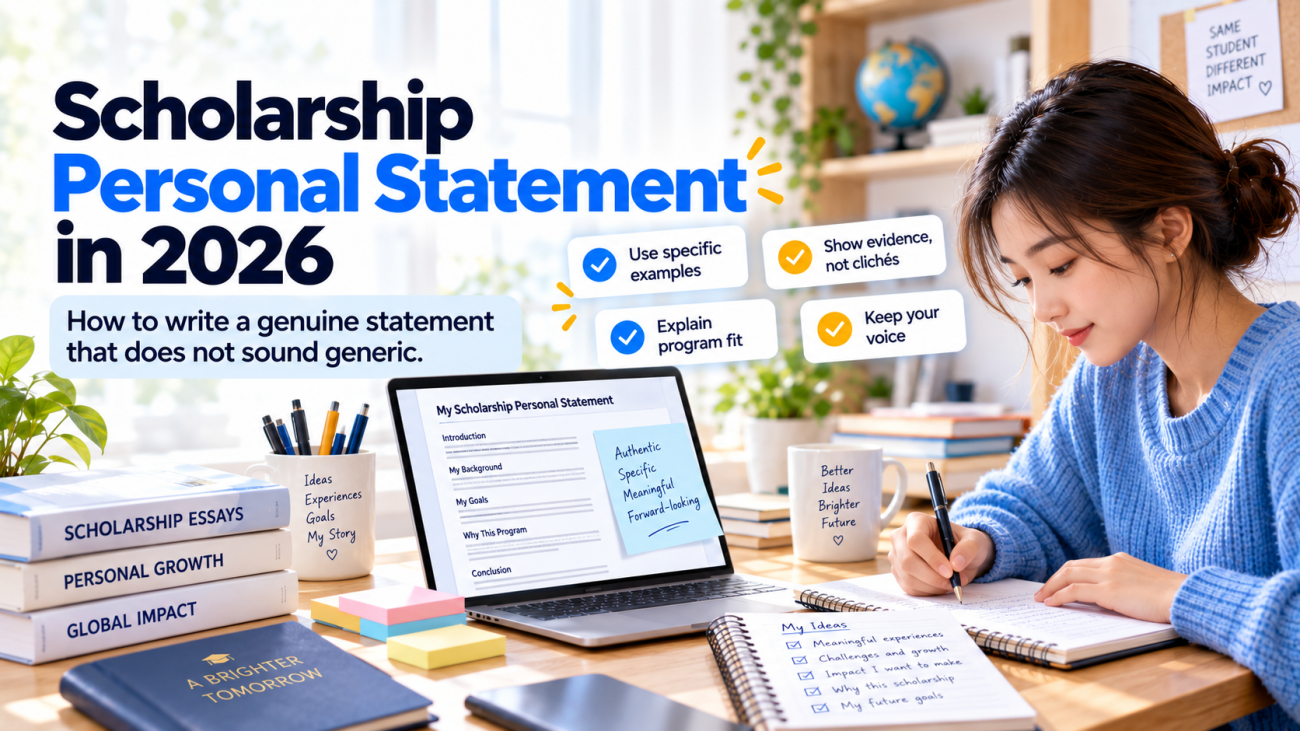
You open the scholarship application and reach the part many students spend the most time worrying about:
Personal statement.
The grades are already on your transcript.
Your experience is listed on your CV.
Your recommendation letters will come from other people.
Now the scholarship committee wants to hear from you.
That sounds straightforward until you open a blank document.
You write:
I have always been passionate about education and strongly believe this scholarship will help me achieve my dreams.
Then you read it again.
It sounds fine.
It also sounds like something thousands of other applicants could write.
This is the real challenge of writing a scholarship personal statement in 2026.
You do not need to sound more intelligent than everyone else. You need to help the reader understand your background, experiences, motivation, direction, and why this particular opportunity makes sense for you.
A strong personal statement should sound like a real person with a clear direction, not a collection of impressive phrases.
This guide explains how to write one step by step, what scholarship committees are actually looking for, how to choose experiences, what to avoid, and how to use AI without allowing it to remove your personality from the application.
What Is a Scholarship Personal Statement?
A scholarship personal statement is a written part of your application where you explain who you are beyond your grades and documents.
Depending on the scholarship, you may discuss your academic interests, experiences, challenges, leadership, career plans, motivation, and reasons for applying.
The exact format varies.
Some programs give you one broad question.
Others divide the application into several essays.
Universities may call the document a:
Personal statement
Motivation letter
Statement of purpose
Application essay
These documents can overlap, but they are not always identical.
That is why your first task should not be writing.
Your first task should be reading the instructions.
Personal Statement vs Motivation Letter vs SOP
Students often use these terms as though they mean exactly the same thing.
They can have different emphasis.
A personal statement usually gives more room to explain your experiences, motivations, interests, personal development, and future direction.
A motivation letter often focuses more directly on why you want a particular opportunity and why you are a good match.
A statement of purpose, or SOP, commonly has a stronger academic and professional focus. It may emphasize your educational background, research interests, program choice, and career plans.
The important rule is simple:
Write the document the application asks for.
Do not change the filename of one generic essay and send it everywhere.
Your Scholarship Documents Checklist 2026 already explains how personal statements, SOPs, motivation letters, CVs, references, and research proposals can appear as separate scholarship documents. Peggy Nelsen Design
Why Scholarship Committees Ask for Personal Statements
Your transcript can tell a committee what grades you received.
It cannot fully explain why you chose your field.
Your CV can show that you led a student organization.
It cannot always explain why that experience changed the way you think about leadership.
A personal statement gives context.
UCAS describes the university personal statement as an opportunity for applicants to demonstrate their motivation, knowledge of the subject, relevant skills, experiences, and potential beyond their grades. UCAS
Scholarships use written responses in different ways, but the same principle is useful:
Evidence matters more than adjectives.
Instead of telling the committee that you are motivated, show them what you have done because of that motivation.
Start With the Scholarship, Not With Yourself
This may sound strange for a personal statement.
Before deciding what to write about yourself, understand the opportunity.
Research:
What does the scholarship value?
Who is it designed to support?
Does it prioritize leadership?
Academic excellence?
Public service?
Research?
Professional development?
Community impact?
Your experiences should remain truthful.
The emphasis can change depending on what the scholarship is assessing.
Chevening, for example, currently evaluates applicants through areas including leadership and influence, relationship building, course choice, and realistic career planning. Its guidance asks applicants to provide specific examples with meaningful outcomes rather than vague claims. Chevening
A research scholarship may care about something completely different.
Do not write for an imaginary universal scholarship committee.
Write for the actual opportunity in front of you.
Build a Personal Statement Evidence Bank Before Writing
Opening Word and immediately trying to write the introduction often makes the process harder.
Start somewhere simpler.
Create a private document and write down experiences that might be useful.
Think about situations where you:
Led something.
Solved a problem.
Worked with others.
Failed and improved.
Completed research.
Helped someone.
Started a project.
Handled responsibility.
Changed your career direction.
Developed a skill.
Overcame an academic challenge.
Do not worry about beautiful writing yet.
You are collecting evidence.
Later, you can decide which experiences best support the scholarship.
Your Scholarship CV in 2026 is useful during this stage because your CV can remind you of projects, research, work experience, leadership, and achievements worth exploring in more depth. Peggy Nelsen Design
Your CV and Personal Statement Should Not Be Identical
This is an important distinction.
Your CV might say:
President, Computer Science Club, 2025–2026
Your personal statement can explain what happened during that experience.
For example:
When I became president of our computer science club, attendance at workshops had fallen significantly. I initially assumed students had lost interest. After speaking with members, I discovered that our sessions were too advanced for newer students. We introduced beginner workshops alongside technical sessions, and attendance began growing again. The experience changed how I think about leadership: solving a problem sometimes begins with listening rather than leading from the front.
Now the committee understands more than your title.
Your CV gives the fact.
Your personal statement gives the meaning.
Do Not Start With a Famous Quote
You have probably seen statements begin with:
“Education is the most powerful weapon…”
or:
“As Nelson Mandela once said…”
The quote may be meaningful.
It usually tells the committee very little about you.
UCAS specifically advises applicants to avoid clichés and quotations and instead use the available space to communicate their own experiences and motivations. UCAS
You have limited words.
Use them for your story.
You Also Do Not Need a Dramatic Childhood Story
Another common opening sounds like this:
Ever since I was five years old, I dreamed of becoming a data scientist.
If that is genuinely true and relevant, you can explain it.
Do not invent an early-life story because you think personal statements need one.
It is completely acceptable for your interest to have developed later.
For example:
My interest in health data did not begin with a childhood dream. It began during my third year at university when our machine learning project used a medical dataset for the first time.
That actually sounds more human because it describes a specific turning point.
A Strong Opening Can Be Simple
You do not need to shock the reader.
You need to make them want to understand your direction.
Compare these two openings.
Generic:
I am writing to express my strong interest in the Global Scholarship because I am passionate about technology and want to make a positive contribution to society.
More specific:
During my final-year project, our model achieved high accuracy on the dataset we trained it on. When we tested it on data collected under different conditions, its performance dropped sharply. That experience made me interested not only in building AI systems, but in understanding when they can actually be trusted.
The second opening gives us something to follow.
It introduces an experience.
It shows curiosity.
It naturally leads toward further study.
You do not need to copy this style.
The principle is to begin with something real.
Explain Why You Chose Your Subject
“Passion” is not enough by itself.
Write about the experiences that created or strengthened your interest.
Maybe it was:
A university module.
A research project.
An internship.
A problem you encountered at work.
A community experience.
Independent learning.
A professor’s course.
A professional challenge.
UCAS’s current 2026 guidance asks applicants to explain why they want to study their chosen subject and encourages them to connect their motivation with knowledge of the field and future ambitions. UCAS
The strongest explanation is usually not:
I love computer science.
It is:
Here is what made computer science important to me.
Explain What You Have Already Done
Motivation without evidence is easy to write.
The committee wants to know what you have done with that interest.
Suppose you say:
I am deeply interested in renewable energy.
What proves that?
Maybe you completed a research project.
Maybe you volunteered with an environmental organization.
Maybe you completed an online course.
Maybe you built a small prototype.
Maybe you studied energy policy independently.
Your actions make the statement believable.
Use Specific Experiences Instead of Personality Labels
Try removing unsupported labels such as:
Hardworking.
Passionate.
Dedicated.
Resilient.
Leader.
Innovative.
These words are not bad.
They become weak when they are used without evidence.
Instead of:
I am a resilient person.
You might explain:
During my second year, I struggled with programming courses after entering university with very little coding experience. I started attending weekly lab sessions, practiced outside class, and built small projects alongside my coursework. By the following year, I was helping junior students debug their first applications.
You never needed to write “I am resilient.”
The story shows it.
Use the “Claim, Evidence, Meaning” Approach
This is a simple way to strengthen your paragraphs.
First, make a point.
Then provide evidence.
Then explain why it matters.
For example:
Claim: I became interested in using technology to improve access to education.
Evidence: During a volunteer tutoring program, I noticed students repeatedly missed sessions because scheduling information was scattered across messaging groups. I built a simple online scheduling page that allowed tutors and students to see available sessions in one place.
Meaning: The project showed me that useful technology does not always begin with an advanced technical problem. Sometimes it begins with understanding a small friction in someone’s daily life.
That final part matters.
A personal statement is not just a list of events.
It is reflection.
Show Your Contribution Clearly
If you describe a team achievement, the committee still needs to understand what you did.
Avoid:
We organized a successful campaign.
Explain your contribution.
For example:
Our five-member team organized the campaign, and I was responsible for recruiting volunteers and coordinating the university partnerships.
Chevening’s application guidance similarly tells applicants to make their own individual contribution clear when describing leadership and impact. Chevening
You can give credit to the team without disappearing from your own statement.
Results Make Examples More Credible
Whenever possible, explain what happened.
For example:
I organized student workshops.
becomes:
I coordinated four beginner coding workshops attended by around 180 students.
Or:
I improved communication with volunteers.
becomes:
I introduced a shared schedule and weekly update system, reducing last-minute volunteer cancellations during the following three events.
Do not invent numbers.
Use them when they are real and meaningful.
You Do Not Need Extraordinary Achievements
Students sometimes think every scholarship statement needs:
A startup.
A published paper.
An international award.
A nonprofit organization.
It does not.
What matters is how relevant your experience is and what it demonstrates.
A part-time job can demonstrate responsibility.
Helping organize a small student event can demonstrate initiative.
Supporting classmates can demonstrate mentoring.
A failed project can demonstrate learning.
Do not dismiss useful experiences because they do not sound prestigious.
Explain Challenges Carefully
Personal challenges can belong in a statement when they help the reader understand your development or context.
You do not need to include difficult personal experiences simply because emotional stories can be memorable.
Share what feels relevant and appropriate.
UCAS notes that applicants can discuss personal circumstances and the skills developed from them, but students are not required to disclose circumstances they do not want to discuss. UCAS
If you include a challenge, try not to let the entire statement become a description of what happened to you.
Show what you did next.
Explain Why This Specific Scholarship
This is where generic applications often fail.
Do not write:
This prestigious scholarship will allow me to achieve my dreams.
Replace prestige with specifics.
Ask yourself:
What does this scholarship provide that matters to my plan?
Maybe:
Specialized academic study.
A professional network.
Leadership development.
Research access.
An international community.
A particular program.
Financial support that makes study possible.
The explanation should connect the scholarship to your next step.
Do Not Copy the Scholarship Website
Imagine the scholarship website says:
We develop leaders who create transformative global impact.
Then your statement says:
I want to become a transformative global leader who creates global impact.
The committee already knows its own marketing language.
What it does not know is how the opportunity connects to you.
Chevening’s own application advice tells candidates to avoid copying language from university or promotional websites and instead explain their reasons authentically. Chevening
Research the scholarship.
Then explain the connection in your own language.
Explain Why This Course
Your course choice should not feel random.
Connect it with your current skills and future needs.
For example:
My experience in frontend development has taught me how to build usable interfaces, but the education platform I eventually want to develop will require stronger knowledge of scalable systems and data-driven personalization. Modules in distributed systems and applied machine learning would help me build that technical foundation.
This shows a gap.
It shows why the course matters.
It gives the committee a logical reason for the next step.
Chevening currently asks applicants to explain how specific course content connects to their background, career aspirations, and intended impact. Chevening
Research the Course Before Mentioning It
Do not write:
Your world-class modules perfectly match my goals.
Which modules?
What will you learn?
Why do you need it?
Look at:
Course modules.
Research centers.
Labs.
Projects.
Faculty interests.
Industry partnerships.
Do not force all of these into your statement.
Pick the details that genuinely matter to your plan.
Explain Your Career Goals Without Pretending You Know Everything
A career plan should have direction.
It does not need to predict the next twenty years perfectly.
Avoid:
After graduation I will become CEO of the world’s leading AI company and revolutionize global healthcare.
Ambition is fine.
A realistic path is more convincing.
For example:
After graduation, I plan to work in applied machine learning within healthcare or health technology, where I can build experience deploying models in real clinical environments. Over time, I hope to move into roles focused on responsible AI deployment and contribute to systems designed for resource-constrained healthcare settings.
Now the committee can see progression.
Chevening’s current assessment guidance specifically asks applicants to present short-, medium-, and long-term plans that are realistic, achievable, and measurable. Chevening
Connect the Past, Present, and Future
A strong personal statement often has an invisible structure:
Past: What experiences shaped you?
Present: What skills, knowledge, and questions do you have now?
Future: What are you trying to do next?
The scholarship sits between the present and future.
That creates a logical story.
For example:
I worked on X.
That helped me understand Y.
Now I need to learn Z.
This program provides Z.
I intend to use it to pursue A.
That is much stronger than jumping between unrelated achievements.
Scholarship Personal Statement Structure
You do not need to use the same structure for every application, but a practical sequence could be:
Opening: Introduce your motivation through a specific experience or clear direction.
Academic background: Explain relevant education and how your interests developed.
Experience and evidence: Discuss one or two meaningful projects, leadership situations, research experiences, or professional achievements.
Why this scholarship and program: Explain the fit.
Career direction: Show what you intend to do with the opportunity.
Closing: Bring the story together without repeating your entire statement.
Do not force equal word counts for every part.
Give space to what matters most for the particular application.
How to Write a Better Closing
Weak closing:
In conclusion, I strongly believe that I am the ideal candidate for this prestigious scholarship and hope you will consider my application.
You do not need to declare yourself the ideal candidate.
A more natural ending could be:
I see postgraduate study as the next stage of work I have already begun rather than a change in direction. The scholarship would allow me to strengthen the technical and professional skills I need to turn that experience into work with a broader impact. I would approach that opportunity with the same curiosity and responsibility that have shaped my journey so far.
The closing should feel like the end of your story.
Not an advertisement.
How Long Should a Scholarship Personal Statement Be?
Follow the stated limit.
Do not assume one universal length.
Some applications give:
500 words.
1,000 words.
2,000 characters.
Multiple short-answer questions.
UCAS university applications for 2026 entry onwards use three personal-statement questions within an overall 4,000-character limit, with a minimum of 350 characters for each response. UCAS
That is a UCAS-specific system, not a universal scholarship rule.
If your scholarship says 500 words, write for 500 words.
Answer the Actual Prompt
A beautifully written statement can still fail if it does not answer the question.
Suppose the scholarship asks:
Describe a situation where you demonstrated leadership and explain what you learned.
Do not spend 80% of the answer explaining why you want a master’s degree.
Before finishing any response, reread the prompt.
Ask:
Did I actually answer every part?
One Strong Example Can Beat Five Weak Ones
Students often try to fit every achievement into one essay.
That creates a statement like:
I volunteered, attended conferences, led clubs, completed internships, conducted research, organized events and participated in competitions.
The reader learns very little about any of them.
Chevening’s application advice explicitly recommends developing one or two detailed examples instead of listing many examples without substance. Chevening
Depth often beats quantity.
Avoid Repeating Your Grades
Your transcript already shows them.
Writing:
I received a 3.81 CGPA and earned A grades in Data Structures, Algorithms, AI, Machine Learning and Database Systems.
may use valuable space without explaining anything new.
Instead, discuss a relevant project or idea from those studies.
UCAS similarly advises students not to waste statement space simply repeating grades that appear elsewhere in the application. UCAS
Match Your Statement With Your CV
Consistency matters.
If your statement says:
I worked at XYZ Company for two years.
your CV should not say:
January 2025 – August 2025.
If you describe yourself as project lead, your CV should not call your position an observer unless there is a clear explanation.
Before submitting, compare your statement with your Scholarship CV in 2026. Peggy Nelsen Design
Your application should feel like several documents describing the same person.
Match Your Statement With Your Recommendation Letter
Your recommender does not need to repeat your personal statement.
It is useful if they understand what you are applying for and your broader direction.
Once a professor or employer agrees to recommend you, send them:
Your current CV.
Scholarship description.
Deadline.
Relevant achievements.
Your personal statement or draft when appropriate.
Your Scholarship Recommendation Request Email in 2026 explains how to approach referees professionally and what supporting information to provide. Peggy Nelsen Design
Be Ready to Defend Everything in an Interview
Anything you write can become an interview question.
If your statement says:
My greatest achievement was transforming our student organization.
the panel might ask:
What exactly did you change?
If you say:
I have extensive research experience.
they may ask:
Which research problem interested you most?
This is one reason exaggeration is dangerous.
UCAS warns applicants not to exaggerate because they may later be asked to elaborate on their claims. UCAS
Before submitting your final statement, imagine an interviewer asking:
Tell me more about this sentence.
Could you answer comfortably?
Your Scholarship Interview in 2026 can help you prepare once your written application progresses to that stage.
How Much Should You Customize?
You do not need to start completely from zero for every application.
Create a master document containing your best material.
Keep:
Important experiences.
Career goals.
Academic background.
Strong examples.
Then customize what you submit.
Change:
Program fit.
Scholarship connection.
Relevant examples.
Course details.
Word limits.
The final statement should feel written for that opportunity.
Your Scholarship Shortlisting in 2026 article explains why focusing on strong-fit opportunities can also prevent you from copying the same generic application everywhere. Peggy Nelsen Design
Can You Use AI to Write a Scholarship Personal Statement?
This needs careful handling in 2026.
AI can be useful for tasks such as:
Improving grammar.
Finding repetition.
Suggesting clearer structure.
Helping you identify vague paragraphs.
Generating questions that expose missing details.
It should not invent your story.
It should not create achievements you never had.
It should not turn your application into generic polished language you cannot explain.
You also need to check the rules of the specific scholarship.
Chevening currently states that using AI software to generate answers for its scholarship application is prohibited and says applications should be written in the applicant’s own words. Chevening
UCAS gives its own AI guidance for university personal statements and stresses originality and authenticity. UCAS
Policies differ.
Check before using AI on an application.
A Safer Way to Use AI for Applications That Permit It
If the rules allow AI assistance, start with your own material.
For example, write:
I worked as an intern in a software company. The main issue I worked on was mobile responsiveness. I fixed 12 pages and also started learning React there.
Then use AI for feedback such as:
Which part of this paragraph is too vague?
or:
Help me make this more concise without adding new facts.
That preserves your story.
Avoid:
Write an emotional scholarship essay that guarantees selection.
No tool can guarantee selection, and the output is likely to sound generic.
Humanized Writing Does Not Mean Casual Writing
A personal statement can be professional and still feel human.
You do not need phrases such as:
I hereby wish to express my profound inclination toward pursuing this esteemed academic opportunity.
You can write:
I want to study this program because it addresses a gap I have repeatedly encountered in my work.
Simple does not mean weak.
Clear writing often sounds more confident.
Avoid Vocabulary You Would Never Normally Use
If you would never say:
ameliorate the socioeconomic paradigm
do not suddenly use it in your personal statement.
Complex words do not automatically make writing academic.
They can make it harder to understand.
Scholarship committees care about your ideas.
Do not bury those ideas underneath a thesaurus.
Remove Empty Sentences
During editing, look for sentences that sound good but say almost nothing.
For example:
I firmly believe education is the key to success.
What does this contribute?
Or:
In today’s rapidly changing world, technology has become increasingly important.
The committee already knows.
Delete sentences that do not help the reader understand you.
Avoid Repeating “I Am Passionate”
You can use the phrase.
You probably do not need it five times.
Show interest through actions.
If you have spent two years researching something, taken additional courses, built projects, or volunteered in the field, your interest is already visible.
Read the Statement Out Loud
This is one of the simplest editing techniques.
You may notice:
Sentences that are too long.
Repeated words.
Awkward phrases.
Language that does not sound like you.
If you cannot comfortably say the sentence aloud, reconsider whether it belongs in your application.
Ask for Feedback, Not Rewriting
Give your draft to someone you trust.
Instead of asking:
Can you make this better?
ask:
Which part feels generic?
Where do you want more detail?
What do you remember after reading it?
Does my career plan make sense?
Which paragraph sounds least like me?
This produces more useful feedback.
UCAS encourages applicants to produce several drafts and seek feedback from trusted people while keeping the statement original. UCAS
Scholarship Personal Statement Example
Here is a short fictional example to show the approach.
Do not copy it into an application.
My interest in educational technology began with a surprisingly small problem. While volunteering in a weekend tutoring program, I noticed that students frequently missed classes because tutors were sharing schedules across several messaging groups. I built a simple web page where students could check available sessions from one place. It was not technically sophisticated, but seeing students actually use something I had created changed how I thought about software development.
Since then, I have focused my studies and projects on building digital tools around real user problems. During my undergraduate degree in computer science, I worked on web applications, data analysis projects, and a final-year project exploring personalized learning recommendations. These experiences strengthened my technical skills while showing me where my knowledge remains limited, particularly in scalable systems and responsible use of learner data.
I now want postgraduate training that will allow me to explore these questions more deeply. The program’s modules in machine learning, distributed systems, and human-centered computing closely match the skills I need for the education platform I eventually hope to develop.
My long-term goal is to work on affordable learning technologies for students who have limited access to high-quality tutoring and academic guidance. I do not expect one degree to solve that problem. I see it as the next step in building the technical knowledge, professional network, and practical experience necessary to contribute to it responsibly.
Notice what the example does not say.
It does not claim the applicant will change the entire world.
It gives a starting experience.
It shows development.
It identifies a gap.
It connects the program to a future direction.
That is the logic you want.
Scholarship Personal Statement Checklist for 2026
Before submitting, check only these essentials:
- Does my statement answer the actual prompt?
- Does the opening say something specific about me?
- Have I included evidence instead of only adjectives?
- Is my individual contribution clear?
- Have I explained why this scholarship or program fits my goals?
- Does my career direction feel realistic?
- Does the information match my CV and other documents?
- Have I removed clichés, unnecessary quotes, and repeated grades?
- Can I explain every claim in an interview?
- Have I followed the exact word or character limit?
- Have I checked the scholarship’s AI policy?
- Does the final draft still sound like me?
If the answer to the final question is no, edit again.
Frequently Asked Questions About Scholarship Personal Statements
How do I start a scholarship personal statement?
Start with something relevant and specific: an experience, problem, project, academic interest, or turning point that naturally connects to why you are applying.
How long should a scholarship personal statement be?
Follow the scholarship’s stated limit. There is no universal word count. UCAS, for example, uses a specific 4,000-character structure for 2026 undergraduate applications, while individual scholarships can set completely different limits. UCAS
Should I talk about financial need?
If the scholarship asks about financial circumstances, answer it directly. If the award is mainly merit-based and never asks about financial need, do not make financial hardship the entire statement unless it is genuinely relevant to your story.
Should I mention my GPA?
Usually only when it adds something that is not already obvious elsewhere. Your transcript and application form often contain your grades already.
Should I include leadership?
Include it when the scholarship values leadership or when the experience genuinely supports your story. Explain what you actually did rather than simply saying you are a leader.
Can I use the same personal statement for several scholarships?
You can maintain a master draft, but customize the submitted version for each scholarship’s priorities, questions, program, and word limit.
Is a motivation letter the same as a personal statement?
They can overlap, but the requested emphasis may differ. Always follow the exact instructions given by the university or scholarship.
Can I use ChatGPT to write my scholarship statement?
Check the program’s rules first. Policies differ. Chevening currently prohibits AI-generated application answers, while other institutions may permit limited assistance under their own rules. Chevening
Final Thoughts
A scholarship personal statement in 2026 should not be a performance.
You are not trying to sound like the most impressive person the committee has ever met.
You are helping them understand a simple chain:
What have you experienced?
What did you learn from it?
What are you trying to do next?
Why does this opportunity make sense in that journey?
Specific experiences make your application credible.
Reflection makes those experiences meaningful.
A clear career direction gives the story purpose.
The scholarship connects those pieces.
Write your first draft without worrying too much about elegance.
Then remove what is generic.
Add evidence where your claims are vague.
Make the connection between your past and future clearer.
Read it aloud.
And before submitting, ask yourself one final question:
Could someone who knows me read this and believe I wrote it?
If the answer is yes, you are much closer to the kind of personal statement worth submitting.
Add a Comment