
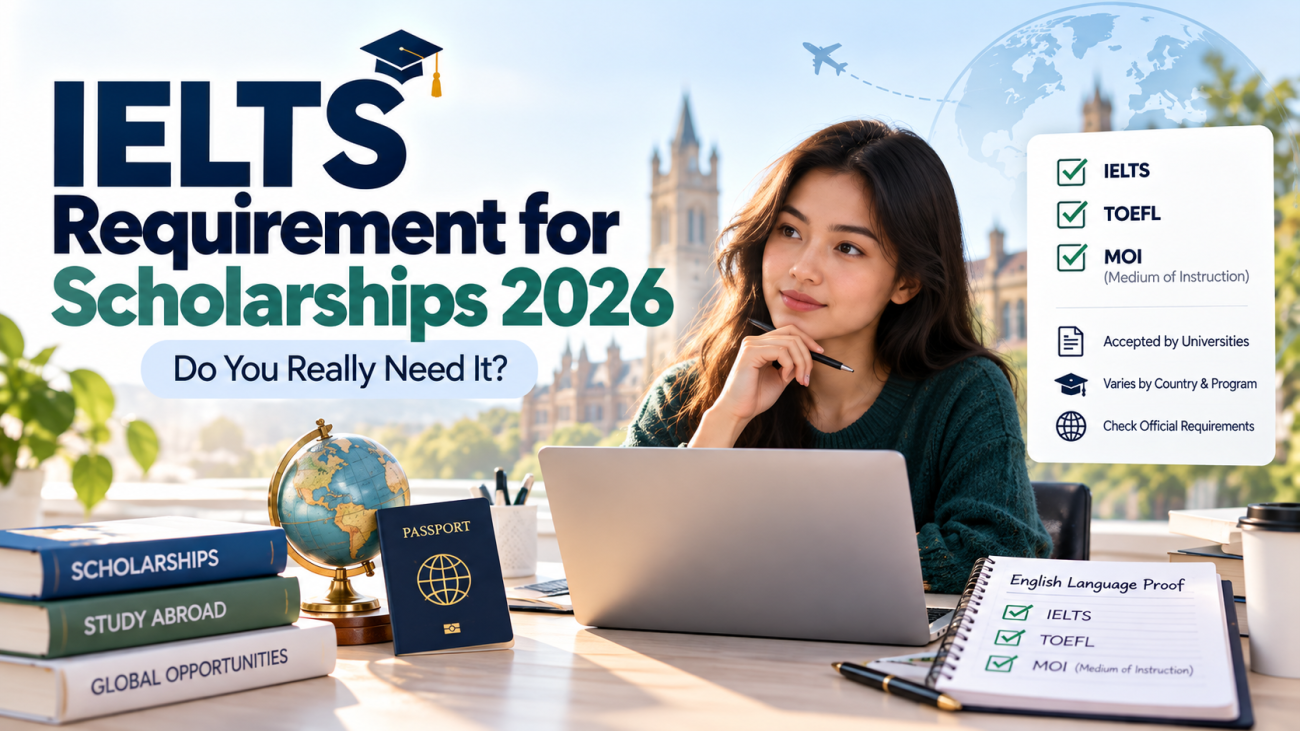
You find a scholarship post online.
The headline says:
“Fully Funded Scholarship 2026 — No IELTS Required.”
That sounds perfect.
You click the link expecting to apply without any English test.
Then you reach the university page and see:
IELTS Academic 6.5 required.
Now you are confused.
Did the scholarship advertisement lie?
Do you need IELTS or not?
Can a Medium of Instruction letter replace it?
Will TOEFL or PTE work instead?
Can you apply for the scholarship first and submit an English test later?
These questions are common because scholarship English-language requirements and university admission requirements are often separate.
A scholarship may not ask you for IELTS during its own application process. The university you eventually attend may still require proof of English before giving you an unconditional offer.
Understanding the IELTS requirement for scholarships in 2026 can save you from rejecting opportunities you actually qualify for and from assuming that “no IELTS” means no English-language proof will ever be needed.
This guide explains how IELTS, TOEFL, PTE, university waivers, Medium of Instruction letters, and scholarship requirements can fit together.
Does Every Scholarship Require IELTS in 2026?
No.
There is no universal IELTS rule for scholarships.
A scholarship may:
- Require IELTS directly
- Accept several English tests
- Leave English assessment entirely to the university
- Allow you to apply before receiving a test score
- Have no separate English-language requirement at all
Chevening is a clear example.
Chevening removed its own English-language requirement in 2020 and currently says applicants do not need to submit an English-language score as part of the scholarship application. Applicants still need to satisfy the English and admission requirements of their chosen university and obtain the required unconditional university offer. Chevening
That distinction is the key to understanding many “no IELTS scholarship” claims.
What Does “No IELTS Required” Actually Mean?
The phrase can mean several different things.
Meaning 1: The scholarship itself does not require IELTS
This is the Chevening-style situation.
You may apply for the scholarship without submitting IELTS to the scholarship provider.
Your university may still ask for it later. Chevening
Meaning 2: The university accepts another English test
You may not need IELTS specifically because alternatives such as TOEFL or another approved qualification are accepted.
Meaning 3: The university may waive a test
Some universities may accept qualifying previous education, nationality, or another form of evidence instead of a test.
Meaning 4: You can apply before taking IELTS
The application may allow you to submit first and meet the English condition later.
These are very different situations.
So when you see:
No IELTS required
the next question should be:
No IELTS required for which stage?
Scholarship Requirement and University Requirement Are Separate
This is one of the most important ideas in this topic.
Imagine you are applying for:
Scholarship: Chevening
University: UCL
Chevening currently does not have its own English-language test requirement. Chevening
UCL, however, has its own English-language requirements for graduate admission. Its current system uses several English proficiency levels, with IELTS Academic requirements ranging from 6.5 overall at Level 1 to 8.0 overall at Level 5, together with minimum component scores. University College London
So both of these statements can be true at the same time:
Chevening does not require IELTS.
Your UCL course may require IELTS or another accepted form of English evidence.
There is no contradiction.
They are different organizations evaluating different things.
Your recent Scholarship Eligibility in 2026 guide introduces this distinction when discussing English-language eligibility. This article goes deeper into exactly how those requirements can work. Peggy Nelson Design
Do You Need IELTS to Apply for Chevening in 2026?
Not for the Chevening application itself.
Chevening states that its own English-language requirement was removed in 2020. Applicants still need to meet the requirements of their chosen universities and obtain an unconditional offer from at least one eligible course by the required stage. Chevening
That means you may be able to submit your Chevening application before taking IELTS.
Whether you can eventually receive an unconditional university offer without an English test depends on the university.
Do not read:
Chevening has no IELTS requirement
as:
Every UK university will admit me without English evidence.
Why Universities Still Care About English Proficiency
A university needs to know that you can successfully study in the language of instruction.
A postgraduate course may involve:
- Lectures
- Academic reading
- Essays
- Presentations
- Group work
- Research
- Dissertation writing
Different courses can demand different levels of English.
That is why one university may require a higher score for law, education, journalism, or another writing-intensive program than it does for a different course.
For example, UCL currently uses five English-language levels rather than one universal IELTS score for every graduate program. University College London
Check the exact course.
Not only the university homepage.
What IELTS Score Do You Need for Scholarships?
There is no single “scholarship IELTS score.”
The required score depends on:
- Scholarship
- University
- Course
- Study level
A common mistake is searching:
IELTS score needed for scholarship
when the more useful search is:
[University] + [Course] + English language requirements
For example, Oxford’s graduate courses can specify their own English-language level. One current Oxford graduate course requiring the University’s standard level lists IELTS Academic at 7.0 overall with at least 6.5 in each component, alongside several accepted alternatives. Oxford University
That score belongs to the university/course requirement.
It is not a universal scholarship score.
Do All UK Universities Require IELTS?
No.
They usually require acceptable evidence of English proficiency where relevant, but IELTS is only one possible form of evidence.
Depending on the institution, accepted evidence may include:
- IELTS Academic
- TOEFL iBT
- Cambridge qualifications
- Other recognized tests
- Certain previous education
- Other institution-approved evidence
UCL, for example, currently accepts IELTS Academic and TOEFL among its recognized options, subject to its rules and required levels. University College London
Oxford also lists multiple accepted qualifications for relevant graduate courses, including IELTS Academic, TOEFL iBT, Cambridge C1 Advanced, Cambridge C2 Proficiency, and the Oxford Test of English Advanced. Oxford University
The exact accepted tests can change.
Check before booking one.
Can TOEFL Replace IELTS?
Sometimes.
If the university accepts TOEFL, you may use it instead of IELTS.
Do not assume every institution uses the same score conversion.
UCL’s current guidance, for example, confirms that it continues to accept TOEFL iBT and has separate requirements for tests taken before and after January 21, 2026 because of changes to the TOEFL scoring system. University College London
This illustrates another important point:
English-test rules can change during an application cycle.
Always check the latest university page before paying for a test.
Can PTE Replace IELTS?
At some universities, yes.
At others, acceptance and minimum scores may differ.
The best approach is not:
Which English test is easiest?
Start with:
Which tests does my target university accept?
Then compare:
- Availability in your country
- Cost
- Test format
- Required score
- Result time
- Validity period
There is no value in taking an easier test if your university does not accept it.
Can a Medium of Instruction Letter Replace IELTS?
Sometimes.
A Medium of Instruction, or MOI, letter is usually a document from your previous institution confirming that your degree was taught in English.
Students often assume:
My bachelor’s degree was taught in English, so IELTS will definitely be waived.
That is not always true.
Universities decide what previous English-medium education they accept and under what conditions.
The institution may consider:
- Country of previous study
- Institution
- Qualification level
- How recently you studied
- Whether the whole degree was taught in English
Do not obtain an MOI letter and assume the problem is solved.
Check whether your target university accepts it.
“My University Says IELTS Is Waived.” Does the Scholarship Still Need It?
Possibly, although many scholarships leave English assessment to the university.
Check both sets of rules.
This is the same principle you should use throughout scholarship applications:
Scholarship requirement ≠ university requirement.
Your Scholarship Documents Checklist 2026 already advises students to check whether the scholarship and university use the same English-language rule rather than assuming one automatically covers the other. Peggy Nelson Design
Can You Apply Before Taking IELTS?
Often, yes.
A university may give you a conditional offer.
For example:
Admission offered subject to achieving IELTS 6.5 with no component below 6.0.
You can then take the test and satisfy the condition later.
A scholarship may also allow you to apply before your university offer becomes unconditional.
Chevening, for example, currently does not require an English test in its scholarship application, but applicants eventually need to meet their university requirements and obtain the required unconditional offer. Chevening
This can save you from paying for IELTS before you know whether your scholarship application is competitive.
Still, do not delay so long that you miss university or scholarship deadlines.
Conditional Offer Because of English Language
Suppose your university says:
Conditional Offer
Condition:
IELTS Academic 7.0 overall
You have still been admitted conditionally.
You simply need to meet the outstanding English requirement before the university can remove that condition.
Your Scholarship Acceptance Deadline in 2026 and eligibility content are useful alongside this because scholarship timelines can depend on when your admission becomes unconditional.
Do not wait until the final week to take the test if the scholarship requires an unconditional offer by a fixed date.
When Should You Take IELTS?
Work backward from the real deadline.
Suppose:
Scholarship application: October
University unconditional-offer deadline: July
Do not automatically assume you need IELTS in September before submitting the scholarship application.
You may have time.
On the other hand, taking it in late June could be risky.
You need to account for:
- Test availability
- Results
- Possible retake
- University processing time
A sensible plan includes enough time for one unsuccessful attempt.
Do Not Aim Only for the Minimum Score
Suppose your course requires:
IELTS 6.5 overall, minimum 6.0 each component
You achieve:
Overall 7.0
Writing 5.5
That may still fail the requirement.
Universities often set both:
Overall score
and
minimum component scores
UCL’s current IELTS requirements demonstrate this clearly: each of its five levels has both an overall score and minimum scores for individual components. University College London
Always read the complete score requirement.
IELTS Academic vs IELTS General Training
Universities typically specify which version they accept.
For academic study, IELTS Academic is commonly the relevant test.
Do not book IELTS General Training just because the test date is more convenient.
Check the exact language on the university page.
UCL’s graduate English requirements specifically refer to the IELTS Academic version. University College London
Booking the wrong test can waste both time and money.
IELTS for UKVI vs Normal IELTS Academic
Students applying to the UK sometimes assume they automatically need IELTS for UKVI.
Not always.
The appropriate test depends on how your university assesses your English and the visa circumstances.
Chevening’s student-visa guidance notes that when the university has assessed English competence and records this appropriately on the CAS, an IELTS for UKVI certificate may not need to be submitted with the visa application. Chevening
Do not pay extra for a specific UKVI test simply because someone in a Facebook group told you to.
Ask your university which test you need.
What Is a CAS and Why Does English Matter?
For UK study, the CAS is the Confirmation of Acceptance for Studies issued by your university for the Student visa process.
The university assesses whether you meet its admission and relevant English-language requirements before issuing the appropriate CAS.
Chevening’s visa guidance notes that universities assess English ability during the admissions process and normally record how the requirement was assessed on the CAS. Chevening
This is another reason the university’s English requirement matters even when the scholarship itself does not ask for IELTS.
Can Your Nationality Exempt You From an English Test?
In some immigration or university systems, nationality can matter.
Chevening’s UK Student visa guidance lists specific majority English-speaking nationalities and certain qualifications that can affect whether separate English-language testing is required for the visa process. Chevening
That is a visa-related rule.
The university may have its own academic requirements.
Do not assume one exemption automatically applies everywhere.
What If Your Previous Degree Was Entirely in English?
Check the university’s exemption policy.
You may be able to provide:
- Official degree certificate
- Transcript
- MOI letter
- University confirmation
The receiving university decides whether this evidence satisfies its requirement.
If the university page is unclear, write a short email.
Your Scholarship Email in 2026 guide includes a simple example for asking whether an English-medium degree can replace IELTS. Peggy Nelson Design
Email Example: Asking Whether IELTS Can Be Waived
Subject: English Language Requirement for 2026 Admission
Dear Admissions Team,
I am preparing my application for the MSc Data Science program for the 2026 intake.
My bachelor’s degree was fully taught and assessed in English. My university can provide an official Medium of Instruction letter confirming this.
Could you please confirm whether this may satisfy the English-language requirement for my application, or whether I would still need to submit IELTS or another approved test?
Thank you for your guidance.
Kind regards,
[Your Name]
This is much better than emailing:
I don’t have IELTS. Can I apply?
Give them enough information to answer accurately.
Can You Apply for Scholarships With a Low IELTS Score?
Possibly, if IELTS is not required at the scholarship-application stage.
But eventually you may still need to satisfy the university.
Imagine:
Current IELTS: 6.0
University requirement: 7.0
Scholarship application deadline: October
University condition deadline: June
You may submit the scholarship application first and retake IELTS later if the scholarship and university rules permit it.
That could be more sensible than abandoning the scholarship immediately.
What If You Miss the English Condition Deadline?
This can become serious.
Your university may be unable to make your offer unconditional.
That can affect:
- Scholarship confirmation
- CAS
- Visa application
- Enrollment
For a scholarship such as Chevening, where candidates need to secure the required unconditional university offer, failing to meet the university’s English condition in time can prevent progression even though Chevening itself has no English-language test requirement. Chevening
Track the university deadline carefully.
Should You Take IELTS Before Applying for Any Scholarship?
Not necessarily.
IELTS costs money.
Your first scholarship application may not require it.
A better approach can be:
Step 1: Shortlist scholarships.
Step 2: Check target universities.
Step 3: Identify accepted English evidence.
Step 4: Determine when proof is actually required.
Step 5: Book a test if needed.
This avoids paying for a test before knowing whether it is useful.
Your Scholarship Shortlisting in 2026 guide can help you narrow the opportunities before spending money on application requirements. Peggy Nelson Design
Remember That English Test Results Can Expire
English-language tests typically have validity rules.
A score you earned years ago may no longer be accepted.
Universities can also impose their own recency requirements.
For example, UCL’s current TOEFL guidance refers to scores being accepted within a two-year timeframe under its rules. University College London
Check the university before relying on an older result.
Do Not Fake an English Certificate
This should be obvious.
Still, fake IELTS certificates and altered score reports are advertised online.
Do not use them.
Universities can verify results.
A fraudulent document can lead to:
- Admission cancellation
- Scholarship cancellation
- Visa problems
- Future application consequences
If your score is too low, retake the test or explore legitimate accepted alternatives.
“No IELTS” Scholarship Ads Can Be Misleading
Not every “No IELTS” headline is fake.
It can still be misleading.
An article may say:
Germany scholarship without IELTS!
What it really means:
This university may accept an alternative form of English proficiency for certain applicants.
Those are not identical claims.
Always click through to the official university and scholarship requirements.
Your Scholarship Scams in 2026 article explains why social-media headlines and third-party scholarship listings should be used for discovery rather than final verification.
Scholarship English Requirement Checklist for 2026
Before paying for IELTS or another test, check:
- Does the scholarship itself require English-test evidence?
- Does my university require English proficiency?
- What level does my exact course require?
- Is IELTS specifically required?
- Is TOEFL accepted?
- Is PTE or another test accepted?
- Can previous English-medium education qualify?
- Is an MOI letter accepted?
- Can I apply before receiving my score?
- What is the deadline for meeting the condition?
- Are minimum component scores required?
- Is my existing test result still valid?
- Do I need a UKVI-specific test for my circumstances?
Answer these first.
Then decide which test to take.
Frequently Asked Questions About IELTS and Scholarships
Do I need IELTS for every scholarship in 2026?
No. Scholarship requirements differ. Chevening, for example, currently has no separate English-language test requirement, although applicants still need to meet their university’s admission requirements. Chevening
Can I get a fully funded scholarship without IELTS?
Possibly. The scholarship may not require IELTS, and a university may accept another approved form of English evidence. Always verify both the scholarship and university requirements.
Does Chevening require IELTS in 2026?
No. Chevening’s English-language requirement was removed in 2020. Candidates still need to satisfy their chosen university’s requirements and secure the required unconditional offer. Chevening
Can TOEFL replace IELTS?
Yes at universities that accept TOEFL. UCL and Oxford are examples of institutions that currently list TOEFL among accepted English qualifications for applicable graduate study. University College London
Can a Medium of Instruction letter replace IELTS?
Sometimes. Whether it is accepted depends on the university’s policy and your previous education. Ask the university when its published guidance does not clearly cover your situation.
Can I apply before I have IELTS?
Often yes, depending on the scholarship and university. You may receive a conditional university offer and satisfy the English requirement later.
Is an overall IELTS score enough?
Not always. Universities often require minimum scores in reading, writing, listening, and speaking as well as an overall score. UCL’s current graduate requirements are structured this way. University College London
Do I need IELTS for UKVI for a UK scholarship?
Not automatically. The requirement depends on the university’s assessment and your visa circumstances. Chevening’s visa guidance notes that a separate IELTS for UKVI certificate may not be required when the university has appropriately assessed and recorded English competence on the CAS. Chevening
Final Thoughts
The phrase “scholarship without IELTS” sounds much simpler than the reality.
In 2026, you need to separate three questions:
Does the scholarship require IELTS?
Does the university require English-language evidence?
What evidence will the university accept?
Those answers may be completely different.
A scholarship like Chevening can have no separate IELTS requirement while your university still requires a specific level of English proficiency. Chevening
Another university may accept TOEFL.
Another applicant may qualify through previous English-medium education.
Your job is not to search only for scholarships carrying a “No IELTS” label.
Your job is to understand the actual pathway from scholarship application to unconditional admission.
Check the scholarship.
Check the exact course.
Check accepted tests and exemptions.
Then take IELTS only when it is genuinely necessary.
That can save you money, reduce unnecessary stress, and prevent a misunderstanding about English requirements from blocking an otherwise strong scholarship application.
Add a Comment