
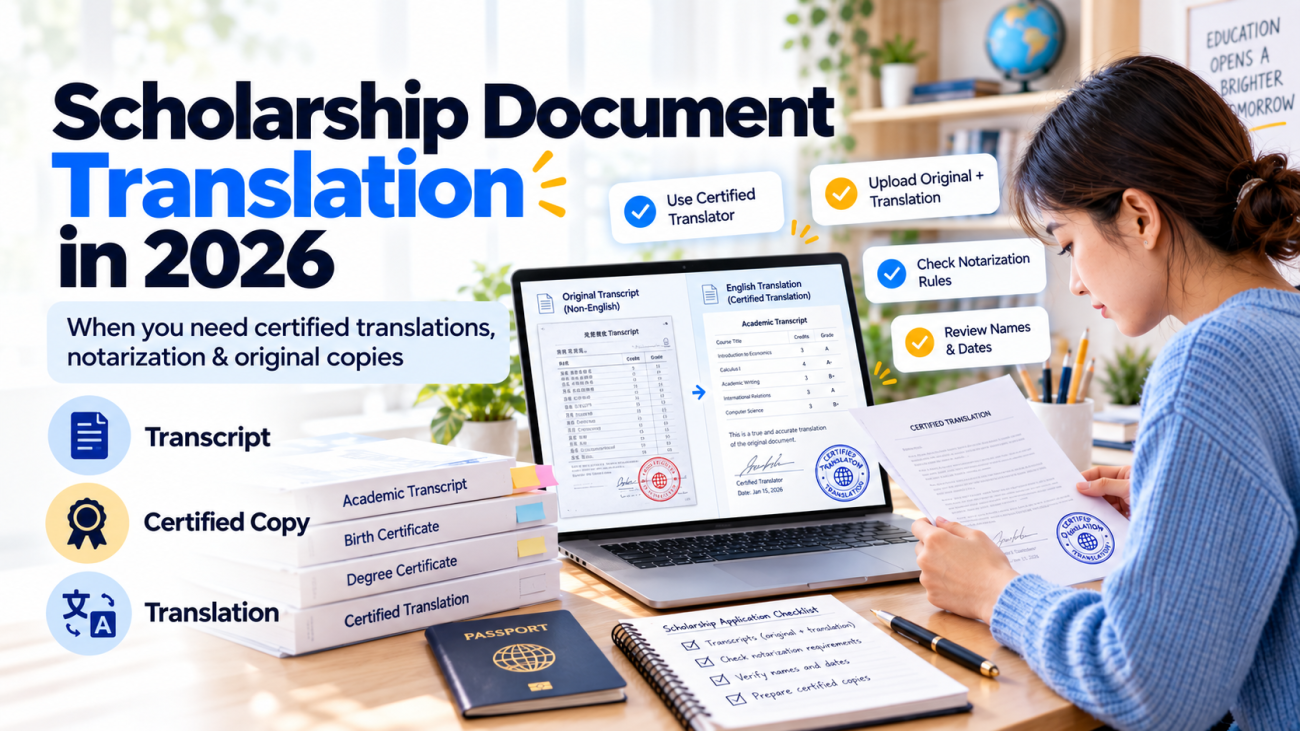
You finally find a scholarship that fits your profile.
Your CV is ready.
Your personal statement is almost finished.
Your professor has agreed to write a recommendation letter.
Then you reach the document section and see something like:
“Academic documents not issued in English must be accompanied by a certified English translation.”
That one sentence creates several new questions.
Can you translate the document yourself?
Does your university need to translate it?
What does “certified translation” actually mean?
Is notarization the same thing?
Should you upload the translated version only, or both the original and translation?
These details can feel small compared with writing a scholarship essay. They can still delay an application or make a document unacceptable.
The requirements are not identical everywhere either. Oxford, UCL, WES, government scholarship programs, and individual universities can use different document rules.
This guide explains scholarship document translation in 2026, including certified translations, notarized copies, academic transcripts, degree certificates, what to upload, and common mistakes international students should avoid.
What Is a Certified Translation?
A certified translation is a translation completed or formally verified by someone accepted under the rules of the institution receiving your documents.
It is not simply an English version of your transcript.
For example, the University of Oxford currently requires applicants whose official transcripts are not in English to provide both the original transcript and an English translation. Oxford accepts translations issued and stamped by the original institution or completed by a professional translator and visibly certified by the translator or an authorized notary. Oxford University
Oxford’s official transcript requirements
The important point is that a translation needs to meet the receiving institution’s rules.
A document that works for one university may not automatically satisfy another.
Do Scholarship Documents Always Need Translation?
No.
You generally need translation when the scholarship, university, or credential evaluator requests documents in a language different from the one in which your originals were issued.
For many English-language programs, documents already issued in English do not need another translation.
If your university provides an official English transcript alongside the local-language version, that may sometimes satisfy the requirement.
You still need to check the specific application instructions.
Your first step should always be:
What does this scholarship or university actually ask for?
Avoid paying for translation, certification, or notarization before knowing whether it is required.
Your Scholarship Documents Checklist 2026 is a useful starting point for identifying which documents each application needs before you begin preparing translations. Peggy Nelsen Design
Which Scholarship Documents May Need Translation?
The answer depends on your application, but international students commonly encounter translation requirements for:
- Academic transcripts
- Degree certificates
- Provisional certificates
- Graduation certificates
- Secondary-school certificates
- Academic references in some cases
- Employment certificates
- Birth certificates
- Civil documents
- Financial documents
Do not translate everything in your personal files simply because one transcript needs translation.
Applications may only require a small number of documents.
Can You Translate Your Own Transcript?
Usually not when the university specifically requests an official or certified translation.
Oxford explicitly states that it does not accept transcripts that applicants have typed or translated themselves. Oxford University
UCL also tells graduate applicants that non-English academic documents must have a full translation prepared by the institution or a registered translator. Applicants must not translate their own documents. UCL
This is important because your English ability is not the issue.
You may understand every word on your transcript perfectly.
The university needs confidence that the translation accurately represents the official academic record.
What Is the Difference Between Translation and Certification?
A translation converts the content from one language into another.
Certification adds confirmation that the translated document has been prepared or verified according to an accepted professional process.
A certified translation may contain information such as:
- Translator’s name
- Signature
- Stamp
- Date
- Professional registration or credentials
- Declaration of accuracy
The exact certification format varies between countries and institutions.
Do not assume that a translation agency’s normal format automatically meets your university’s requirements.
Show the translator the instructions from the university before paying.
What Is a Notarized Translation?
Notarization and translation are different things.
A notary generally verifies signatures, declarations, copies, or other legal formalities according to local rules.
The notary does not necessarily translate your academic document.
Some universities accept a translation certified through an authorized notary.
Others want the translator themselves to be registered or certified.
Oxford, for example, currently allows a translation visibly certified by a professional translator or an authorized notary, alongside translations issued and stamped by the original institution. Oxford University
That does not mean every scholarship requires notarization.
If the instructions say certified translation, do not automatically pay for notarization too.
Certified Copy vs Certified Translation
These terms are easy to confuse.
A certified copy confirms that a copy matches an original document.
A certified translation confirms the translated content.
You may sometimes need both.
Imagine your original degree certificate is in Bengali.
An application might require:
- A copy of the original Bengali degree certificate.
- Certification that the copy is genuine.
- An English translation.
- Certification of the translation.
Another university may only require a scanned original plus a professionally translated version.
Read the exact instructions.
Should You Upload the Original Document Too?
Very often, yes.
This is one of the most important mistakes to avoid.
Oxford currently requires applicants with non-English transcripts to submit both the original official transcript and the English translation. A translated transcript without the original can be rejected. Oxford University
UCL also asks applicants to upload the original-language transcript and the English translation as separate documents when translation is required. UCL
That means this may not be enough:
English translation.pdf
You may need:
Original Transcript.pdf
and
English Translation.pdf
Do not delete or replace the original language document unless the instructions explicitly tell you to.
Why Do Universities Want the Original and Translation?
The translation helps the admissions team understand the document.
The original lets them compare the translation with the source record and verify authenticity.
That is why a translation is usually supporting evidence rather than a replacement for the original.
This same principle appears in credential evaluation.
World Education Services, or WES, explains that when translation is required, it needs an independently translated version in addition to the original academic documentation. WES
WES Translation Requirements in 2026
Students applying to universities, immigration programs, or professional organizations may also need a credential evaluation.
WES is one widely used credential evaluation organization in the United States and Canada.
Its current guidance says that, when translations are required, documents for U.S. evaluations need English translations, while Canadian evaluations may require English or French translations for documents issued in other languages. WES
WES also states that translations should be exact, complete, clear, and prepared by a professional translator rather than the applicant. WES
Always check the current required-document list in your own WES account because requirements can vary by education system and evaluation type. WES
Do Not Translate Only the Important Parts
Your transcript may contain information such as:
- Course titles
- Grades
- Credit hours
- GPA
- Grading scale
- University notes
- Academic standing
- Degree information
Do not tell a translator:
Just translate the subjects and grades.
WES currently requires word-for-word translations of the relevant documentation when translation is requested. WES
A partial translation may leave the evaluator without important context.
What About Degree Certificates?
A transcript and degree certificate are not the same document.
Your transcript normally lists:
- Courses
- Grades
- Credits
Your degree certificate normally confirms:
- Degree title
- Awarding institution
- Completion
- Award date
A scholarship may request one or both.
Oxford notes that a degree certificate cannot normally replace a transcript because it lacks the detailed grade information required for graduate applications. Oxford University
If both documents are not in the required language, both may need translation.
What If Your University Can Issue Documents in English?
This can make the process easier.
Ask your registrar or academic records office whether it can issue:
- Official English transcript
- Bilingual transcript
- English degree certificate
- English academic verification letter
Some universities routinely provide English-language versions for international applications.
If the university itself provides an accepted official English version, you may not need to pay an outside translator.
Check the destination university’s rules first.
University-Issued Translation vs Professional Translation
Both can sometimes be accepted.
Oxford currently accepts an English translation issued and stamped by the institution that issued the original transcript. Oxford University
UCL allows the required translation to be prepared by the applicant’s institution or a registered translator. UCL
If your university offers translation services, this can be convenient because the academic institution is already familiar with:
- Course titles
- Academic terminology
- Grading system
- Degree structure
Ask whether the translated document will contain the required stamp or certification.
Do References Need Translation?
Sometimes.
This is easy to overlook.
Oxford currently states that references should generally be in English unless another language has specifically been permitted or the reference is accompanied by a certified English translation. The reference and translation must still be submitted directly by the referee when required. Oxford University
Do not ask your referee to send you the confidential letter simply because translation is required.
Contact the admissions office if you are unsure how the translation should be handled.
Your Scholarship Application Mistakes in 2026 guide covers several other avoidable document and submission errors that can weaken an otherwise strong application. Peggy Nelsen Design
Do Personal Statements Need Certified Translation?
Usually, application essays are different from official academic documents.
If a university expects your personal statement in English, you normally write the statement in English.
You do not usually write it in your first language and submit a certified translation unless the application specifically allows that.
Oxford’s supporting-document guidance distinguishes applicant-written materials from official transcripts. It notes that applicant-written supporting work may need to be written in English according to the course requirements. Oxford University
Always follow the course-specific instructions.
When Should You Start Translating Documents?
Earlier than you think.
Oxford advises international applicants to allow time to obtain translation before their application deadline. Oxford University
Do not wait until:
Deadline: Friday
Translation request: Thursday evening
A translator may need time to:
- Review documents
- Confirm names and terminology
- Prepare translation
- Certify the finished version
- Correct errors
A good target is to identify translation requirements several weeks before the deadline.
How to Choose a Translator
Do not choose only based on the cheapest price.
First check what the receiving institution requires.
Then ask the translator:
- Are you professionally registered or certified?
- Have you translated academic documents before?
- Will the translation include your signature?
- Will it include your stamp?
- Can you provide a certification statement?
- Can you translate every page?
- Can you provide a digital PDF?
- What is the turnaround time?
Send them the university’s translation requirements.
This avoids paying for a translation you later discover is unusable.
Should the Translator Convert Your GPA?
Usually, no.
A translator’s job is to translate the document accurately.
They should not normally change:
- Grades
- GPA
- Credit values
- Degree classification
If a university needs credential conversion, it will usually handle the process itself or ask for a credential evaluation.
Do not ask a translator to turn:
3.62/4.00
into:
First Class
unless that wording actually appears in the original record or the institution specifically asks for equivalency information.
Translation and credential evaluation are different services.
Translation vs Credential Evaluation
This distinction is important.
Translation
Converts language.
Credential evaluation
Assesses how a qualification compares with another education system.
WES is a credential evaluation organization.
A translator cannot normally provide an official degree equivalency simply because they translated the transcript.
If a university asks for both a certified translation and WES evaluation, you may need to complete both processes separately.
Should You Send Original Physical Documents?
Only when requested.
Do not automatically mail your only original degree certificate to a scholarship provider.
Oxford tells applicants that original hard-copy documents may be requested after an offer, but students should only send originals when specifically instructed. Oxford University
WES similarly advises applicants to follow the precise required-document instructions rather than sending unnecessary original documents. WES
Keep your originals safe.
Can You Scan Translated Documents With Your Phone?
Possibly, if the application accepts uploaded scans and the quality is good.
Make sure:
- All corners are visible
- Text is sharp
- Stamp is readable
- Signature is visible
- No page is missing
- File orientation is correct
Do not submit a dark photograph taken at an angle.
The admissions team should not have to zoom in repeatedly just to read your grades.
Check File Size Before Uploading
Application portals often have file limits.
For example, UCL currently allows several document formats and sets an upload limit for academic transcripts. It also warns applicants not to password-protect documents because admissions staff need to access them. UCL
WES similarly specifies accepted upload formats and file-size requirements for translated documents in its system. WES
Check the portal before creating one enormous high-resolution PDF.
Use Clear File Names
Do not upload:
scan00037.pdf
Use something like:
Rahim_Hasan_Transcript_Original.pdf
Rahim_Hasan_Transcript_English_Translation.pdf
Rahim_Hasan_Degree_Certificate_Translation.pdf
Good file names reduce the chance that you upload the wrong document.
They also make your own application folder easier to manage.
Make Sure Your Name Matches
Suppose your passport says:
Md Rahim Hasan
Your transcript says:
Mohammad Rahim Hasan
Your translation says:
Muhammad Rahim Hassan
That could create unnecessary questions.
A translator should represent the original accurately, but name transliteration can vary between languages.
If your documents contain different established spellings, check whether the application allows you to explain alternative names.
Do not secretly edit official documents to make everything match.
Check Dates Carefully
Date formats can cause problems too.
For example:
03/04/2026
could mean:
- March 4
- April 3
depending on the country.
A professional translator should preserve the meaning of the original correctly.
Review translated:
- Graduation date
- Enrollment date
- Birth date
- Certificate issue date
before submitting.
Check Course Titles
Academic course names can be difficult to translate accurately.
A literal translation may sometimes sound strange in English.
Still, the translator should remain faithful to the official record.
Do not rewrite course names to make your academic history sound more impressive.
For example, do not turn:
Introduction to Programming
into:
Advanced Software Engineering
Accuracy matters more than presentation.
What If the Translation Contains an Error?
Do not edit the certified PDF yourself.
Contact the translator.
Ask them to correct and reissue the document.
Editing a signed or certified translation yourself can undermine its credibility.
Review everything before the application deadline:
- Name
- Degree
- Grades
- Dates
- Institution
- Course names
The best time to notice an error is before uploading it.
Do You Need Notarization for Every Scholarship?
No.
This is one of the easiest ways students waste money.
A scholarship may only require:
scanned copies
Another may require:
certified copies
Another may require:
certified English translations
Another may require:
notarized documents
These are different instructions.
Do not turn a simple $20 translation task into a $150 translation-and-notarization process unless the application requires it.
Can Scholarships Request Certified Documents Later?
Yes.
Some programs use simpler documentation during the initial application and request more formal verification only after selection.
This can save applicants from paying certification costs before they know whether they will progress.
Read the application stages carefully.
Your What to Do After Winning a Scholarship in 2026 guide explains how document requirements can continue after selection through admission, visa, and pre-departure stages. Peggy Nelsen Design
Keep Both Digital and Physical Copies
Create a folder such as:
Scholarship Documents 2026
Inside it:
Academic Records
- Original Transcript
- English Translation
- Degree Certificate
- Degree Translation
Certification
- Translator Certification
- Notary Documents
Applications
- University A
- Scholarship B
Back everything up securely.
You may need the same documents again for:
- Scholarship
- University admission
- Visa
- Credential evaluation
- Enrollment
Do Not Send Sensitive Documents Through Random Channels
Be cautious if someone asks you to send your:
- Passport
- Transcript
- Financial documents
- Birth certificate
through an unknown WhatsApp account or personal email.
Use:
- Official scholarship portal
- University application portal
- Verified institutional email
- Approved credential evaluation service
Academic documents contain personal information.
Treat them carefully.
What If the Scholarship and University Have Different Translation Rules?
Follow both.
Imagine:
Scholarship accepts university-issued English translations.
University requires a professionally certified translation.
You need to meet the stricter university requirement for the admission application.
The scholarship and university are separate organizations.
One organization’s acceptance does not automatically bind the other.
This is similar to conditional university admission and scholarship eligibility. My guide to conditional vs unconditional offers in 2026 explains why university and scholarship requirements need to be checked separately. Peggy Nelsen Design
Should You Translate Documents Before Shortlisting Scholarships?
Not necessarily.
Certified translations can cost money.
First identify realistic opportunities.
Then check which documents they require.
If five scholarships all need your translated transcript, preparing it early makes sense.
If only one program requests a translated employment certificate, you may wait until you decide to apply.
Preparation should save time without creating unnecessary expenses.
Common Scholarship Translation Mistakes
Students often make the same avoidable errors.
Translating the Document Yourself
Many institutions do not accept this for official academic records.
Uploading Only the Translation
The original-language document may also be required.
Translating Only Part of the Transcript
Important academic information may be missing.
Paying for Unnecessary Notarization
Check whether notarization is actually required.
Using an Unqualified Translator
The translation may not meet certification requirements.
Changing Grades or Course Names
Translations should represent the original accurately.
Forgetting Stamps or Signatures
Certification may be incomplete.
Submitting Blurry Scans
Readable originals and translations matter.
Waiting Until the Deadline
Professional translation takes time.
Assuming One Translation Works Everywhere
Each institution can have different rules.
Scholarship Document Translation Checklist for 2026
Before submitting translated documents, confirm:
- I checked the scholarship’s translation requirements.
- I checked the university’s separate requirements.
- I know whether certification is required.
- I know whether notarization is required.
- A qualified translator prepared the document.
- The translation includes all pages.
- My name is correct.
- Grades and dates are correct.
- Translator certification is visible.
- I kept the original-language document.
- Original and translation are uploaded where required.
- Files are readable.
- File sizes meet portal requirements.
- File names are clear.
- I kept backup copies.
This checklist can save you from one of the most frustrating scholarship problems: having the right document in the wrong format.
Frequently Asked Questions About Scholarship Document Translation
Do scholarship transcripts need certified translation?
They may if the original transcript is not in the language accepted by the scholarship or university. Oxford and UCL, for example, currently require appropriate English translations for non-English academic records. Oxford University
Can I translate my own transcript?
Many institutions do not allow applicant-prepared translations. Oxford and UCL both explicitly require accepted institutional or professional translation arrangements for non-English transcripts. Oxford University
Do I upload the original transcript with the translation?
Often, yes. Oxford requires both the original and translated transcript when the original is not in English. Oxford University
Is notarization mandatory?
Not for every scholarship. Some applications accept certified translations without separate notarization.
Can my university translate my academic documents?
Sometimes. Oxford and UCL both allow certain institution-prepared translations under their current rules. Oxford University
Does WES translate documents for applicants?
No. WES says applicants are responsible for obtaining any translation required for their evaluation. WES
Is a translation the same as a credential evaluation?
No. Translation changes the language. Credential evaluation assesses the qualification against another education system.
Should I send my original degree certificate?
Only if the scholarship, university, or evaluator specifically requests the original. Do not send irreplaceable documents unnecessarily.
Final Thoughts
Scholarship document translation in 2026 is one of those tasks that looks simple until you start reading the instructions.
The safest approach is straightforward.
Check the requirement first.
Keep the original document.
Use an accepted translator when certification is required.
Do not assume notarization is necessary.
Upload both the translation and original when requested.
Check every name, grade, and date before submitting.
Most importantly, do not wait until the night before the deadline.
A scholarship committee should be evaluating your academic potential, motivation, and achievements.
Do not let an avoidable document-format problem become the reason your application gets delayed.
Add a Comment