
A scholarship application can ask for several documents.
Your personal statement explains your motivation.
Your recommendation letters show how other people see your abilities.
Your academic transcript provides evidence of your results.
Your CV brings much of that information together in one place.
That sounds simple until you open a blank document.
Should your scholarship CV be one page or two?
Should you include your photo?
What if you do not have much work experience?
Do you need to mention school-level achievements?
Should you use a colorful template?
These questions matter because a scholarship committee may review hundreds or thousands of applications.
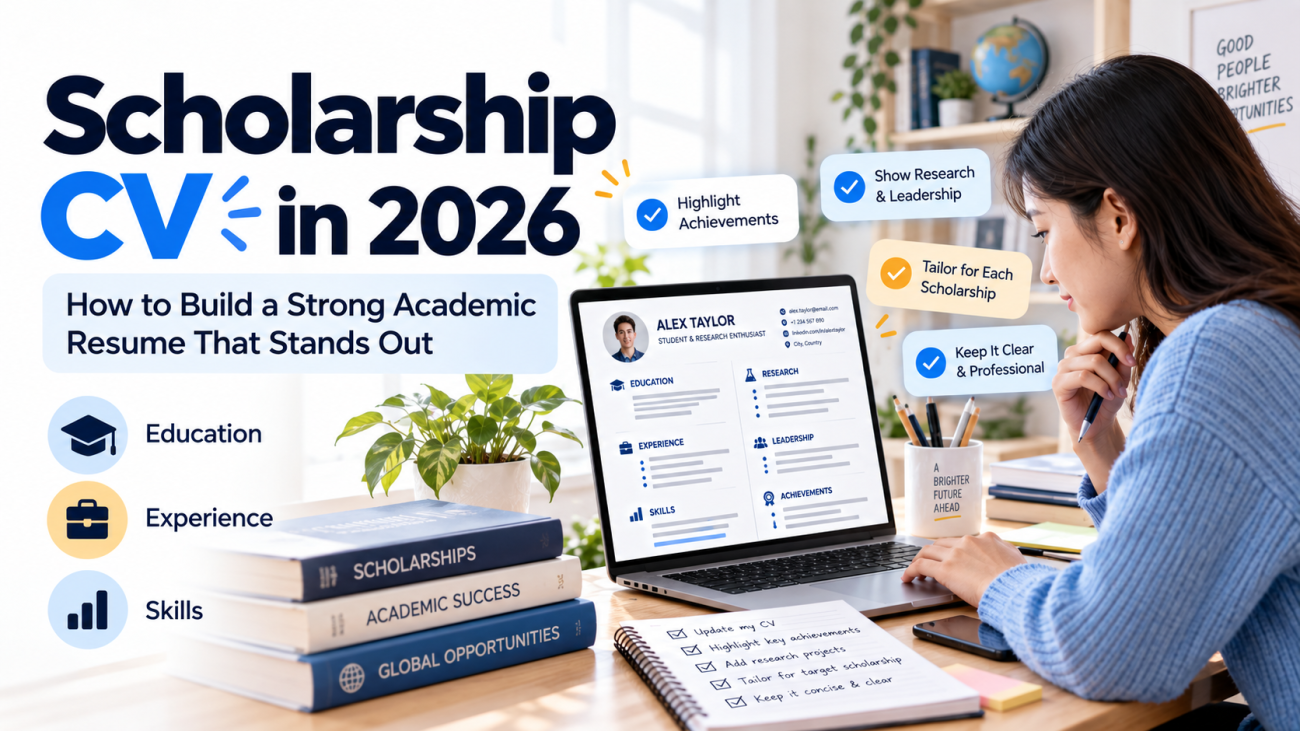
Your scholarship CV in 2026 should make it easy for a reviewer to understand your education, experience, achievements, leadership, research, and skills without searching through several pages of unnecessary information.
This guide explains how to write a scholarship CV that is clear, professional, honest, and tailored to the opportunity you are applying for.
What Is a Scholarship CV?
A scholarship CV is a concise document summarizing the experiences and qualifications relevant to your scholarship application.
Depending on your background, it can include:
- Education
- Academic achievements
- Research
- Employment
- Internships
- Leadership
- Volunteering
- Projects
- Awards
- Publications
- Skills
- Professional training
A scholarship CV is not supposed to tell your entire life story.
It gives the committee a structured overview of the experiences that support your application.
The University of Kansas Center for Undergraduate Research & Fellowships recommends organizing scholarship and fellowship CVs into clear sections and focusing on achievements and outcomes rather than simply listing responsibilities. Curf
University of Kansas scholarship CV guidance
Is a Scholarship CV Different From a Job CV?
Sometimes.
The basic principles are similar, but the emphasis can be different.
A job CV may focus heavily on:
- Professional experience
- Technical skills
- Business achievements
A scholarship CV may give more space to:
- Academic performance
- Research
- Leadership
- Community activities
- Awards
- Projects
- Educational goals
Imagine you are applying for a research scholarship.
Your research assistant experience may deserve more space than a temporary retail job you had two years ago.
If you are applying for a leadership scholarship, your involvement in student organizations may become more important.
The CV should reflect what the scholarship values.
Start by Reading the Scholarship Requirements
Do not create your CV first and investigate the scholarship later.
Look at:
- Eligibility criteria
- Selection criteria
- Scholarship mission
- Required experience
- Application questions
Then ask:
Which parts of my experience provide evidence for these criteria?
If the scholarship emphasizes leadership, make your leadership visible.
If it emphasizes research potential, highlight:
- Research projects
- Publications
- Conferences
- Technical methods
If it focuses on community impact, your volunteering and social initiatives may deserve more attention.
Your CV should help support the story you are telling throughout the rest of the application.
How Long Should a Scholarship CV Be in 2026?
There is no universal length.
Always follow the scholarship’s own instructions first.
For many competitive scholarship and fellowship applications, one to two pages can work well.
The University of Kansas notes that CVs used for many national scholarship competitions typically should stay within two pages. Curf
A PhD applicant with publications, conferences, and several research projects may need more space when the program allows it.
A first-year undergraduate probably does not need four pages.
The goal is not:
How can I fill two pages?
The better question is:
What information genuinely strengthens this application?
Scholarship CV Structure in 2026
A simple structure can work very well.
1. Contact Information
Include:
- Full name
- Professional email
- Phone number if requested
- City and country
- LinkedIn if relevant
- Portfolio or personal academic website if relevant
You usually do not need to include:
- Passport number
- National ID
- Full home address
- Marital status
- Religion
- Sensitive personal information
Only provide information the application actually requires.
Use a professional email address.
Something like:
is better than:
2. Short Profile or Academic Summary
A profile is optional.
If you use one, keep it short.
For example:
Final-year Computer Science student with research experience in medical image analysis and machine learning. Interested in postgraduate study in responsible AI, particularly applications in healthcare. Experienced in collaborative research, student leadership, and Python-based data analysis.
That gives the reader immediate context.
Avoid generic statements such as:
Hardworking, motivated and passionate student seeking opportunities to develop my career.
Those words could describe almost anyone.
Your summary should tell the committee something specific.
3. Education
For most scholarship applicants, education should appear near the top.
Include:
- Degree
- University
- Location
- Dates
- GPA or classification if useful
- Relevant specialization
Example:
BSc in Computer Science
ABC University, Dhaka, Bangladesh
2022–2026
CGPA: 3.78/4.00
You can add relevant information such as:
- Thesis title
- Academic distinction
- Major concentration
Do not include every course you completed unless the scholarship specifically needs them.
Should You Include Your GPA?
Usually, if it strengthens the application or the scholarship requests it.
Do not hide your GPA when the application already asks for your transcript.
If your grading system is unusual, you can write:
CGPA: 3.71/4.00
instead of leaving the reviewer to guess the scale.
4. Research Experience
This section can become important for master’s, PhD, and research-focused scholarships.
For each research experience, include:
- Project title
- Institution
- Role
- Dates
- Your contribution
Weak example:
Worked on a machine learning research project.
Better:
Preprocessed chest X-ray datasets, trained convolutional neural network baselines, and evaluated classification performance using accuracy, precision, recall, and F1-score.
The second version tells the reader what you actually did.
If you are pursuing research funding, your CV can support the proposal without repeating it.
My Scholarship Research Proposal 2026 guide explains how research questions, methodology, literature gaps, and expected contributions fit together in a scholarship application.
5. Work Experience and Internships
You do not need ten years of professional experience to have a useful scholarship CV.
Include experience relevant to your application.
For each position:
Job title
Organization
Dates
Then add two or three strong points explaining your work.
Avoid turning each role into a job description.
Weak:
Responsible for managing social media.
Better:
Planned and scheduled weekly content across three platforms, increasing average monthly engagement by 28% over four months.
Focus on contribution and outcome.
The University of Kansas specifically recommends emphasizing accomplishments and outcomes rather than only duties. Curf
Use Strong Action Verbs
Good CV bullet points often begin with clear verbs.
Examples include:
- Developed
- Coordinated
- Led
- Designed
- Analyzed
- Researched
- Implemented
- Presented
- Organized
- Improved
- Published
- Mentored
Europass also recommends using clear language and strong verbs when describing your experience. Europass
6. Leadership Experience
Scholarship committees often care about leadership.
Leadership does not mean you had to be president of something.
You may have demonstrated leadership by:
- Managing a student project
- Organizing an event
- Mentoring classmates
- Starting an initiative
- Coordinating volunteers
- Solving a team problem
Example:
Project Lead – Student Technology Club
2025–2026
- Coordinated an eight-member team delivering monthly coding workshops.
- Organized four beginner programming sessions attended by more than 180 students.
- Introduced a volunteer scheduling system that reduced last-minute cancellations.
This is much stronger than writing:
Good leadership skills.
Show the evidence.
7. Volunteering and Community Experience
Volunteering can strengthen a scholarship application when it demonstrates:
- Commitment
- Responsibility
- Leadership
- Social impact
Do not include volunteering only to make your CV look longer.
Explain what you actually contributed.
For example:
Tutored 12 secondary-school students in mathematics through a weekend education program over six months.
That gives the committee something concrete.
8. Academic Projects
Students with limited professional experience can use projects to show ability.
This is especially useful in:
- Computer science
- Engineering
- Design
- Business
- Research
For each project, explain:
- What you built or studied
- Your role
- Tools used
- Result
For example:
Inventory Management Web Application
- Built a responsive inventory management system using React and Node.js.
- Designed stock alerts, sales reporting, and role-based user access.
- Worked in a four-person team using Git for version control.
This is useful evidence of practical skills.
9. Awards and Scholarships
Include meaningful achievements.
Examples:
- Dean’s List
- Academic merit award
- Research competition
- Hackathon award
- Previous scholarship
- Department distinction
You do not need to write a long paragraph about each one.
Example:
Dean’s List, ABC University — 2024, 2025
Keep it easy to scan.
10. Publications and Conferences
If you have academic publications, include them where relevant.
You could use a section called:
Publications
or:
Research Publications & Presentations
Do not claim papers that are still incomplete as published.
You can clearly label different statuses:
- Published
- Accepted
- Under review
- Conference presentation
Accuracy matters.
11. Skills
Your skills section should be specific.
Weak:
- Communication
- Teamwork
- Microsoft Office
- Hardworking
Better:
Programming: Python, JavaScript, SQL
Data Analysis: Pandas, NumPy, scikit-learn
Web: React, Next.js
Languages: Bengali — Native, English — Professional working proficiency
Soft skills are easier to prove through experience than by listing them.
Instead of writing:
Leadership
show leadership in your experience section.
12. Languages
Language skills can matter for international scholarships.
Be realistic.
You can use descriptions such as:
- Native
- Fluent
- Professional working proficiency
- Intermediate
- Beginner
If you have an official test score, include it if useful.
For example:
English: IELTS Academic 7.5
Do not write “Fluent” if you would struggle to communicate in an interview.
Do You Need a Photo on a Scholarship CV?
It depends on the application and country.
Some European CV formats commonly allow photographs.
Other scholarship systems do not expect them.
Do not automatically add a photo because a template includes space for one.
Follow the scholarship’s own instructions.
If a photo is optional, the quality of your academic and professional information matters much more.
Should You Use Europass?
Sometimes.
Europass is an official European Union tool that lets users create and store CVs for employment, education, training, and other opportunities. Europass
Europass can be useful when:
- The scholarship requests it.
- You are applying to an institution that expects the format.
- You want a straightforward standardized CV.
It is not automatically required for every European scholarship.
If the scholarship does not specify Europass, you can often submit your own clean CV instead.
Europass itself encourages applicants to tailor their CV rather than include every experience they have ever had. Europass
This is important.
A template is not a replacement for good content.
Tailor Your Scholarship CV for Each Application
Avoid sending exactly the same CV to every scholarship.
You do not need to redesign the document every time.
Change the emphasis.
Suppose Scholarship A values research.
Your order might be:
Education
Research
Publications
Projects
Experience
Leadership
Scholarship B focuses on leadership.
Your order might become:
Education
Leadership
Community Impact
Experience
Projects
Research
The information is still truthful.
You are simply showing the most relevant evidence first.
Europass recommends tailoring your CV to the specific opportunity and focusing on information relevant to the role or course. Europass
Match Your CV With Your Personal Statement
Your CV and personal statement should support each other.
Suppose your essay says:
Leading community education initiatives has become one of the most important parts of my development.
The committee should be able to find evidence of that work somewhere in your application.
Your CV may show:
Coordinated a weekend tutoring program serving 60 secondary-school students.
Now your statement has evidence behind it.
Match Your CV With Your Recommendation Letters
Your referee may also mention experiences listed in your CV.
This consistency can strengthen the application.
Before asking someone to recommend you, send them an updated CV.
Your existing Scholarship Recommendation Request Email in 2026 guide explains what supporting documents to provide your recommender and how to ask professionally. Peggy Nelsen Design
Keep Your Scholarship Documents Consistent
Imagine your CV says:
Internship: June 2025–December 2025
Your application form says:
July 2025–December 2025
Your recommendation letter says:
Eight-month internship
That creates unnecessary confusion.
Before submitting, compare:
- CV
- Application form
- Personal statement
- Transcript
- Employment documents
- Recommendation information
Dates, titles, and organization names should be consistent.
Your Scholarship Documents Checklist 2026 can help organize these documents before submission. Peggy Nelsen Design
What If You Have Little Work Experience?
Do not panic.
Scholarships for students do not always expect a long employment history.
Focus on what you actually have:
- Academic projects
- Research
- Coursework
- Volunteering
- Student clubs
- Competitions
- Freelance work
- Internships
A university student with no full-time job can still have a strong CV.
The committee wants evidence of potential.
What If You Have No Major Awards?
Do not invent an Awards section just because you think every CV needs one.
If you have no meaningful awards, leave the section out.
Use the space for stronger evidence.
A clean one-page CV is better than a two-page CV padded with weak information.
Should You Include School Achievements?
For undergraduate scholarships, school achievements can still be relevant.
For postgraduate applicants, secondary-school activities usually become less important once you have stronger university-level experience.
There are exceptions.
A major national or international achievement can remain worth including.
Use judgment.
Scholarship CV Formatting in 2026
A good scholarship CV should be easy to skim.
Use:
- Clear headings
- Consistent spacing
- Readable font
- Bullet points
- Simple formatting
- Enough white space
The University of Kansas recommends a readable main font in roughly the 10–12 point range for scholarship and fellowship CVs. Curf
Avoid:
- Five different fonts
- Large decorative graphics
- Complex charts
- Skill bars
- Huge icons
- Extremely small text
The CV is an information document.
The design should help people read it.
Should Your Scholarship CV Be Colorful?
A small amount of color is usually fine when the application allows it.
Do not make the design more noticeable than your achievements.
A clean black-and-white CV can be completely effective.
Scholarship committees usually care more about:
- Relevance
- Clarity
- Evidence
- Accuracy
than whether you used a fashionable template.
Use Reverse Chronological Order
Within most sections, place your newest experience first.
For example:
2026 — Research Assistant
2025 — Software Intern
2024 — Student Volunteer
Europass recommends reverse chronological organization so readers can see your recent experiences first. Europass
Use Numbers Carefully
Numbers can make achievements more understandable.
Instead of:
Organized events.
write:
Coordinated three career workshops attended by more than 300 students.
Instead of:
Managed social media.
write:
Managed weekly content across three channels and increased average engagement by 22% over six months.
Only use numbers you can support.
Never invent statistics to make a CV look stronger.
Scholarship CV Before-and-After Example
Weak:
Student Club President
- Responsible for club activities.
- Organized events.
- Managed members.
Stronger:
President — Computer Science Club
- Led a 12-member executive team serving more than 400 registered students.
- Organized five technical workshops and two industry networking sessions.
- Introduced monthly planning meetings that improved volunteer coordination across events.
The stronger version tells the reviewer what happened.
Keep Bullet Points Short
Your CV is not a personal statement.
Avoid writing paragraphs under every role.
A useful bullet usually explains:
Action + context + result
For example:
Developed a Python-based data-cleaning pipeline that reduced manual preprocessing time for a university research dataset.
That is enough.
Avoid Exaggerated Language
You do not need sentences such as:
Revolutionized the organization’s operational ecosystem through transformational leadership.
Write:
Introduced a shared task system that reduced missed project deadlines.
Specific language feels more credible.
Check Your CV Before a Scholarship Interview
Anything in your CV can become an interview question.
If you write:
Led a community project serving 500 people.
be ready to explain:
- What the project did
- What your responsibility was
- What challenge you faced
- What result you achieved
Your Scholarship Interview in 2026 guide explains how to turn experiences like these into natural interview answers using specific examples rather than memorized speeches. Peggy Nelsen Design
Do Not Include Experiences You Cannot Explain
This sounds obvious.
Students sometimes make small activities sound much larger on paper.
If you attended one event, do not claim:
Led a national initiative.
If you helped with part of a project, do not claim full ownership.
A scholarship interview can expose exaggerated claims very quickly.
Use the strongest accurate version of your experience.
Scholarship CV File Name
Do not submit:
cvnewfinalFINAL2.pdf
Use something professional.
For example:
Sarah_Ahmed_Scholarship_CV_2026.pdf
The same principle applies to the rest of your documents.
Clear file names make your application easier to manage.
Save Your CV as a PDF
PDF usually preserves formatting better when uploaded or opened on another device.
Use PDF unless the scholarship requests another format.
Before uploading:
- Open the PDF.
- Check every page.
- Click any links.
- Look for missing characters.
- Confirm that no text is cut off.
Do not assume the export worked correctly.
Create a Master Scholarship CV
This is one of the easiest ways to speed up future applications.
Create one longer master CV containing all your useful experience.
For example:
Master_Scholarship_CV_2026
It can include:
- Education
- All projects
- All internships
- Research
- Volunteering
- Awards
- Courses
- Leadership
Then create a shorter customized version for each opportunity.
Do not submit the master version automatically.
It is your personal source document.
Can AI Help Write a Scholarship CV?
Yes, but use it carefully.
AI can help you:
- Improve bullet points
- Remove repetition
- Identify weak descriptions
- Reorganize sections
- Shorten unnecessary language
It should not invent:
- Achievements
- Jobs
- Research
- Statistics
- Awards
- Skills
A useful way to use AI is to provide a factual description such as:
I organized weekly coding workshops for around 40 students for six months.
Then ask it to make the sentence concise.
You remain responsible for making sure every statement is accurate.
Scholarship CV Checklist for 2026
Before submitting your CV, confirm:
- My name and contact details are correct.
- Education information matches my transcript.
- Dates match the rest of my application.
- The most relevant experience appears early.
- Bullet points describe achievements rather than only responsibilities.
- I use specific evidence where possible.
- There are no exaggerated claims.
- The CV is easy to scan.
- The font is readable.
- Formatting is consistent.
- The CV is tailored to the scholarship.
- Spelling and grammar are checked.
- The file name is professional.
- The final PDF opens correctly.
Do not submit until you are comfortable discussing everything on the page.
Frequently Asked Questions About Scholarship CVs
How long should a scholarship CV be in 2026?
Follow the scholarship’s requirements. Many competitive scholarship CVs can fit within one or two pages. The University of Kansas notes that many national scholarship competitions typically expect no more than two pages. Curf
Should I use a Europass CV for scholarships?
Use Europass when the scholarship requests or prefers it. Europass is an official EU tool for creating CVs for jobs, education, training, and other opportunities, but it is not mandatory for every European scholarship. Europass
Should I include a photo?
Only when appropriate for the scholarship and country. Do not assume a photo is required.
What should I include if I have no work experience?
Use academic projects, volunteering, research, clubs, internships, competitions, and other relevant experiences.
Should I include references on my CV?
Usually, recommendation letters are submitted separately. Include referee information on the CV only when the scholarship requests it.
Should my scholarship CV include hobbies?
Only when they are relevant or reveal something meaningful. Your limited CV space is usually better used for academic and professional evidence.
Can I use the same CV for every scholarship?
Use a master CV as your base, but tailor the final version to each scholarship’s priorities.
Final Thoughts
A strong scholarship CV in 2026 does not need complicated graphics or impressive vocabulary.
It needs useful information.
Show your education.
Show what you have done.
Show the impact where you can.
Keep the structure clean.
Make the most relevant experiences easy to find.
Tailor the document to the scholarship.
Most importantly, make sure the person described on the CV is actually you.
Your CV should not try to make you look perfect.
It should help the scholarship committee understand why your real experiences, achievements, and potential deserve closer attention.
Add a Comment