
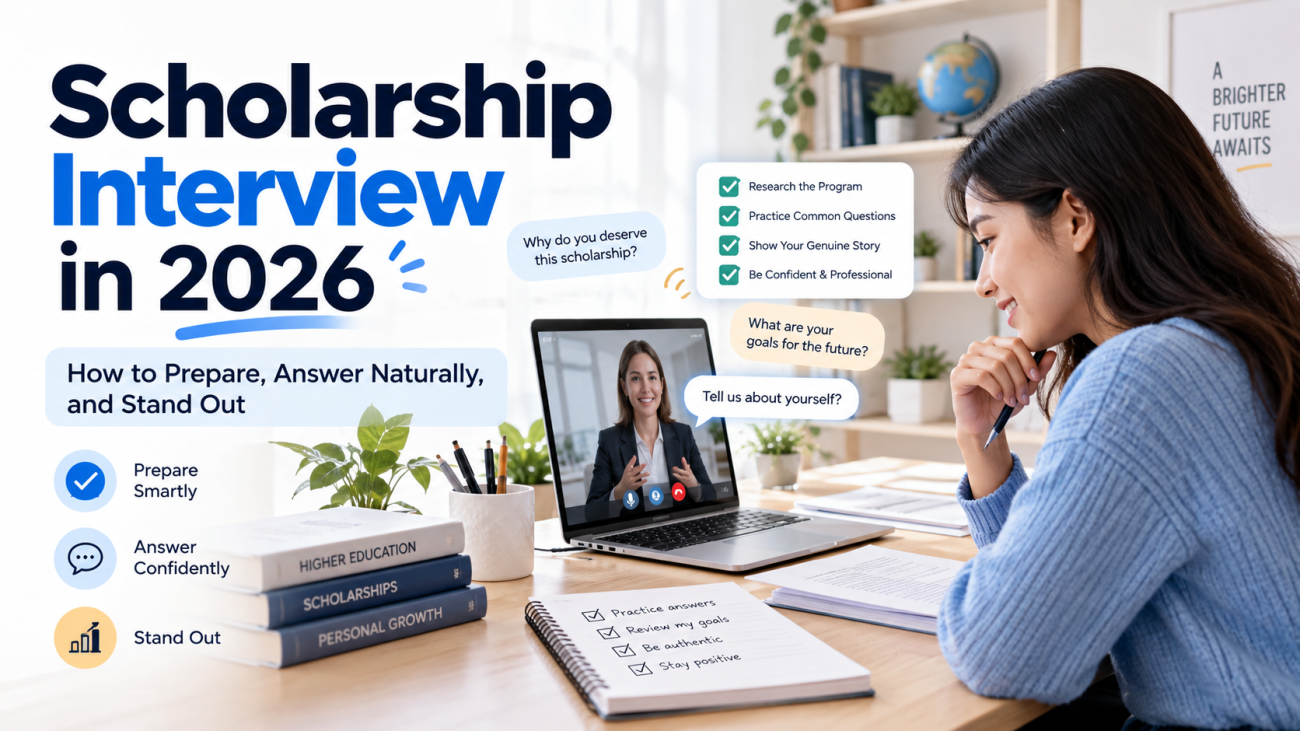
Getting invited to a scholarship interview feels exciting for about five minutes.
Then the questions start in your head.
What are they going to ask?
How long should my answers be?
What if I forget everything?
Should I memorize answers?
What if they ask something completely different from what I prepared?
A scholarship interview can feel intimidating because you know you have already made it through an important part of the selection process. Your application was strong enough to get attention, and now the scholarship panel wants to understand the person behind it.
The good news is that good interview preparation is not about memorizing perfect speeches.
It is about knowing your own application, understanding your goals, and being able to explain your experiences clearly.
This guide explains how to prepare for a scholarship interview in 2026, what questions you should expect, how to structure your answers, what mistakes to avoid, and how to sound confident without sounding scripted.
What Is a Scholarship Interview?
A scholarship interview is usually one of the final stages of a competitive selection process.
The panel may want to understand:
- Why you want the scholarship
- Why you chose your course
- Why you chose your university
- Your academic interests
- Your leadership experience
- Your career plans
- Your achievements
- How you handle challenges
- How the scholarship connects to your future
Different scholarships use different interview formats.
DAAD notes that scholarship providers may invite shortlisted candidates to interviews, evaluation rounds, workshops, presentations, or group discussions depending on the organization and funding program. www.daad.de
That is why you should always check the official instructions for your specific scholarship.
Being Invited to an Interview Is Already a Positive Sign
You should take the interview seriously.
At the same time, remember what the invitation means.
The scholarship provider has already reviewed your application and decided that you are worth speaking with.
For Chevening, applicants invited to interview have already demonstrated evidence in areas such as leadership, relationship building, career planning, and understanding how studying in the UK fits their goals. Chevening
Your job in the interview is not to become a completely different person.
It is to explain the person they already saw in the application more clearly.
If you are still at the application stage rather than interview stage, my Scholarship Shortlisting in 2026 guide can help you focus on scholarships that actually match your profile. Peggy Nelsen Design
Start by Reading Your Application Again
This should be one of the first things you do after receiving an interview invitation.
Months may have passed since you submitted the application.
You may have forgotten the examples you used.
Go back and read:
- Personal statement
- Scholarship essays
- CV
- Career plan
- Course choices
- Leadership examples
- Research proposal if applicable
Chevening scholars repeatedly recommend revisiting your original application before the interview because the discussion can build on the experiences and goals you already presented. Chevening
Do not memorize the exact sentences.
Understand the ideas behind them.
Make Sure Your Story Still Makes Sense
Your application should connect logically.
For example:
Your past experience led to your current interest.
Your chosen course helps you develop specific skills.
Those skills help you reach a realistic career goal.
The scholarship makes that path possible.
If these pieces feel disconnected, the panel may notice.
Think of your interview as one connected story rather than ten unrelated answers.
Prepare the Five Questions You Almost Certainly Need to Understand
You cannot predict every question.
You can prepare the areas that most scholarship interviews commonly explore.
Why do you want this scholarship?
Avoid:
Because it is fully funded.
Funding matters, of course.
The panel usually wants to understand why this particular scholarship fits your goals.
Think about:
- Academic opportunities
- Professional network
- Leadership development
- International exposure
- Research opportunities
- Scholarship community
Your answer should explain what the scholarship provides beyond money.
Why This Course?
This sounds simple.
It is one of the most important questions.
Chevening’s official course-choice guidance recommends connecting your chosen course directly to your background, career goals, and the skills you need to develop. Chevening
Instead of:
I chose MSc Data Science because data science is growing rapidly.
Try something closer to:
During my undergraduate project, I worked with health data and realized that I could build models but lacked deeper knowledge of statistical learning and responsible AI. The modules in this master’s directly address those gaps, which is why the program fits the work I want to do next.
Now the answer connects your past, present, and future.
Why This University?
Do not answer:
Because it is a top-ranked university.
Rankings can be relevant.
They should not be your entire answer.
Look at:
- Specific modules
- Research groups
- Faculty interests
- Facilities
- Industry partnerships
- Teaching approach
- Alumni network
Show that you actually researched the institution.
Why You?
This question may not always be asked directly.
It can appear as:
Why should we select you?
What makes you a strong candidate?
What will you contribute to the scholarship community?
This is where many candidates become too modest.
Chevening identifies excessive modesty as a common interview mistake because applicants sometimes downplay achievements that would help the panel understand their leadership or impact. Chevening
You do not need to brag.
You need to provide evidence.
What Will You Do After Graduation?
This is where vague answers become dangerous.
Avoid:
I want to help my country.
That is a good intention.
It is not a career plan.
A stronger answer might explain:
Short term: work as a data analyst in public health.
Medium term: lead analytics projects involving disease surveillance.
Long term: build or lead systems that improve data-driven healthcare decisions nationally.
Chevening’s current criteria emphasize clear short-, medium-, and long-term goals that are realistic and measurable. Chevening
Use the STAR Method for Experience Questions
One of the easiest ways to structure a strong answer is the STAR method.
S — Situation
What was happening?
T — Task
What was your responsibility?
A — Action
What did you personally do?
R — Result
What happened because of your actions?
Chevening’s 2026 interview guidance specifically recommends STAR for competency-based questions and suggests putting most of the emphasis on your actions and measurable results. Chevening
STAR Method Example
Imagine the question is:
Tell us about a time you demonstrated leadership.
Weak answer:
I was the leader of my university project, and I helped everyone work together.
Stronger answer:
Situation: Our final-year software project was three weeks behind schedule.
Task: As team lead, I needed to reorganize the work before the final presentation.
Action: I separated the remaining tasks into frontend, backend, and testing responsibilities, introduced short daily check-ins, and personally helped two members resolve integration problems.
Result: We completed the project two days before the deadline and received one of the highest marks in the class.
This answer gives the panel evidence.
Focus on What You Did
A common problem with leadership answers is using “we” for everything.
We organized the event.
We solved the problem.
We increased participation.
The panel needs to know what you contributed.
You can acknowledge the team while explaining your role.
For example:
Our team organized the event, and my responsibility was coordinating the speakers and building the registration process.
That sounds collaborative without hiding your contribution.
Use Numbers When They Actually Add Meaning
Numbers make impact easier to understand.
Compare:
I organized several workshops.
with:
I coordinated three workshops attended by around 250 students.
Or:
I improved the process.
with:
The new process reduced average response time from three days to one day.
Do not invent numbers just to sound impressive.
Use real evidence.
Prepare More Than One Example
Do not use the same university project for every question.
Prepare a small collection of stories.
You might have examples involving:
- Leadership
- Teamwork
- Failure
- Conflict
- Initiative
- Research
- Volunteering
- Problem-solving
- Professional responsibility
One experience can support multiple answers, but variety makes your application feel deeper.
Prepare for “Tell Me About a Failure”
This question makes students nervous.
Do not pretend you have never failed.
Avoid fake weaknesses such as:
My biggest weakness is that I work too hard.
Choose a real example that you can discuss professionally.
A useful structure is:
What happened → what you learned → what changed afterward
For example:
During my first group project, I tried to handle too much myself instead of delegating. We finished the work, but I realized that I had created unnecessary pressure for the team. In later projects, I started assigning responsibilities earlier and using weekly progress reviews.
The important part is not the failure.
It is what you learned.
Prepare for Questions About Your Country or Community
Some international scholarships want to understand the challenges you hope to address after graduation.
You may be asked:
What problem in your country do you want to work on?
Avoid giving a speech about every national problem.
Choose something connected to your field.
For example:
If you study public health, discuss a public-health issue.
If you study renewable energy, discuss an energy challenge.
If you study education technology, discuss a relevant education problem.
Then explain how your studies connect to that issue.
Research Your Course Properly
Know more than the course title.
Look at:
- Core modules
- Optional modules
- Dissertation or project requirements
- Research centers
- Faculty expertise
Chevening’s application criteria explicitly expect candidates to demonstrate that they have researched their course and can explain how relevant modules will help them develop the skills needed for their goals. Chevening
Choose two or three specific academic features you can discuss naturally.
Know Why You Chose the Country
If your scholarship is tied to a destination, you may be asked:
Why study there?
Avoid answers based mainly on tourism.
Instead, think about:
- Academic ecosystem
- Research strengths
- Professional networks
- Industry
- Teaching approach
- International collaboration
The answer should connect to your academic and career goals.
Do a Mock Interview
Mock interviews are useful because thinking about an answer is different from saying it out loud.
Ask someone to interview you.
Give them questions such as:
- Why this scholarship?
- Why this university?
- Why this course?
- Tell me about your leadership.
- What are your career goals?
- Tell me about a failure.
- What impact do you want to create?
Chevening scholars recommend mock interviews because they help candidates become comfortable answering questions and identifying weak points. They also warn that too much rehearsal can make answers sound mechanical. Chevening
One or two thoughtful mock interviews can be more useful than ten rehearsed performances.
Record Yourself Answering Questions
Your phone is enough.
Record yourself answering one question.
Then watch it.
You may notice:
- Answers are too long
- You repeat yourself
- You speak too fast
- You avoid the actual question
- You use too many filler words
- Your examples lack results
This can feel uncomfortable.
It is also extremely useful.
Do Not Memorize Full Answers
This is one of the biggest scholarship interview mistakes.
You memorize:
“My passion for sustainable development was cultivated during my undergraduate journey…”
Then the interviewer changes the question slightly.
Suddenly your memorized answer no longer fits.
Instead, memorize points.
For example:
Leadership example
- Student club
- Attendance problem
- Introduced registration system
- 200+ participants
- Learned delegation
Now you can adapt those points to several different questions.
A 2026 Chevening scholar similarly recommends building connections between your experiences and goals rather than memorizing complete scripts. Chevening
It Is Okay to Pause Before Answering
You do not need to answer within half a second.
A short pause can make your answer better.
Chevening’s interview guidance explicitly notes that candidates can pause to think and ask for clarification when needed. Chevening
If necessary, say:
That’s a good question. Let me think for a moment.
Then answer.
That sounds more natural than panicking and talking without direction.
Ask for Clarification If You Do Not Understand
There is nothing wrong with saying:
Could you please repeat the question?
or:
Do you mean my academic experience specifically, or my professional experience as well?
Understanding the question is more important than pretending you understood it.
Keep Your Answers Focused
Some candidates think longer answers sound more impressive.
They often do not.
A three-minute answer full of unrelated detail can be weaker than a focused 60-second answer.
For many questions, this structure works well:
Direct answer
Example
Result
Connection to scholarship
You do not need to explain everything you have ever done.
Do Not Turn Every Answer Into a Speech
The interview should feel like a conversation.
Chevening’s recent interview guidance describes the process as a conversation rather than an interrogation and encourages candidates to support their motivation with concrete examples. Chevening
Listen carefully.
Answer what was asked.
Allow follow-up questions.
Know Your CV
Anything on your CV may become a question.
If your CV says:
Research Assistant — Machine Learning Project
be ready to explain:
- What the project was
- Your role
- What you learned
- Your contribution
Do not include achievements you cannot comfortably discuss.
Be Ready to Explain Your Research
Research applicants may receive questions such as:
- Why this research problem?
- What is the research gap?
- Why this methodology?
- What data will you use?
- What limitations do you expect?
If you are applying for research funding, your proposal should be something you understand rather than something that merely sounds academic.
If this is your situation, my Scholarship Research Proposal in 2026 guide can be used alongside your interview preparation to organize your research question, gap, methodology, and expected contribution.
What Should You Wear?
Dress professionally.
You do not necessarily need the most formal outfit you own.
For Chevening interviews, official guidance recommends business-casual clothing that is professional but comfortable. Chevening
The goal is simple:
Look prepared without spending the entire interview worrying about your clothes.
If the Interview Is Online
Check your setup beforehand.
Test:
- Camera
- Microphone
- Internet
- Lighting
- Meeting link
- Laptop charger
Choose a quiet place.
Keep your phone on silent.
Have your application nearby for reference, but do not spend the interview reading from it.
Look at the camera when speaking when possible.
If the Interview Is In Person
Confirm:
- Location
- Time
- Required documents
- Identification
- Travel time
Arrive early enough that a traffic problem does not turn into panic.
Do not arrive one hour early and sit nervously outside the room.
Around 15–20 minutes early is normally comfortable unless your scholarship provides different instructions.
Bring the Documents They Request
Depending on the scholarship, you may need:
- Passport or ID
- Degree certificate
- Reference letters
- Academic documents
- Interview invitation
Chevening’s current application guidance states that shortlisted candidates need to upload specified reference letters and their undergraduate degree certificate before the relevant deadline. Chevening
Check your own scholarship instructions carefully.
Your Scholarship Documents Checklist 2026 can also help keep your interview paperwork organized.
Do Not Lie or Exaggerate
If you say:
I led 500 volunteers.
the panel may ask:
How did you organize them?
If the real number was 20, you are now in trouble.
Use your real achievements.
You do not need to make them sound bigger.
Specific and honest experiences are usually much easier to discuss convincingly.
Do Not Copy Someone Else’s Story
Watching successful scholarship interviews online can be useful.
Copying their answers is not.
Their:
- Background
- Career goals
- Leadership
- Country context
are different from yours.
Use other candidates to understand structure.
Use your own experiences for content.
Avoid Generic Career Plans
Chevening interview guidance repeatedly emphasizes that candidates should be specific and realistic about future goals rather than presenting broad ambitions without a practical path. Chevening
Instead of:
I want to become a global leader.
Explain:
After graduation, I plan to return to the telecommunications sector and work in data infrastructure. Within five years, I want to lead projects focused on expanding reliable digital services outside major cities.
That gives the panel something concrete.
What If You Do Not Know an Answer?
Do not invent one.
You can say:
I haven’t looked at that issue deeply enough to give you a confident answer, but based on what I know…
Then explain what you do know.
That is better than confidently making something up.
Should You Ask Questions at the End?
If the panel gives you the opportunity, yes.
Ask something meaningful.
Chevening advises candidates not to use this opportunity for questions that can easily be answered on its website. Chevening
Better questions might explore:
- Scholar network
- Professional engagement opportunities
- Alumni collaboration
- Program activities
Avoid asking:
How much is the stipend?
if the answer is already clearly published.
Common Scholarship Interview Mistakes
Memorizing Complete Answers
You risk sounding robotic.
Talking Too Much
Answer the actual question.
Being Too Modest
Explain your contribution clearly.
Giving Generic Examples
Use real situations.
Not Knowing Your Own Application
Read it again.
Saying Only What You Think the Panel Wants to Hear
Authenticity matters.
Giving Unrealistic Career Plans
Ambition is good. A believable path is better.
Failing to Research the Course
Know why it fits your goals.
Panicking After One Weak Answer
One imperfect answer does not automatically destroy an interview.
Move on.
A 7-Day Scholarship Interview Preparation Plan
If your interview is one week away, you can organize your preparation like this:
Day 1: Re-read your complete application and CV.
Day 2: Research your course, university, and scholarship.
Day 3: Prepare leadership, teamwork, failure, and impact examples.
Day 4: Refine your short-, medium-, and long-term career goals.
Day 5: Complete a mock interview.
Day 6: Review weak answers and prepare interview logistics.
Day 7: Light review only. Rest and prepare for the interview.
Do not spend the final night memorizing answers until 3 AM.
Scholarship Interview Checklist for 2026
Before your interview, confirm:
- Application reviewed
- CV reviewed
- Scholarship mission understood
- Course researched
- University researched
- Career plan clear
- Leadership example ready
- Teamwork example ready
- Failure example ready
- Impact example ready
- STAR structure practiced
- Mock interview completed
- Documents ready
- Interview location or online link confirmed
- Technology tested if online
Preparation should make you more comfortable.
It should not turn you into a script.
Frequently Asked Questions About Scholarship Interviews
What questions are asked in scholarship interviews?
Questions vary, but common themes include your motivation, course choice, university choice, leadership, achievements, career plans, and how the scholarship connects to your future.
Should I memorize scholarship interview answers?
It is better to prepare key ideas and examples rather than memorizing complete scripts. Over-rehearsed responses can sound mechanical. Chevening
How should I answer leadership questions?
The STAR method can help you explain the situation, your responsibility, your actions, and the result. Chevening’s 2026 interview guidance specifically recommends this approach. Chevening
What if I get nervous?
Pause before answering. Focus on the question rather than trying to remember a prepared script. Asking for clarification is also acceptable when needed. Chevening
Should I mention weaknesses?
Be honest when relevant, but explain what you learned and how your behavior changed.
How long should a scholarship interview answer be?
There is no universal time limit for each answer. Aim to answer clearly and directly rather than filling time unnecessarily.
What should I do after the interview?
Follow any instructions from the scholarship provider and monitor your official email or application portal. If the result is not successful, your Scholarship Rejection in 2026 guide explains how to review the experience and prepare for another application. Peggy Nelsen Design
Final Thoughts
A scholarship interview in 2026 is not a competition to see who can memorize the most impressive answers.
The panel wants to understand you.
Know your application.
Know your experiences.
Know why you chose the course.
Know where you want to go after graduation.
Prepare examples that prove what you have done.
Practice explaining them clearly.
Then stop trying to sound like the perfect scholarship candidate.
Speak like yourself, with better preparation.
You may not control every question the panel asks.
You can control how well you understand your own story.
And that is usually the strongest preparation you can take into the room.
Add a Comment