
Scholarship applications often feel overwhelming for one simple reason: too many things need to happen at the same time.
You may need to prepare transcripts, ask for recommendation letters, take an English-language test, write a personal statement, update your CV, research universities, and still keep track of deadlines.
The problem is not always that the application is difficult.
The problem is that students often start too late.
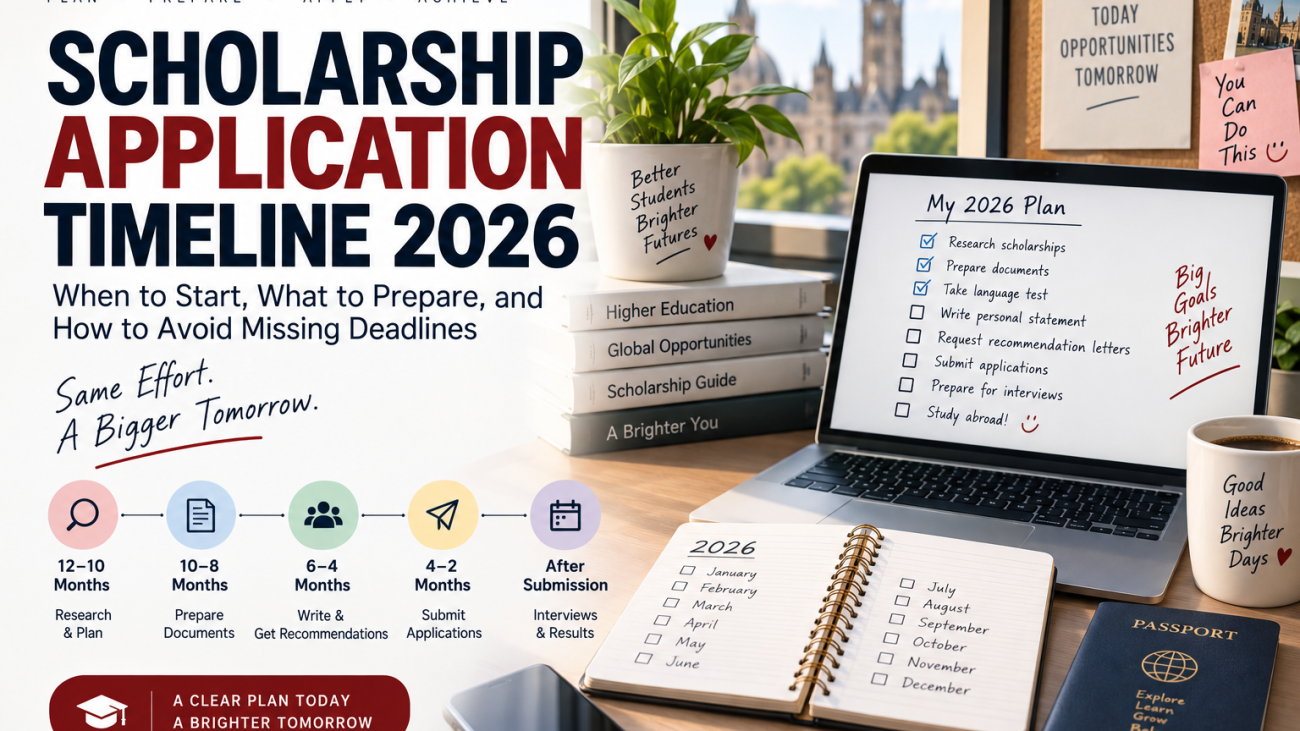
A good scholarship application timeline for 2026 can make the whole process much easier. Instead of rushing through everything in the final few weeks, you can break the work into smaller steps and prepare each part properly.
This guide explains when to start, what to do each month, how to organize multiple applications, and which mistakes can cost you a scholarship before the committee even reads your essay.
Why a Scholarship Application Timeline Matters
Scholarship applications are rarely just one form.
They often involve several moving parts.
For example, you may need to:
- Research eligible programs
- Compare funding
- Prepare academic documents
- Sit for IELTS, TOEFL, or another test
- Request recommendation letters
- Write a personal statement
- Prepare a scholarship CV
- Submit a university application
- Attend an interview
If you leave all of this until the last month, small problems become serious.
A referee may be unavailable.
A transcript may take longer than expected.
A test date may be full.
An application portal may close in a different timezone.
A timeline helps you avoid that.
When Should You Start Applying for Scholarships in 2026?
A practical starting point is 8 to 12 months before your intended intake.
That may sound early, but much of the first stage is simply research.
You are not writing essays for a full year.
You are giving yourself enough time to identify the right opportunities and understand what they require.
For competitive international scholarships, starting early is especially useful because some programs open and close long before the university course begins.
12 Months Before Your Intended Intake
This is the research stage.
Do not worry about completing applications yet.
Focus on understanding your options.
Decide What You Want to Study
Start with your academic direction.
Ask yourself:
- What subject do I want to study?
- Which degree level am I applying for?
- Which countries am I considering?
- Do I want a taught or research-based program?
This prevents you from collecting random scholarships that do not fit your goals.
Research Countries and Universities
Create a shortlist.
You may want to compare:
- Course content
- Tuition fees
- Living costs
- Scholarship availability
- Admission requirements
- Language requirements
- Career opportunities
Do not choose a university only because it appears high in a general ranking.
Look at whether the actual program suits you.
Start a Scholarship Tracker
A simple spreadsheet can save you a lot of stress.
Useful columns include:
- Scholarship name
- Country
- University
- Degree
- Deadline
- Funding
- Eligibility
- Required documents
- Application link
- Status
- Notes
Update it whenever you find a promising opportunity.
10–12 Months Before Intake
Now you can begin filtering your shortlist.
Check Eligibility Carefully
Before spending time on an application, verify:
- Nationality requirements
- Academic requirements
- GPA
- Age restrictions
- Work experience
- Language requirements
- Subject restrictions
- Degree level
Do not assume you qualify because someone on social media said the scholarship is “open to everyone.”
Always confirm through the official source.
Understand the Funding
Check exactly what the scholarship covers.
Look for:
- Tuition
- Monthly stipend
- Accommodation
- Travel
- Insurance
- Visa support
- Research allowance
This is especially important for scholarships advertised as fully funded.
8–10 Months Before Intake
This is a good time to focus on academic and language requirements.
Check Your Passport
If you plan to study internationally, make sure your passport is valid.
Renewal can take time.
Do not wait until the application portal asks for a passport copy.
Prepare Academic Documents
Gather:
- Transcripts
- Degree certificates
- Enrollment letters
- Graduation certificates
If translations are required, organize them early.
Book an English-Language Test
If you need IELTS, TOEFL, PTE, or another test, do not assume you can take it immediately.
Test dates can fill up.
You may also want enough time to retake the test if your first result is below the required score.
6–8 Months Before Intake
This is when your application materials should start taking shape.
Update Your Scholarship CV
Your CV should highlight the experiences most relevant to the scholarship.
Review:
- Education
- Work experience
- Research
- Leadership
- Volunteering
- Awards
- Skills
Keep it clear and easy to scan.
Start Your Personal Statement
Do not try to write the perfect version immediately.
Start with rough ideas.
Write down:
- Why you chose the field
- Important experiences
- Achievements
- Challenges
- Future goals
- Why the scholarship matters
You can refine the writing later.
Identify Your Referees
Think about who could write a strong recommendation.
Possible referees include:
- Professors
- Research supervisors
- Employers
- Managers
- Volunteer supervisors
Choose people who actually know your work.
4–6 Months Before Intake
This is the serious application stage.
Ask for Recommendation Letters
Give your referees enough time.
Ideally, contact them several weeks before the deadline.
Send them:
- Your CV
- Scholarship description
- Personal statement if available
- Deadline
- Submission instructions
- Relevant achievements
Make it easy for them to help you.
Customize Your Personal Statement
Do not use one identical essay for every scholarship.
Adjust it based on:
- Scholarship values
- Program goals
- University strengths
- Selection criteria
Your background may stay the same, but the emphasis should change.
Prepare Any Research Proposal
If you are applying for a research degree, begin early.
A good proposal may require:
- Literature review
- Research question
- Methodology
- Expected contribution
- Supervisor research
This usually takes more time than students expect.
2–4 Months Before Intake
At this point, you should be submitting many of your applications.
Review Everything Before Submission
Check:
- Names
- Dates
- Course title
- Scholarship title
- Word count
- File format
- Referee details
- Contact information
Small copy-and-paste mistakes can make a strong application look careless.
Check Timezones
A deadline listed as 11:59 PM may be based on the scholarship provider’s local time.
Do not assume it follows your timezone.
Submit early whenever possible.
Save Copies
Keep copies of:
- Application forms
- Essays
- CVs
- Submitted documents
- Confirmation emails
You may need them later for an interview.
1–2 Months Before the Deadline
If you are still preparing an application, focus on quality.
Follow Up With Referees
Send a polite reminder if the recommendation has not been submitted.
Do not wait until the final day.
Check the Application Portal
Make sure every section is complete.
Some systems show an application as incomplete even when you think everything has been uploaded.
Proofread Again
Read your essay slowly.
Check whether it actually answers the question.
A beautifully written essay can still be weak if it does not answer the scholarship prompt.
After You Submit
Submitting the application is not always the end.
Keep checking:
- Scholarship portal
- University account
You may receive requests for:
- Additional documents
- Verification
- Interview
- Admission confirmation
Respond as quickly as possible.
How to Manage Multiple Scholarship Deadlines
Many students apply to several opportunities at once.
That can become confusing quickly.
A tracker helps.
You can categorize applications as:
Researching
Preparing
Waiting for referee
Ready to submit
Submitted
Interview stage
Result received
This gives you a clear overview of what needs attention.
Should You Apply Early?
Usually, yes.
There are several benefits.
You avoid:
- Website problems
- Internet issues
- Last-minute document errors
- Timezone confusion
- Referee delays
Some programs may also review applications before the final deadline, though this depends on the scholarship.
Never assume early submission creates an advantage unless the official program says so.
But it does reduce unnecessary risk.
What If You Find a Scholarship Late?
Do not automatically give up.
Check what is required.
If you already have:
- Transcripts
- CV
- Test score
- Referees
- Personal statement draft
you may still have enough time.
However, avoid submitting a poor application simply because the scholarship looks attractive.
Ask yourself whether you can realistically prepare a strong submission before the deadline.
Common Scholarship Timeline Mistakes
Waiting Until the Scholarship Opens
You can prepare many documents before applications open.
Your CV, transcripts, referee list, and personal statement ideas can all be prepared early.
Asking for Recommendations Too Late
Your referee has their own schedule.
Give them time.
Taking IELTS Too Close to the Deadline
A low score may leave no time for a retake.
Forgetting Admission Deadlines
The university deadline and scholarship deadline may be different.
Sometimes you need admission before applying for funding.
Applying to Too Many Scholarships at Once
Ten rushed applications can be weaker than four carefully prepared ones.
Choose opportunities where you genuinely fit.
Ignoring Document Processing Time
Translations, certifications, transcripts, and official letters may take days or weeks.
Plan accordingly.
A Simple Scholarship Timeline Example
Here is a practical example for a student planning to begin university in September 2026.
September–November 2025
Research scholarships, countries, and universities.
November 2025–January 2026
Check eligibility, prepare academic documents, and take required tests.
January–March 2026
Prepare CV, personal statement, recommendation requests, and research proposal if needed.
March–May 2026
Submit major scholarship and university applications.
May–July 2026
Prepare for interviews and provide additional documents.
July–September 2026
Complete visa, accommodation, travel, and enrollment arrangements.
This is only an example.
Actual deadlines vary widely.
Always follow the official dates for each scholarship.
How to Stay Organized Without Feeling Overwhelmed
Do not think about every application every day.
Focus on the next action.
For example:
Today:
Finish CV.
Tomorrow:
Email professor.
Friday:
Draft personal statement introduction.
Breaking a large application into smaller tasks makes the process feel much more manageable.
Frequently Asked Questions About Scholarship Timelines
When should I start preparing for 2026 scholarships?
Ideally, start researching around 8–12 months before your intended intake.
Is three months enough to apply?
It can be, especially if your documents are already ready. However, more preparation time is usually helpful.
Can I apply before my final results are published?
Some scholarships allow provisional transcripts or expected graduation documents. Check the official requirements.
Should I take IELTS before applying?
If the scholarship requires a valid English-language result at submission, yes. Some universities may allow conditional applications.
Can I apply for scholarships and university admission at the same time?
Often, yes. But some scholarships require an admission offer first, while others have a combined application process.
What should I prepare first?
Start with research, eligibility, transcripts, passport, test requirements, CV, and potential referees.
Final Thoughts
A strong scholarship application timeline for 2026 is less about doing everything early and more about doing the right things in the right order.
Start with research.
Check eligibility.
Prepare your documents.
Give your referees time.
Write your essays carefully.
Submit before the deadline.
The students who look the most organized are not necessarily the ones who have fewer things to do.
They are usually the ones who started before everything became urgent.
Add a Comment