
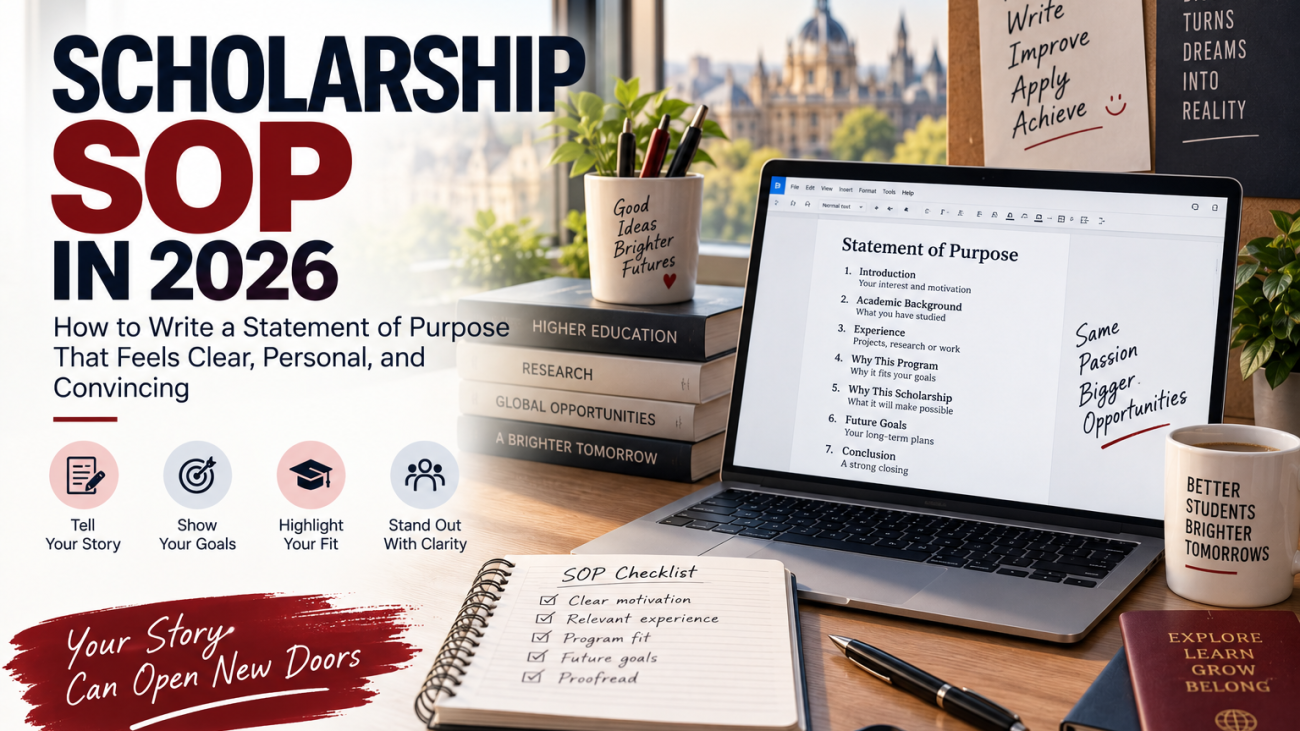
Writing a Statement of Purpose can feel harder than it should.
A lot of students open a blank document and immediately feel pressure to sound impressive.
So they start using big words.
They write things like:
I have always been deeply passionate about academic excellence and global development.
The sentence sounds formal, but it does not really tell the reader much.
A good scholarship SOP in 2026 should do the opposite.
It should make your academic journey, motivation, experience, and future plans easy to understand.
You do not need to sound like a professor.
You need to sound like a serious student who knows why they are applying and what they want to do next.
This guide explains how to write a strong scholarship SOP, what to include, how to structure it, and how to avoid the common mistakes that make an application feel generic.
What Is a Statement of Purpose?
A Statement of Purpose, usually called an SOP, is a written document that explains your academic background, professional experience, reasons for choosing a program, and future goals.
It is commonly required for:
- Master’s applications
- PhD applications
- Research programs
- International scholarships
- Graduate admissions
The purpose is simple.
The university or scholarship committee wants to understand why you are applying and whether your background makes sense for the opportunity.
Is an SOP the Same as a Personal Statement?
Not exactly.
They can overlap, but they usually have a different emphasis.
A personal statement may focus more on:
- Personal experiences
- Motivation
- Challenges
- Character
- Leadership
- Life story
An SOP usually focuses more on:
- Academic background
- Professional experience
- Research interests
- Program fit
- Career goals
Think of it this way.
Your personal statement explains more about who you are.
Your SOP explains more about where you are going academically and professionally.
Why the Scholarship SOP Matters
A scholarship committee can already see your grades from your transcript.
They can see your experience from your CV.
They can see your achievements from your documents.
The SOP explains how those pieces connect.
For example, your CV might show that you studied computer science.
Your SOP can explain why a particular project made you interested in artificial intelligence.
Your transcript may show strong results in data science.
Your SOP can explain why you now want to pursue research in medical imaging.
That connection matters.
A strong application feels like one story.
What Should a Scholarship SOP Include?
A good SOP usually answers several important questions.
What Have You Studied?
Explain your academic background briefly.
Do not rewrite your entire transcript.
Focus on subjects, projects, or experiences that are relevant to the program.
What Experience Do You Have?
This may include:
- Internships
- Work experience
- Research
- Projects
- Volunteering
- Academic activities
Choose the experiences that support your academic direction.
Why This Program?
Explain why the course makes sense for you.
Do not simply say:
This university is prestigious.
That could apply to many universities.
Talk about the actual program.
Why This Scholarship?
Explain what the scholarship would make possible.
This should go beyond financial support.
You might mention:
- Access to research
- International exposure
- Specialized training
- Professional networks
- Academic development
What Do You Want to Do Next?
Your future goals should be clear enough to show direction.
You do not need to know your exact job title 15 years from now.
But the committee should understand the kind of work you want to pursue.
How to Structure a Scholarship SOP
There is no single perfect structure, but this format works well for many applicants.
Paragraph 1: Introduction and Academic Interest
Start by explaining your academic interest.
You can begin with:
- A meaningful project
- A research experience
- A problem you became interested in
- A course that influenced you
Avoid generic openings.
Weak:
Since childhood, I have always been passionate about education.
Stronger:
During my final-year project on urban traffic prediction, I became interested in how data could be used to solve everyday infrastructure problems.
The second version gives the reader something specific.
Paragraph 2: Academic Background
Explain what you studied and how it prepared you.
You may mention:
- Relevant courses
- Thesis
- Academic projects
- Research
- Skills
Keep it focused.
The goal is to show progression.
Paragraph 3: Professional or Research Experience
Discuss your most relevant experience.
For example:
During my internship at a software company, I worked with a small data team to clean and analyze customer behavior data. That experience helped me understand the practical challenges of working with imperfect datasets.
This sounds more human than:
I gained extensive industry exposure and enhanced my technical competencies.
Use real details.
Paragraph 4: Why This Program
This section should be specific.
Look at:
- Modules
- Research areas
- Faculty expertise
- Labs
- Program structure
- Industry partnerships
Choose one or two things that genuinely matter to you.
Do not list everything on the university website.
Paragraph 5: Why This Scholarship
Explain what the scholarship would help you do.
For example:
Receiving this scholarship would allow me to focus fully on the program and participate in research opportunities that would otherwise be difficult for me to access.
You can mention financial support, but also explain the academic or professional impact.
Paragraph 6: Future Goals
Explain what you want to do after graduation.
A strong answer creates a clear path.
For example:
After completing the program, I hope to work in health data science and contribute to machine-learning systems that support medical decision-making in resource-limited settings.
That is specific and realistic.
Paragraph 7: Conclusion
Your conclusion should bring everything together.
You can briefly reinforce:
- Your preparation
- Your motivation
- Your future direction
- Why the opportunity fits
Keep it simple.
Do not repeat your entire SOP.
How Long Should a Scholarship SOP Be?
Always follow the official instructions.
Some programs ask for:
- 500 words
- 800 words
- 1,000 words
- Two pages
- A specific character limit
If no limit is given, one to two pages is often enough for many graduate applications.
The goal is not to make the SOP long.
The goal is to make it useful.
How to Make Your SOP Sound Human
This matters a lot.
Many SOPs sound almost identical because students try too hard to sound formal.
A humanized SOP usually has three qualities.
It Uses Specific Details
Instead of:
I developed an interest in research.
Write:
My interest in research grew while working on a project comparing two image-classification models for chest X-rays.
Specific details make your writing believable.
It Explains Why Things Matter
Do not only say what you did.
Explain what you learned.
For example:
The project taught me that model accuracy alone is not enough when working with medical data; interpretability and reliability matter just as much.
That shows thought.
It Uses Simple Language
Good writing does not need to sound complicated.
Weak:
This opportunity will significantly facilitate the advancement of my multidisciplinary academic competencies.
Better:
This program would help me strengthen both my technical and research skills.
The second version is easier to trust.
How to Explain a Low GPA in Your SOP
If your academic performance is weaker in one period, you may explain it briefly if there is a real reason.
Do not turn the whole SOP into an apology.
A simple approach works better.
You can explain:
- What affected your performance
- What changed
- Evidence of improvement
For example:
My second-year results were lower than I expected because I was adjusting to a heavier academic workload. I changed my study routine, and my grades improved steadily over the following semesters.
Keep it factual.
Should You Mention Financial Need?
Yes, if it is relevant.
But do not make the entire SOP about money.
A scholarship committee also wants to understand your academic potential and future impact.
You can explain financial need briefly, then connect it to what the scholarship would enable.
How to Write About Career Goals Without Sounding Unrealistic
Avoid very broad claims.
Weak:
I want to become a global leader and change the world.
Stronger:
I hope to work in renewable-energy policy and contribute to projects that improve access to clean energy in developing regions.
The second answer is easier to believe.
Specific goals feel more serious.
Common Scholarship SOP Mistakes
Copying a Template
Templates can help with structure.
They should not become your final SOP.
A copied SOP is usually easy to recognize.
Writing Too Much About the University
Do not spend half the essay praising the institution.
The committee already knows its strengths.
Explain why those strengths matter to you.
Repeating Your CV
Do not list every internship, award, and project.
Choose the ones that support your story.
Using Too Many Big Words
Clarity is more valuable than complexity.
Giving No Evidence
Do not write:
I am a strong leader.
Show it.
Writing the Same SOP for Every University
Your background may stay the same.
Your program-fit section should change.
How to Research a Program Before Writing Your SOP
Before writing, look at the official university page.
Check:
- Course structure
- Modules
- Research areas
- Faculty
- Labs
- Projects
- Career outcomes
Take notes.
Then ask yourself:
Which of these things genuinely connects with my goals?
Use only the strongest connections.
Can AI Help Write a Scholarship SOP?
Yes, but use it carefully.
AI can help you:
- Organize ideas
- Improve grammar
- Shorten repetitive sections
- Check clarity
- Suggest structure
But your experiences should come from you.
A generic AI-generated SOP may sound polished but empty.
A better approach is:
- Write your real experiences.
- Write your reasons for applying.
- Write your future goals.
- Use AI to improve structure and clarity.
The story should remain yours.
Scholarship SOP Checklist
Before submitting, check that your SOP:
- Answers the actual prompt
- Explains your academic background
- Includes relevant experience
- Shows why you chose the program
- Explains why the scholarship matters
- Includes realistic future goals
- Uses specific examples
- Avoids generic language
- Does not repeat your CV
- Follows the word limit
- Uses the correct university name
- Has been proofread
Frequently Asked Questions About Scholarship SOPs
How do I start a scholarship SOP?
Start with a specific academic experience, project, research interest, or problem that connects to your chosen field.
Should I mention personal challenges?
You can, if they help explain your academic journey. Keep the focus on what you learned and how you responded.
Can I use the same SOP for multiple scholarships?
You can reuse parts of your background, but the sections about the program and scholarship should be customized.
Should I include my GPA?
You can mention it if it is strong or directly relevant. Your transcript already contains the official result.
Is an SOP required for undergraduate scholarships?
Sometimes, but it is more common for postgraduate and research applications.
How formal should an SOP be?
Professional but natural. You should sound serious without trying to make every sentence overly academic.
Final Thoughts
A strong scholarship SOP in 2026 should make your direction easy to understand.
It should show where you started, what you have learned, why you are choosing this program, and where you want to go next.
You do not need to sound extraordinary.
You need to sound clear.
Use real examples.
Keep your language simple.
Connect your past experience with your future goals.
When the scholarship committee finishes reading your SOP, they should understand not only what you have done, but why the next step makes sense for you.
Add a Comment